

Joint ventures (JVs) have become the load-bearing walls of the industrial economy. In mining, over three-quarters of copper and nearly two-thirds of lithium production come from JVs[1]. In oil and gas, roughly half the output at majors like Shell, ExxonMobil, and Chevron comes from ventures they do not operate.[2] Beyond natural resources, JVs now account for more than half of new AI-infrastructure partnerships and most new battery plants. New JV formation is up nearly 550% since 2020.[3]
The reason, at first, is just project economics: a semiconductor fab runs past $20 billion, a gigafactory north of $10 billion, an LNG terminal $30 billion. No company wants that much risk on its own balance sheet, so it finds a partner, sets up a separate company, and splits the check.
That growth was built on a decade of cheap money, when rates were low, debt was easy, and partners could always fund the next capital call. That era is over. Higher rates have repriced the debt these structures run on, and the weakest partners are running out of room. The exposures built in the easy years now face their first real stress test.
Risk-sharing is the reason everyone gives, but there is also a quieter one. Move that $10 billion plant into a JV and your reported leverage falls, your return on capital rises, and your asset base looks leaner — while a loan you make to the venture counts as an asset, not debt. The economics match building it yourself; only the optics improve. That is one reason a growing share of today’s deals are JVs.
Consider a company that puts $500 million of equity into a $10 billion JV — the figure the approval memo leads with. The rest comes from partners and lenders, but the parent usually guarantees a slice of that debt, lends on top of its equity, and commits to buy the output for years. None of it is equity, so none lands on the equity line; it sits in shareholder loans, completion guarantees, and purchase commitments. A $10 billion venture with $6 billion of debt now lands on each parent’s books as one line: “Investment in JV: $500 million.” The real exposure is not $500 million, nor the full $10 billion — it is whatever the parent has quietly agreed to stand behind, almost always a multiple of the equity it reported.
None of this is an accounting error — it is exactly what accounting was built to do. In 2013, IFRS 11 made the equity method mandatory for JVs and retired proportionate consolidation,[4] which had reported a company’s slice of a venture’s assets and debts line by line. In the transition, common in oil and gas, mining, and telecoms, that share of JV assets and liabilities left the balance sheet.[5] The disclosures changed; the risks did not. This is not just a European problem: U.S. GAAP bars proportionate consolidation for corporate JVs too, producing the identical one-liner under GAAP’s ASC 323.
We wanted to know how wide that blind spot really was, so we counted. We pulled the FY2025 filings of 50 of the world’s largest public companies across natural resources, energy, chemicals, automotive, semiconductors, and aerospace, and rebuilt four layers of JV exposure from the disclosures: (1) the equity-method investment, (2) shareholder loans, (3) guarantees and contingent liabilities, and (4) committed-but-unfunded capital. Every figure traces to a note, and where a company disclosed too little to quantify, we dropped it rather than guess.
Our analysis only includes equity-method JVs — the structures that collapse into a single balance-sheet line, where the blind spot lives. We leave out three things that do not create this problem: joint operations, where a company already reports its share of the assets and liabilities; ventures it controls and consolidates, which appear in full; and stakes too small to confer significant influence, carried as ordinary investments. Take-or-pay offtake is noted but not counted.[6] The result is deliberately conservative — a floor, not a ceiling.
The 40 Percent Delta
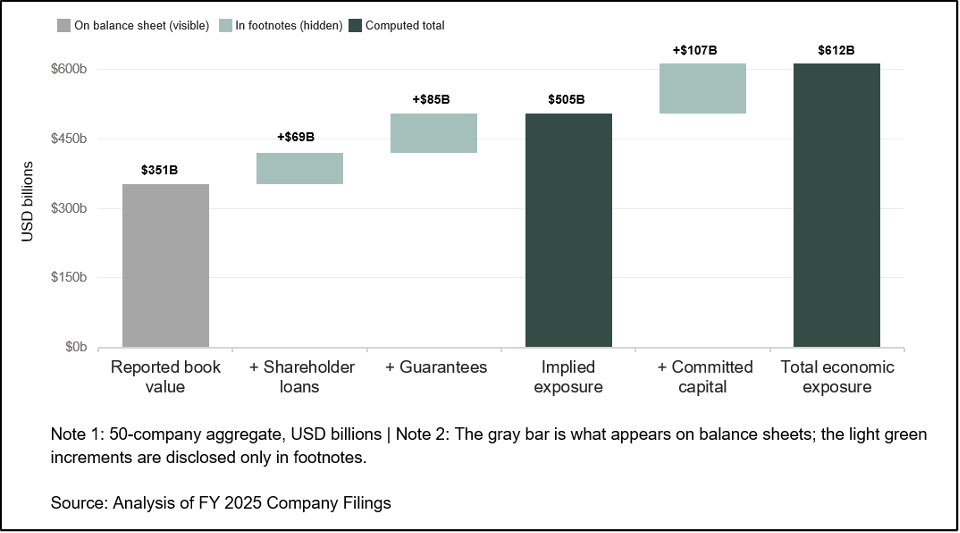
The findings were eye-opening. On paper, the 50 companies held $351 billion in JV investments; their total implied exposure is at least $505 billion. The $154 billion difference is real loans and guarantees that no single balance-sheet line adds up. And that excludes capital committed but not yet paid; add it, and the total reaches $612 billion (Exhibit 1). A separate study by Nikkei puts just the off-balance-sheet debt for five U.S. tech majors at $1.65 trillion[7].
Exhibit 1: Book Value vs. Total Economic Exposure – Aggregate 50 Companies (FY2025)
The total is the least interesting part. What matters is the gap between what a company reports and what it is actually carrying — the JV blind-spot multiplier. For most of the cohort it is modest; for a handful, alarming.
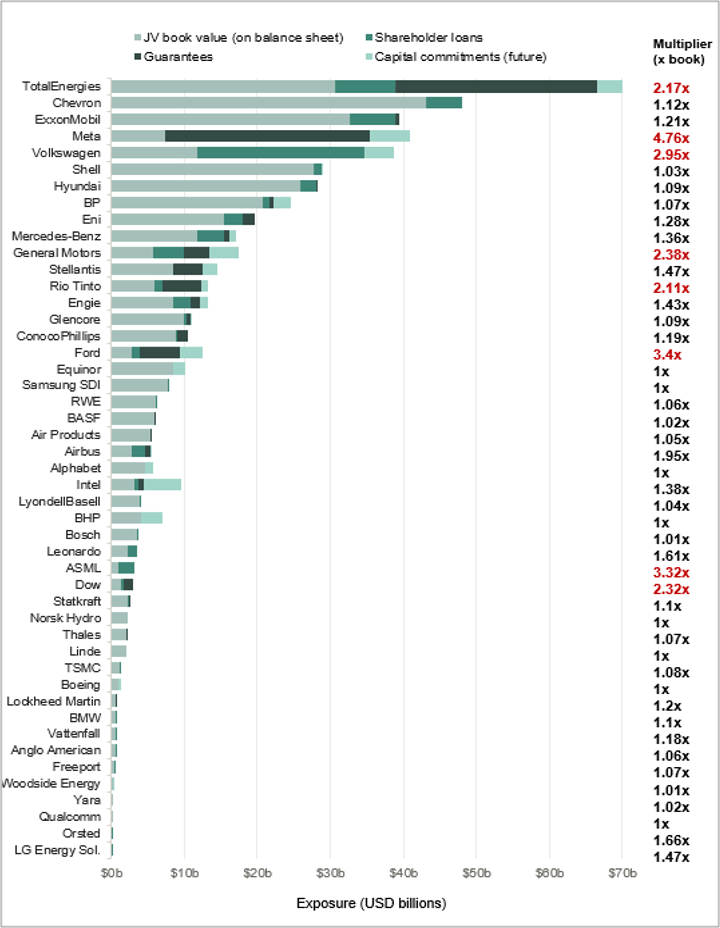
Take four examples. TotalEnergies reports $30.7 billion of equity-method investments — plus $8.1 billion of loans to those JVs and $27.7 billion of guarantees on their borrowings, a real exposure of $66 billion, more than double the book figure and the largest in the group. None of the extra $35 billion is hidden; it is disclosed, just buried in notes few readers reach. Meta is cleaner, precisely because JVs are not its story: its equity-method investments are about $7.5 billion, yet its Hyperion data center JV alone carries a roughly $28 billion residual-value guarantee — almost ten times that book value of the investment, in an easily missed footnote[8]. Then there is Dow, where the stake is underwater. Its investment in a petrochemical JV sits at negative book value after mounting losses, yet Dow still guarantees roughly $1.3 billion of the JV’s debt and believes “it is no longer remote” it will have to perform. The equity line calls the venture a write-off; the guarantee puts Dow on the hook for more than a billion dollars. Volkswagen has lent its JVs around $23 billion, almost twice what its stakes are worth. A shareholder loan is filed as an asset, but if the venture fails, it is paid last, if at all — the riskiest dollar a parent puts in, recorded as one of the safest.
“Investment in JV: $X” smooths all four shapes into one number, yet a loan is first-loss money in an asset’s clothes, and a guarantee is a loan you have promised to take out the moment your partner cannot.
There is a fifth layer the balance sheet skips, and it looks forward, not back: capital these companies have signed up to fund but not yet paid in. Across the cohort, it adds $107 billion, the bridge between the $505 billion already committed and the $612 billion of total exposure. These are not “maybes” but commitments already inked and will likely be exceeded as project costs balloon.
Exhibit 2: Total JV Exposure – By Company[9]
The Market Looks Through. The Board and Investors Should Too
Two groups already see through this: the rating agencies and forensic accountants. Moody’s and S&P do not take the equity-method line at face value; they haul a parent’s share of JV debt back onto the balance sheet, treat guarantees and offtake as debt-like, and rerun the leverage math on a look-through basis. So, the same company holds two truths: the credit market sees one, the equity market often sees the other, and equity investors tend to learn what the bond desk already knew at the worst moment. That gap is also a screen: where reported and look-through leverage diverge most is where the next surprise sits.
The second group is forensic accountants. In 2014, Noble Group was Asia’s largest commodity trader and a market favorite, running associates and JVs whose accounting did quiet lifting — booking fair-value gains on long-dated contracts to flatter profit while the cash flow said otherwise. One year it reported a profit while hemorrhaging more than a billion dollars in operating cash. A small firm laid the gap out in public; Noble denied it, sued, and kept reporting. By the time the market came around, it had shed more than 90% of its value.
Noble was not a freak event but the logical end of a chain that starts when a board approves an equity check without an assembled view of the obligation behind it. The same pattern sank Abengoa, the Spanish energy group whose “non-recourse” JV debt turned out to be largely parent-guaranteed, leaving reported debt a fraction of the real total. A Spanish teenager flagged the hole in a school paper a year before its record-setting bankruptcy.
What links them is not that the risks were unknowable; the risk and finance functions understand the exposures well inside many companies. The governance gap is whether that understanding becomes a single, recurring, board-level view of total economic exposure — equity, loans, guarantees, offtake, and future commitments — tested against the company’s capacity to absorb a downside.
Disclosure rules don’t fix it. Companies must disclose these items, but only once they clear a materiality bar each sets for itself, and with wide latitude over how much to lump together. No rule says: hand the board one number for total economic exposure, JV by JV. Whether that number exists is a matter of the company’s own discipline.
What Every Board Should Do
The fix does not require directors to become forensic accountants, nor new rules from regulators — just better questions in the room. Boards at every company that has JVs, or seeks to enter them, should do the following:
- Take the structure out of the scorecard. A JV flatters the numbers because almost no one adjusts for it. Measure business units and set incentives on a look-through basis: pull attributable JV debt and committed capital back in when you calculate return on capital, leverage, and bonus targets. If the scorecard rewards moving a plant into a JV, people will do it for the optics.
- Ask for a total-economic-exposure number on the approval memo. Every JV should reach the board with one figure on the cover: equity contribution plus attributable JV debt, guarantees, the present value of offtake, and future commitments. If the CFO cannot produce it when the deal is approved, nobody owns the full exposure.
- Set a trigger that sends the big ones back to the full board. Delegated authority is fine for small ventures, but any JV whose guarantees or annual offtake run past, say, 15-20% of the parent’s operating cash flow should get full-board review regardless of the equity check, as should any venture likely to draw serious regulatory or reputational risk. The equity contribution is the wrong yardstick for how much can go wrong.
- Ask the transaction structure question before the deal teams pick the vehicle. Housing a project in a separate legal entity, the choice that triggers off-balance-sheet treatment, is usually made for sound liability reasons, but it carries an accounting consequence the board should understand before it is locked in. The time to ask “Why this structure, and what will it hide?” is in the planning room, not during the audit.
- Decide the partner-default playbook before you sign, not during the capital call. The danger is the choice you face if the partner cannot fund its share: put in capital you never modeled, or decline and watch the venture stall, breach covenants, impair your stake, and trigger the guarantees you wrote. Decide the trigger, who decides, and the cap on rescue capital while you can still say “no.” And test the partner first: one whose balance sheet is mostly investments in associates, not assets it controls, may not fund a call when it matters most.
- Stress-test the JV book, do not just inventory it. A standing review tells you what you hold; a stress test tells you what it does to you when the cycle turns: rates up, a partner defaults, JV debt refinances higher, offtake softens. Size the cash you would inject and the impairment you would take. A semi-annual look-through review turns a pile of forgotten one-line entries into a managed book of risk.
JVs Are Not the Problem. Poor Visibility Is
None of this is an argument against JVs; they are how the hard, expensive, necessary things get built, and there will be more of them, not fewer. The argument is narrower: the people who approve these deals, run them, and fund them should see the whole number, not a tidied-up version.
Half a trillion dollars across 50 companies is not hidden from the market. The rating agencies found it. The forensic analysts found it. A teenager in Barcelona found it. The full exposure is simply too rarely converted into one board-level number — a governance choice, not an accounting constraint.
ENDNOTES
[1] Source: Ankura analysis of public information (2025 data)
[2] Source: Rystad (2024 data)
[3] Source: Ankura Joint Venture Index
[4] IFRS 11 keeps line-by-line, proportionate-style reporting alive for one category: joint operations, where the parties have direct rights to the arrangement’s assets and direct obligations for its liabilities (a co-owned oil field or pipeline is the classic case). Both joint operations and joint ventures require joint control; what separates them is the nature of those rights — a joint venture confers rights only to the net assets of a separate vehicle, which is what forces the single-line equity method. The classification follows the arrangement’s structure and terms, not a free election. This article and supporting analysis focus on the joint ventures according to the accounting definition, and not joint operations (which are often colloquially called joint ventures) or entities where the parent company does not have significant influence.
[5]The effect is documented. Across 2,059 firms in 26 countries, the shift from proportionate consolidation to the equity method reduced the comparability of reported assets and liabilities (Sarquis et al., Accounting and Business Research, 2022); a study of 120 French and Italian listed firms found a matching reduction in the value relevance of co-venturers’ total assets and liabilities (Journal of International Accounting, Auditing and Taxation, 2020).
[6]Companies disclose take-or-pay and unconditional purchase obligations as one aggregated total that bundles JV offtake together with pipeline, cloud, raw-material, and other third-party contracts. Because filings almost never separate the JV-specific slice, it cannot be attributed to a venture without estimation — so it is excluded. The U.S. dropped the standardized contractual-obligations table in 2020, thinning this disclosure further.
[7] Source: “Five US tech giants’ hidden debts soar to $1.65tn on opaque AI funding”, Asia.Nikkei.Com, June 2026
[8] Meta’s 2025 annual filings disclose a total exposure of $45.99BN against an equity book value of $2.37BN;
[9] Data includes 47 of the 50 companies as three disclosed too little to compute. Bars show venture book value, shareholder loans, guarantees, and committed future capital. The multiplier at right is implied exposure divided by reported book value, and excludes committed capital. Take-or-pay offtake is omitted because filers rarely name the joint-venture counterparty. TotalEnergies extends to about $138b. Source: Shishir Bhargava and Audrey Vitalo.
Shishir Bhargava is a managing director, and Audrey Vitalo is a senior director, of Ankura, a consulting firm that advises on joint ventures and other business issues. The views expressed in this post are not necessarily those of Ankura, its management, its subsidiaries, its affiliates, or its other professionals.