

Coercive, non-pro rata debt restructurings—widely known as “liability management exercises” (LMEs), just like their pro rata siblings—have become a central tool for distressed borrowers. Proponents of the non-pro rata restructuring often argue that it gives the company time to turn around and take off, reduce financial distress, and typically avoid bankruptcy. In our soon-to-be-published article, we show that this expectation is overstated. The track record for non-pro rata LMEs is poor; typically they do not avoid bankruptcy or fix the underlying distress. Our explanation for that poor track record is straightforward. The non-pro rata LME shifts value from some creditors to the LME dealmakers. If that shift is substantial enough, weak deals can close without fixing the distress.
An LME, broadly, is an out-of-court debt renegotiation—yesterday’s “workouts.” In recent years, the neutral “liability management” label displaced the earlier, blunter, and perhaps more accurate “creditor-on-creditor violence” descriptive phrase. Whatever the label, in these transactions, debtors pit creditors against each other. Value is lost by the minority creditors and gained by the majority creditors and the company’s owners. Conventional wisdom is that the foundation for “creditor-on-creditor violence” was set in the post-financial crisis low-interest environment: Many creditors competed to lend, and lending became a “borrowers’ market.” “Strong” bank lenders gave way to “weaker,” dispersed creditor groups. Borrowers benefited from low interest rates and loan documents that left creditors more vulnerable than they had been. Controllers, especially “strong” private equity sponsors, could exploit these vulnerable contracts.
These transactions have proceeded for much of the last decade without a firm understanding of whether they lived up to their promise of avoiding bankruptcy. Proponents would call forth successes; opponents could point to multiple bankruptcies quickly after an LME closed. Ours is the first study to test average firm-level effects, based on a hand-collected dataset of 89 larger, coercive, non-pro rata LMEs. The results are sobering.
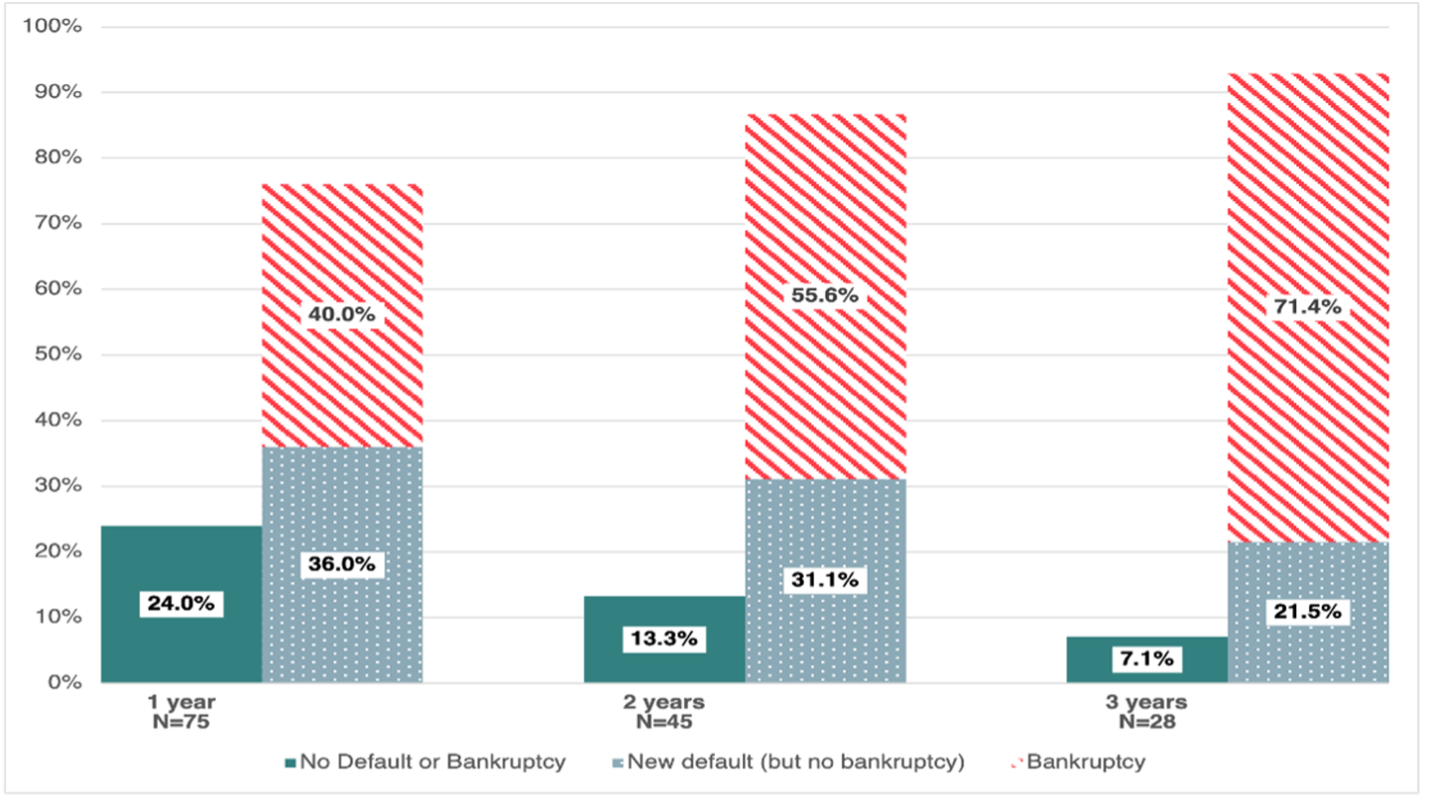
On average, non-pro rata LMEs buy a shorter, more fragile runway than proponents suggest. Most such non-pro rata LMEs in our sample ultimately stumble again or file for bankruptcy anyway. The figure below illustrates. For coercive LMEs with at least one year of post-LME experience, 36% filed and 76% filed, defaulted, or restructured again, despite the non-pro rata LME having closed “successfully.” For advisers on the LME, closing the deal is a sign of success; for the business itself, invigoration and a turnaround would be a sign of success. The latter are few. New adverse credit events pile up at a steep rate. For those firms that go bankrupt, the mean time from the non-pro rata LME to bankruptcy is about 17 months—a very short runway.
Non-pro rata LMEs do poorly when compared with similar types of restructuring deals, like old-school debt exchanges. New-style “creditor-on-creditor,” non-pro rata LMEs file, default, or restructure again about 26 to 36 percentage points more often than those old-school pro rata debt exchanges. In today’s vocabulary, the old-school debt exchange and the new “creditor-on-creditor violence” are both called a “liability management exercise,” even though the two transactions are very different. And these favorable debt exchange results hardly change when we control for credit rating, industry, and the restructuring year, suggesting (but not definitively demonstrating) that the result isn’t likely to be driven by the non-pro rata firms being much weaker from the beginning. And the LME relapse rate also far exceeds our estimated relapse rates for prepackaged bankruptcies—which are often achieved with similar levels of creditor support. Regardless of how the coercive non-pro rata restructuring looks against its most plausible benchmarks, these deals do not typically live up to their advertised value as avoiding bankruptcy, default, or another restructuring.
The post-deal results for the non-pro rata deals are weak in other measures. Aggregate leverage does not decline. Credit ratings remain largely flat for two years after a non-pro rata LME, presumably because the rating agencies assess the risk of the debtor defaulting again as high. The only positive is that debtors on average do obtain some cash, but not enough to prevent the companies on average from filing, defaulting, or restructuring again. Balance sheets are not stabilized through debt–equity swaps. Instead, the majority creditors often obtain higher-priority new debt, complicating the borrowers’ capital structure. The equity cushion remains thin, distorting owners’ incentives. The more cumbersome capital structures can prolong debt overhang and can make a full turnaround and takeoff harder. Finally, the typical post-deal bankruptcy a year or two later takes longer and appears more complex than other benchmarked bankruptcies; many are complicated by creditor infighting and litigation, often over the original LME. These features are for the most part unlikely to help the firm. If they are material, non–pro rata LMEs could generate less value for distressed firms than commonly assumed.
Conceptually, one can understand non-pro rata LME underperformance by examining dealmakers’ incentives. When the dealmakers are able to scoop value away from minority and non-participating creditors, their vigilance for post-deal efficiency slackens. While some non-pro rata LMEs probably help the firm, and dealmakers surely prefer a turnaround to succeed, the incentive distortion is that a value-transferring deal can induce dealmakers to go for that deal even if the firm is not made better off. The value scooped away from minority creditors can be the motivator; improving the firm could be secondary. So the incentives analysis suggests that we should expect the broad set of non-pro rata LMEs to include some (or many) deals that close without fixing the underlying distress—because the deal is not the best for the firm or because the firm is so weak that it would decline regardless, but the dealmakers gain anyway from rearranging the deck chairs ahead of bankruptcy. Definitive findings here are hard to achieve, but our findings and data support that expectation.
Our findings draw on data from leading industry data providers, which some other market compilations also use. But we found that those compilations often differ from ours for two reasons. First, they often pool pro rata and non-pro rata deals, obscuring one of our central findings: that coercive, non-pro rata deals, which distort incentives more than pro rata deals, perform worse. Second, many neglect to “age” the deals. It’s rare for any restructuring to result in a bankruptcy filing in the month after the deal, so adding recent restructurings to the denominator dilutes the rate of firms that stumble, file, or restructure again after the coercive LME.
Some qualifications. We evaluate non-pro rata LMEs, but we do not fine-tune (for lack of data) our analysis of pro rata restructurings, where similar creditors receive the same deal. Pro rata restructurings can also be coercive, but their incentive structures generally give fewer reasons to expect inefficient outcomes because everyone is offered the same deal, unlike the LME restructurings that shift value from one creditor group to another. Moreover, we rely on leading industry information sources, but information on some non-pro rata LMEs may be fully private. Lastly, most reported LMEs involve private firms that do not disclose operating data (EBITDA, sales, and so on). Comparing these measures pre-LME and post-LME would be more probative of their success or failure. All that said, the best evidence available now is in our paper, and it undermines the coercive-LME celebratory story.
Mark J. Roe is the David Berg Professor of Law at Harvard Law School, and Vasile Rotaru is a Research Fellow at Harvard Law School. This post is based on their paper, “Liability Management’s Limited Runway: Corporate Restructuring Today,” forthcoming in the Yale Law Journal and available here.