

In May 2026, the Securities and Exchange Commission (SEC) proposed letting public companies replace their three quarterly reports on Form 10-Q with a single semiannual report on a new Form 10-S. Quarterly reporting would remain the default, and each company could elect the change year by year. For a technical disclosure rule, the response was extraordinary: more than 215,000 public submissions.
Comment letters on accounting and disclosure rules usually come from a familiar cast of reporting companies, auditors, and their trade associations. Individual investors, the people mandatory disclosure is meant to protect, rarely write in. On this issue, they wrote in by the tens of thousands. In a new paper, we examine every comment to answer four questions: Who wrote them, what positions did they take and why, how deeply did they engage with the proposal, and did they seem to understand it?
To answer these questions, we coded each of the more than 215,000 comments in our sample, dated from May 5 through October 7, 2026, using a state-of-the-art large language model guided by a codebook grounded in prior research on comment letters and lobbying. For every comment, the model recorded who the writer said they were, their stance and arguments, the depth of their reasoning and evidence, any alternatives they proposed, their tone, and how they described the proposal.
An Unusual Crowd of Commenters
Almost all of the commenters were individuals. Six in 10 (60.0%) said nothing about who they were. Among those who did say something, self-described retail investors were the largest group (22.5% of all comments), followed by writers who named another occupation or status (15.0%). Retirees stood out: 14.8% of all comments came from writers who said they were retired. Individual professionals in finance, accounting, law and academia wrote 2.4% of the comments. Trade associations, institutional investors, investor advocates and government bodies together wrote just 182, less than 0.1%.
This is in sharp contrast to what we see in standard-setting at the FASB and the IASB, where reporting companies, auditors, and their associations dominate, and users of financial reports are scarce. Individual investors’ stakes did not suddenly become higher. More plausible explanations are the ease of commenting online, the familiarity of a report many investors use directly, and the political prominence the issue gained after President Trump called for semiannual reporting in September 2025.
Most comments were short. The median comment had 27 words, roughly a statement of position and a reason or two for taking that position. The median letter from an institutional investor runs 280 words, and the median letter from a trade association runs 1,621.
Participation was also concentrated in time (Figure 1). The first month after the proposal was quiet. Then about four in five comments (79.4%) arrived in a five-week main wave, peaking at 11,427 on June 23. A lull followed the July 6 deadline, and then, from August 6, came a second wave of more than 42,000 letters, to which we return below.
Figure 1. Comments received per day, May 5 to October 7, 2026
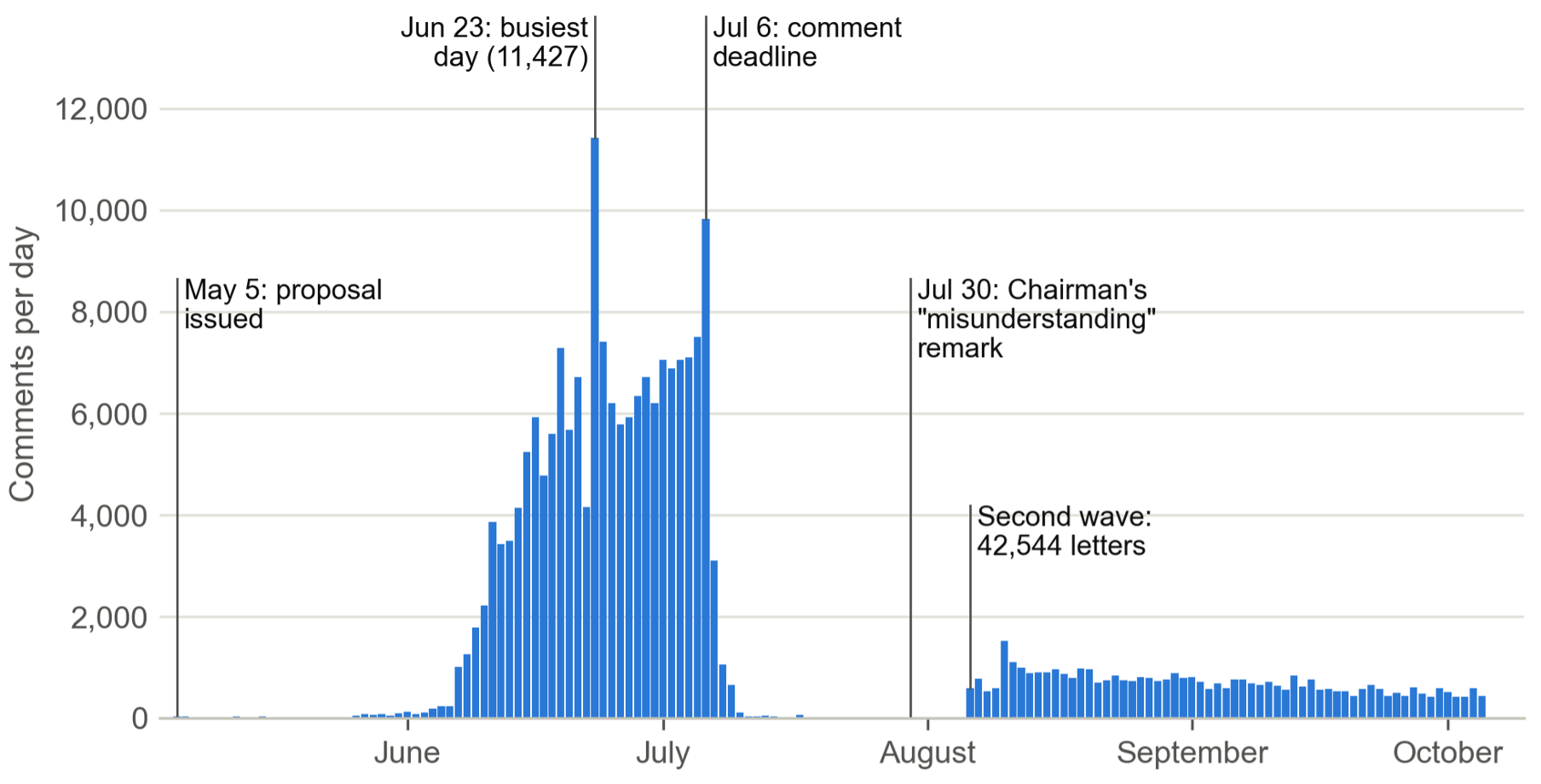
Note: Daily count of all submissions, including a small number later excluded from the analysis sample because they have no usable text or do not address the proposal.
Near-Unanimous Opposition, With One Exception
These figures describe the views expressed in the SEC’s comment record, not a representative survey of investors or the broader public. Opposition to the proposal is close to unanimous. Of all comments, 97.8% oppose it, 0.3% support it fully or with conditions, and the rest take no clear position. Among individual writers, the share opposing ranges only from 97.3% for those who give no identity to 99.0% for retail investors. Institutional investors and investor advocates oppose as well, and none of the 35 institutional investors supports the proposal outright.
Trade associations are the one group that is not overwhelmingly opposed (Figure 2). Of the 48 that commented, 20 support the proposal fully or with conditions, 21 oppose it, and 7 take no clear position. Issuers and executives lean the same way, though far more weakly, with 16 of 274 in support. Because few organizations commented, we caution that these percentages describe only the organizations that wrote in and may not represent the views of trade associations or companies in general.
Figure 2. Share of comments supporting and opposing the proposal, by commenter type
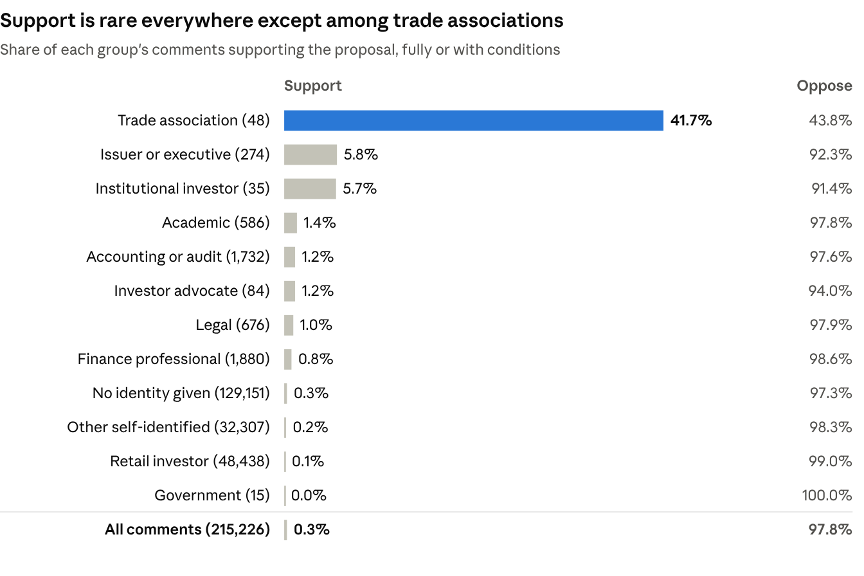
Note: Number of comments in parentheses. Support includes conditional support.
Arguing From Principle, Not Consequences
Opponents defend quarterly reporting mainly on principle (Figure 3). The most common arguments for it are transparency and accountability (36.7% of comments), investors’ need for current information (24.2%), and the concern that, without quarterly reporting, fraud and other problems would stay hidden longer (22.2%). A second tier of arguments concerns fairness and investor protection, including the need to maintain a level playing field for retail investors (12.0%) and the risk that the proposal would serve insiders, Wall Street, or political interests (10.5%). Retail investors stand out for stressing timeliness: 55% of them say investors need current information, compared with 24.2% of all comments.
Figure 3. The most common arguments in the comments
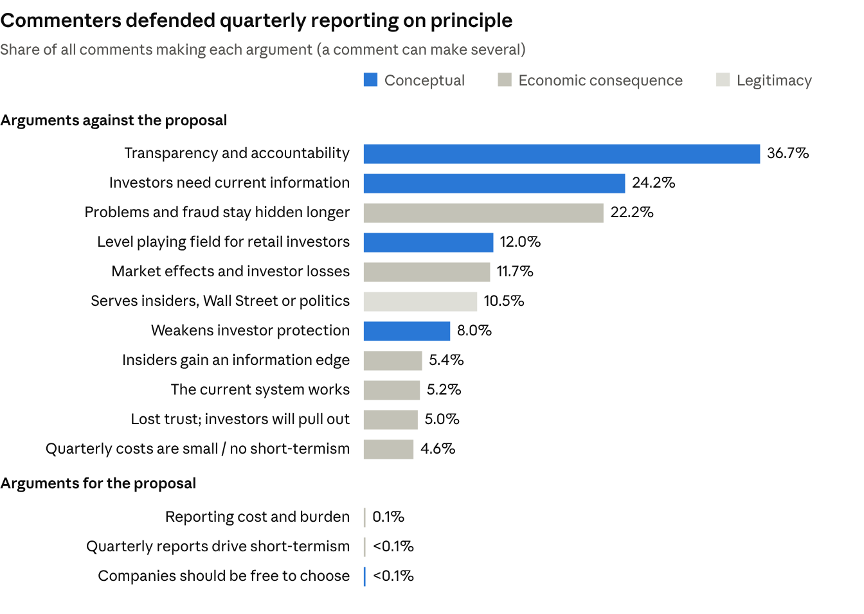
Note: Conceptual arguments appeal to principles of financial reporting, economic-consequence arguments to effects on firms and markets, and legitimacy arguments to the rule’s process or motives.
Arguments for the proposal are almost absent from individual comments. Strikingly, the proposal’s own rationale, that quarterly reporting encourages short-termism, appears in less than 0.1% of comments. Among trade associations, though, the case for the proposal is made in full. All 20 supporting associations argue that reporting frequency should be left to companies, 19 cite reporting costs, and 19 argue that other disclosure methods, such as earnings releases and Forms 8-K, are sufficient. The 21 opposing associations make the users’ case in its most technical form, stressing comparability across firms, effects on markets, and the inadequacy of substitutes for the 10-Q.
The users’ arguments are not idiosyncratic. Most of them track strands of the academic literature: evidence that managers delay bad news, that more frequent reporting is associated with lower information asymmetry and a lower cost of equity, and that 10-Q filings convey information beyond earnings releases. Users also object to optionality itself, and that objection has an economic basis. Research finds that when more of a firm’s peers report quarterly, more firm-specific information is reflected in the firm’s own stock price. Because a firm choosing its own reporting frequency does not capture that benefit to others, it may report less often than is socially optimal.
Reasons, but Little Input on the Rule’s Design
Are mass comments like these reasoned contributions or simple expressions of preference? The answer lies in between. Most commenters give reasons: 81.7% offer at least one, and retail investors do so in 95.2% of their comments. But less than one comment in 10 (8.9%) offers evidence of any kind, and for individuals it is usually a reference to history or to a named case rather than data, research, or legal analysis. Most comments are measured or emphatic in tone. The 5.6% that use hostile language, such as profanity or personal insults, come mostly from writers who give no identity, and such language is nearly absent from organizational letters.
Giving reasons is also not the same as helping a regulator redesign a rule. About 95% of opposing comments simply say no, without proposing an alternative or attaching a condition. Of the 11,065 alternatives that commenters did propose, almost three-quarters (7,975) call for reporting more often than quarterly, often monthly. Only 174 ask for less frequent reporting. Alternatives that work within the proposal’s design, such as additional Form 8-K triggers, auditor review, a simplified Form 10-Q, limits on which companies may elect, shareholder approval of the election, or a pilot program, number fewer than one for every 100 comments.
That kind of design input came almost entirely from a few dozen organizational letters. Trade associations cite law in 75.0% of their letters and data in 58.3%, and 83.3% of them engage with specific content of the proposing release, as compared with 0.3% of all comments. Put simply, individuals stated their beliefs and rejected the proposal, while organizations supplied most of the material a rule writer can act on.
Did Commenters Misunderstand the Proposal?
After the comment period closed, SEC Chairman Paul Atkins said that a common strain in the letters was a misunderstanding of the proposal, which would make semiannual reporting optional rather than prevent quarterly reporting. The comments allow a direct test of that claim. The first thing to note is that most writers do not say what the proposal would do. Only 7.2% of comments (15,594) describe it. Of those, 63.4% describe it accurately, either as letting companies choose semiannual reporting or as ending the quarterly requirement. The remaining 36.6% say that quarterly reporting itself would be abolished, which overstates the proposal.
Abolition language therefore appears in just 2.6% of all comments. Even that figure probably overstates confusion, since a phrase like “end quarterly reporting” may be shorthand from writers who know the change is optional. The 93% of comments that do not describe the proposal provide no evidence either way.
More important, understanding the proposal does not change the verdict. Organizations, whose letters engage with the release in detail, almost always describe the proposal as optional (Figure 4), yet most of them still oppose it. Trade associations, which are divided, are the main exception. Among individual writers who describe the proposal as optional, 97.9% oppose it, about the same share as in the sample as a whole. Users object to leaving the reporting choice to management, not merely to a mandatory change.
Figure 4. How commenters described the proposal, by commenter type
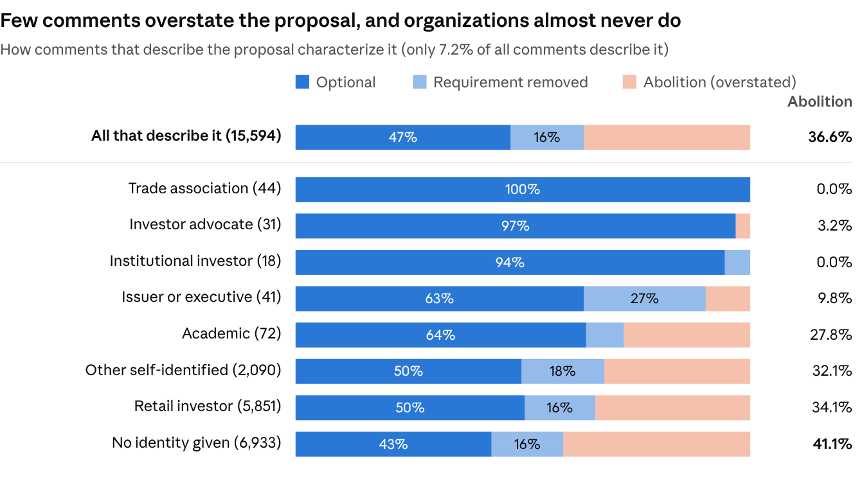
Note: Number of comments that describe the proposal in parentheses. “Optional” and “requirement removed” are accurate; “abolition” overstates the proposal.
The Second Wave
The comment period closed on July 6, but the letters kept coming. After the chairman’s remark, reportedly made on July 30, an advocacy campaign urged investors to file a second comment stating that they understood the proposal. Beginning August 6, a second wave of 42,265 comments arrived, and it answered the charge directly (Figure 5). Nearly all of these comments (96.3%) insist that the writer understands the proposal, a claim almost absent before, although most make it only in the subject line of the submission. Among comments that describe the proposal, the share calling it optional rose from 41.4% in the main wave to 70.3%.
Yet the second wave was less deliberative than the first. Its comments were shorter (a median of 21 words, against 28), more than twice as likely to state a position without any reason, and less than half as likely to develop an argument. Hostile language nearly doubled, from 4.8% to 9.1%.
Figure 5. How comments changed between the main wave and the second wave
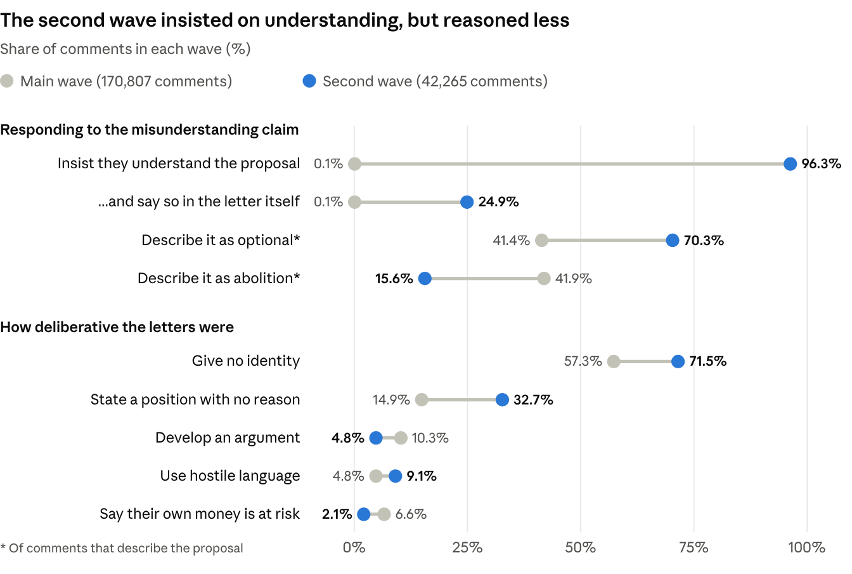
Note: Main wave: June 7 to July 10, 2026. Second wave: August 6 to October 7, 2026.
Many of these letters came from people who had already written. Of the second-wave comments signed with an identifiable name, 42.3% match a name from the main wave. When we compare the first and second letters under the same names, the same shifts appear: The share insisting they understood the proposal jumps from 0.1% to 96.6%, and the share stating a position without a reason roughly doubles. The timing cannot separate the effect of the chairman’s remark from that of the campaign. It does, however, show commenters contesting the regulator’s characterization of their competence, which then became part of the record itself.
Implications for Disclosure Rulemaking
First, mass comments can send a clear signal even when they offer little input on the rule’s design. Rulemaking is not a vote. The SEC must consider the comments it receives and respond to the significant ones, but comments are weighed by their substance, not their number. As a result, campaigns of brief letters often carry little weight.
This record, however, is more than a tally of preferences. Four in five commenters gave a reason, and those reasons consistently framed quarterly reports as a mechanism of accountability rather than a compliance burden. The SEC can meet its duty to consider the record by responding to the detailed organizational letters. But the users’ main message came through many short letters whose force lies in their number, and the formal process is not built to register that kind of signal.
Second, claims that commenters misunderstood a proposal are best tested against what they actually wrote. Here, few commenters described the proposal at all, most of those who did were accurate, and those who described it as optional opposed it just as firmly.
Third, how a regulator characterizes commenters can itself become part of the consultation. This suggests that the legitimacy of due process depends not only on openness and responsiveness, but also on how the rule-setter describes the people who participate. The second wave also shows the limits of a mobilized reply: It corrected the record on understanding while adding little new reasoning.
Finally, for the broader debate over reporting frequency, the comments show that users of periodic reports see them as part of the infrastructure of public capital markets. Their objection to letting each company choose its own frequency echoes evidence that frequent reporting benefits investors in other firms, a benefit that a company deciding for itself has little reason to weigh.
Conclusion
The SEC’s semiannual reporting proposal drew an extraordinary response for a disclosure rule, and its authors were overwhelmingly individuals, many of them the retail investors whom mandatory disclosure is meant to protect. They opposed the proposal almost unanimously and argued from principles of transparency, accountability, and timeliness. When their understanding was questioned, many wrote a second letter insisting that they did understand it.
Victor Xiaoqi Wang is an assistant professor of accounting at California State University, Long Beach, and Xiaoxiao Yu is a senior lecturer in accounting at Monash University. This post is based on their recent paper, “Who Speaks for Quarterly Reporting? Evidence from More Than 215,000 Public Comments on the SEC’s Semiannual Reporting Proposal,” available here.