

Kalshi and other prediction markets have been inundating the CFTC with self-certifications of binary options (i.e., prediction products or event contracts). The figure below shows total self-certifications to the CFTC and self-certifications from Kalshi since it began operating in 2021. As background, since the Commodity Futures Modernization Act of 2000, derivatives exchanges can self-certify products instead of seeking prior authorization to list a product from the CFTC.
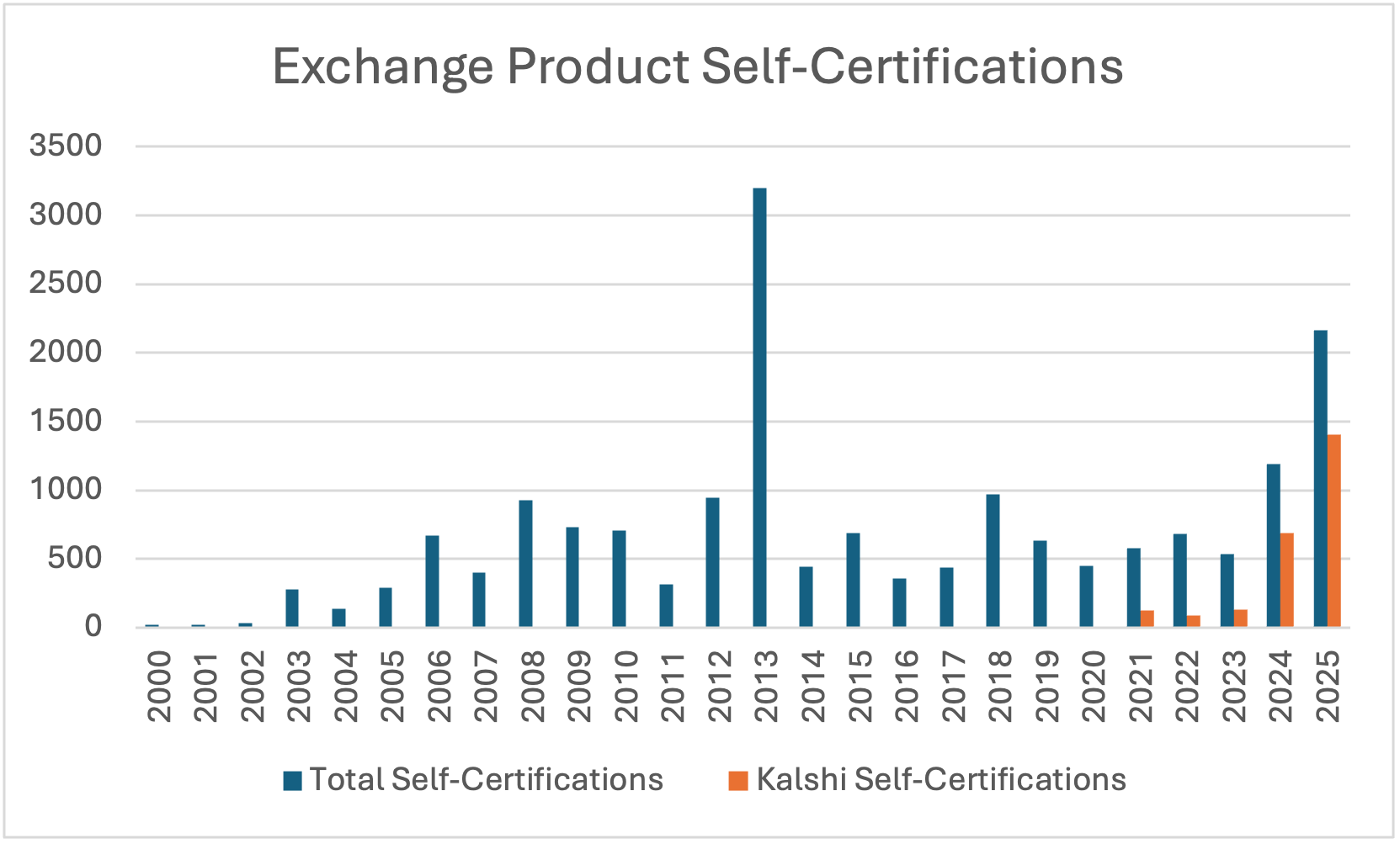
The CFTC has generally acquiesced in these self-certifications from Kalshi and other prediction markets, although it should reject the certifications if they do not conform to the Commodity Exchange Act.[1] This process of self-certification and acquiescence does not involve final agency action that can be challenged by someone, assuming anyone has standing, motive, and resources to mount a challenge. The current approach is especially suspect because the CFTC has taken an aggressive stance in defending prediction markets against state regulation, raising the possibility that acquiescence in product mis-classification is not neglect but regulatory collusion with an upstart industry.
Prediction products pose several issues related to the regulatory jurisdiction of the CFTC. One issue that has received insufficient attention is whether these products are “swaps,” as certified to the CFTC. This post aims to raise two alternatives in this respect. First, the products may qualify under the carveout from the swap definition available for consumer products. Second, a subset of these products are likely securities. Determining the contours of the “swap” definition requires agency deliberation. As discussed below, some of these products may be “security-based swaps”—a determination that must be accomplished through joint action by the CFTC and SEC (with consultation from the Fed).[2]
Are Wagers Swaps?
The Dodd-Frank Act brought swaps within the jurisdiction of the CFTC. In doing so, it carved out security-based swaps (i.e., swaps that settle based on a single security or a narrow index of securities) and many other securities into a separate category governed by the SEC.[3] So called “mixed-swaps” have features of both swaps and security-based swaps and are governed by both the CFTC and SEC. In establishing the regulatory framework for these derivatives, Congress commanded the CFTC and SEC (in consultation with the Fed) to promulgate rules further defining the terms “swap,” “security-based swap,” and “mixed swap.” The agencies completed this rulemaking in 2012 (the “Definitional Rulemaking”).[4]
The definition of the term “swap” is exceptionally lengthy and broad.[5] It partly reflects the trauma of the Great Financial Crisis of 2007-08 and the suspicion of finance it engendered. However, in defining “swap” and related terms in the Definitional Rulemaking, the CFTC and SEC (jointly, the “Commissions”) included a number of carveouts. The Commissions reasoned that “swap” and related terms were meant to capture the types of instruments that precipitated the Great Financial Crisis.[6] Accordingly, the Commissions determined that consumer transactions were meant to be excluded.[7] This applies to wagers entered into for entertainment purposes, which captures the majority of contracts listed on prediction markets like Kalshi.[8] The CFTC should not revisit this carveout without re-enlisting the SEC (and the Fed’s advice), and should not bless prediction-market views as to whether borderline instruments qualify as swaps without prior formal deliberation.[9]
Indeed, viewing a common wager such as on a sports match as a “swap” has absurd and tectonic effects.[10] Market regulation limits some financial activity to subsets of parties, with readers likely being more familiar with restrictions enabling only accredited investors and qualified clients to partake of certain securities transactions. The Commodity Exchange Act (CEA) has a concept of “eligible contract participant” (ECP), which generally captures certain regulated entities and persons with $10 million or more. [11] It is unlawful to enter into a swap with a person who is not an ECP, except on a regulated derivatives exchange.[12] If wagers on sports games are indeed swaps, then millions of CEA violations occur annually at Caesars, on Fan Duel, and in similar venues because those wagering do not meet the $10 million threshold.[13] Similarly, venues offering sports betting would be violating the CEA through not registering with the CFTC as exchanges.
Many states are currently battling the federal government to subject Kalshi and other prediction markets to state gambling regulation. In waging this battle, the states have won in a few cases on the basis of the transactions not being captured by the broad definition of swap.[14] In many other cases, the states lost on the question of whether instruments that prediction markets offer are swaps.[15] The states would be better off including arguments that the transactions are not swaps based on the exemption for consumer transactions buried in the Definitional Rulemaking.[16]
Are Wagers on Firm Performance Swaps or Securities?
Congressional language seeking to govern wide swaths of financial market activity should be expected to be imprecise and knotty. It is difficult to classify many existing products let alone anticipate financial innovation. So there is some ambiguity in the application of key terms. The CFTC and DOJ in their cases against the states and others have a reasonable argument that many products traded on prediction markets are swaps. There is less room to argue, however, that certain contracts that settle based on the activities of individual firms are swaps rather than securities. In this context, there is a high probability that some prediction products have been mis-certified to the CFTC while the CFTC and the SEC have been at best firmly looking the other way.[17]
To the extent they are allowing derivative exchanges to mis-certify products as swaps rather than securities, the Commissions are compromising the distinct protections the securities regime provides to market participants, including (a) distinct oversight for insider trading, other fraud, and manipulation, and (b) distinct obligations of intermediaries aimed at market integrity. The regimes governing advertising also differ in important ways, including with respect to those promoting products in return for consideration.[18] Moreover, the SEC has developed resources for market oversight directed at capital formation, investor protection, and market integrity that the CFTC cannot match in any reasonable period of time.[19] There are solid grounds to view ongoing mis-classification as contributing to conduct that is malum in se rather than malum prohibitum.
The definition of “swap” carves out any “security-based swap” and, more broadly, securities such as options on securities.[20] Under Securities Exchange Act of 1934 Section 3(a)(68), the definition of security-based swap includes “any agreement, contract or transaction that . . . is a swap . . . and is based on . . . the occurrence, nonoccurrence, or extent of the occurrence of an event relating to a single issuer of a security . . . provided that such event directly affects the financial statements, financial condition, or financial obligations of the issuer.” An issuer, for these purposes, does not need to be a public company and can be any firm that issued securities (e.g., a private company that issues common stock or bonds).
Prediction markets list a variety of so called “key performance indicator” (KPI) contracts that settle on specific issuers’ activities, such as whether Apple releases a new iPhone model or whether Tesla makes in excess of a specified number of vehicle deliveries.[21] Some of these contracts even settle based on whether an issuer is acquired or undergoes an IPO.[22] It is hard to see how these agreements do not “directly affect[] the financial statements, financial condition, or financial obligations” of the issuers specified in the contracts, although admittedly the qualifier “directly” injects ambiguity into the analysis.[23] I believe these contracts are likely securities rather than CFTC governed swaps and likely require prediction markets that offer them to operate subject to registration and compliance obligations under SEC rules.
In the absence of required SEC registration, a number of states have a solid argument that with respect to these contracts, CFTC preemption does not apply to securities contracts, and exchanges like Kalshi are flouting state law (e.g., blue sky law and perhaps gambling law). A prediction market violating SEC requirements may also be subject to private rights of action for the consequences of operating as an unlicensed securities exchange, violating federal securities laws and state securities blue sky laws and improperly dealing security-based swaps to its retail customers.[24] A violation of securities laws can put a prediction market’s license to operate and raise financing in jeopardy.[25]
Why would Kalshi and potentially other upstart prediction markets run these risks? Its KPI contracts don’t provide much in the way of revenues.
One reason may be that prediction market lawyers read the qualifier “directly” differently than I do. To this point, I observe that “directly” does not speak to magnitude. Congress did not require a “substantial” or “significant” effect for the financial position of an issuer. Rather, Congress sought to avoid classification as a security-based swap grounded in an attenuated connection. For example, oil prices have an effect on airlines but a contract on oil prices does not have a “direct” effect on Delta, United, or their competitors.[26] Directly speaks to the tightness of the nexus between the event driving settlement and the financial position of an issuer. This line between CFTC derivatives and securities is long established and workable. Instruments on interest rates, currency exchange rates, and many other variables are traditionally within the purview of the CFTC notwithstanding that they have an indirect impact on a variety of issuers. In contrast, a contract settling on even a small event in a specific issuer’s financial life has a “direct,” albeit small, effect on the issuer’s financial position.[27]
The reason for the mis-certification of securities as swaps may be unrelated to a bona fide debate as to the ambiguity in the definition of security-based swap. Rather, the reason may be that prediction markets face a much bigger definitional problem, which they are seeking to avoid by ignoring the border between swaps and securities rather than acknowledging that the nuanced border exists. The majority of prediction market revenue comes from sports betting. Many of the wagers are on matches between professional sports teams. Professional sports teams tend to be operated by entities that have issued securities (i.e., issuers). For example, a prediction market on a New York Knicks game trades a contract that is based on an occurrence of an event directly affecting the financial statements, financial condition, or financial obligations of Madison Square Garden Sports Corp. The contracts that prediction markets hosted on the Knicks may well have been security-based swaps and not swaps. Generally, at least on a qualitative level, an entity operating a sports team will do better financially when the team wins, although the extent to which a victory impacts financial performance may differ between, e.g., regular season games and playoff games. The same is true for other contracts on the operating results of entities that have issued securities, whether or not those entities are publicly held. For example, a wager on the performance of a movie at the box office may be a security-based swap with respect to the entity housing the studio that produced the movie. It may come as a surprise to many, but some of the huge betting markets the CFTC has been aggressively defending may be substantially outside of its jurisdiction and subject to SEC supervision.
What Are the Consequences of Regulation by Non-Enforcement?
Justice delayed is justice denied, even if the Commissions do eventually sort prediction products into their appropriate categories. In the meantime, market expectations get established and trading occurs outside the congressionally designated regulatory environment. The Commissions’ approach to startup prediction markets is protective, and the partiality in the application of law is troubling. It can also contribute to socially corrosive narratives.
When the SEC failed to enforce registration requirements on crypto projects in the first Trump administration, subsequent enforcement on the part of the Biden administration came to be criticized as “regulation by enforcement.”[28] Industry participants and people generally are entitled to a stable legal environment that changes through Constitutionally prescribed channels rather than based on prosecutorial commitments that change with the Executive.[29] When one administration categorically abandons application of laws the president or her appointees disfavor, the next administration is left in an awkward position. If the Commissions do not tidy up the border between swaps and other instruments soon, they will leave a mess that will be politically costly for their successors to clean up. And the longer the mess lasts, the longer markets go without the regulation that Congress and prior agency and industry efforts developed.
ENDNOTES
[1] 7 U.S.C. § 7a-2(c)(2). See Dodd Frank Act § 718 (providing for joint CFTC & SEC process in evaluating novel financial products that may involve the jurisdiction of both agencies). There is a solid argument that many prediction products are not novel but repackage or merely relabel instruments well known to the market (e.g., gambling products, options, futures).
[2] Dodd Frank Act § 712(d).
[3] 7 U.S.C. § 1a(47)(B).
[4] “Further Definition of ‘Swap,’ ‘Security-Based Swap,’ and ‘Security-Based Swap Agreement’; Mixed Swaps; Security-Based Swap Agreement Recordkeeping”, 77 Fed. Reg. 48208 (Aug. 13, 2012).
[5] 7 U.S.C. § 1a(47)(A).
[6]Definitional Rulemaking at 48307-08 (“Prior to the adoption of Title VII [of the Dodd-Frank Act], swaps and security-based swaps were by and large unregulated. . . .In the fall of 2008, an economic crisis threatened to freeze U.S. and global credit markets. The Federal government intervened to buttress the stability of the U.S. financial system. The crisis revealed the vulnerability of the U.S. financial system and economy to widespread systemic risk resulting from, among other things, poor risk management practices of certain financial firms and the lack of supervisory oversight for financial institutions as a whole. More specifically, the crisis demonstrated the need for regulation of the over-the-counter derivatives markets. On July 21, 2010, President Obama signed the Dodd-Frank Act into law. Title VII of the Dodd-Frank Act established a comprehensive new regulatory framework for swaps and security-based swaps. . . Several commenters to the ANPR issued by the Commissions regarding the definitions expressed a concern that the product definitions could be read broadly to include certain types of transactions that previously had never been considered swaps or security-based swaps. In response to those comments, the rules and interpretations clarify that certain traditional insurance products, consumer and commercial agreements, and loan participations are not swaps or security-based swaps, which will increase legal certainty and lower the costs of assessing whether a product is a swap or security-based swap for market participants. In this regard, the rules and interpretations are intended to reduce unnecessary burdens on persons using such agreements, contracts, or transactions, the regulation of which under Title VII may not be necessary or appropriate to further the purposes of Title VII.”)
[7] Definitional Rulemaking at 48318 (“The Commissions are stating that certain customary consumer and commercial transactions that have not previously been considered swaps or security-based swaps do not fall within the statutory definitions of those terms. Specifically with regard to consumer transactions, the Commissions are adopting as proposed the interpretation that certain transactions entered into by consumers (natural persons) as principals or their agents primarily for personal, family or household purposes would not be considered swaps or security-based swaps.”).
[8] Ex-CFTC general counsel, Rob Schwartz, has a creative and powerful counterargument. Robert A. Schwartz, Federal Preemption in Sports Prediction Market Litigation: This Shouldn’t be a Jump Ball, Futures and Derivatives Law Report (March 2026). The argument rests on 7 U.S.C. 1a(47)(iv), which provides that the term “swap” includes “an agreement, contract, or transaction that is, or in the future becomes, commonly known to the trade as a swap.” Under that argument, even if prediction products were not swaps at the outset, those that trade on derivative exchanges have been self-certified as swaps and become known as swaps. As a result, a combination of self-interested labeling on the part of exchanges and tacit agency approval can expand the term swap as terminology becomes established within an industry.
[9] In joining litigation alongside prediction markets against states, the CFTC stridently asserted that event contracts are swaps and only later sought input on the question through a request for comment.
[10] There is at least one important distinction between a traditional sports wager and contracts traded on prediction markets. The distinction is that sports wagers lock an individual into a position whereas a contract on prediction markets can generally be sold before it settles based on prevailing market prices at the time of sale. Distinctions such as these may separate contracts traded on prediction markets from traditional sports wagers, strengthening the argument that prediction market contracts are swaps.
[11] 7 U.S.C. § 1a(18).
[12] 7 U.S.C. 2(e) (“It shall be unlawful for any person, other than an eligible contract participant, to enter into a swap unless the swap is entered into on, or subject to the rules of, a board of trade designated as a contract market under section 7 of this title.”)
[13] See Dave Aron & Matt Jones, States’ Big Gamble on Sports Betting, 12 UNLV Gaming Law Journal 53 (2021) (presciently arguing that CFTC swap regulation may indeed displace state gambling regulation).
[14] See, e.g., KalshiEx v. Hendrick, No. 2:25-cv-00575-APG-BNW, slip op. at 11-20 (D. Nev. Nov. 24, 2025); KalshiEx v. Schuler, No. 2:25-cv-1165, slip op. at 8-13 (S.D. Ohio Mar. 9, 2026); Coinbase Fin. Mkts. v. Nessel, No. 4:25-cv-14092, slip op. at 21-29 (E.D. Mich. Aug. 6, 2026).
[15] See, e.g., KalshiEx v. Flaherty, No. 25-1922, slip op. at 7-8 (3d Cir. Apr. 6, 2026) (referencing exemption for consumer contracts); KalshiEx v. Orgel, No. 3:26-cv-00034, slip op. at 13-17 (M.D. Tenn. Feb. 19, 2026); KalshiEx v. Johnson, No. CV-26-01715-PHX-MTL, slip op. at 2-3 (D. Ariz. Apr. 10, 2026); CFTC v. Minnesota, No. 26-cv-02661, slip op. at 22 (D. Minn. July 27, 2026).
[16] In addition, swaps – as the term is used in finance – generally entail streams of payments rather than just payments at execution and settlement. For this reason, event contracts (i.e., prediction products) and other binary options don’t fit well with background notions as to what swaps are. However, the statutory definition of swap likely sweeps beyond the colloquial notion of “swap” in finance.
[17] This may be coming to a head. The SEC and CFTC issued a joint request for comment on the treatment of a variety of financial products including KPI binary options. Joint Request for Comment on Further Definition of ‘‘Swap’’ and ‘‘Security- Based Swap’’ and on Alternative Compliance, 91 Fed. Reg. 37873 (June 24, 2026). Shortly afterwards, the CBOE filed to launch certain KPI binary options with the SEC as options rather than swaps or security-based swaps. CBOE, Notice of Filing of a Proposed Rule Change To Amend its Rules To Permit the Listing of Binary Options Overlying Key Performance Indicators (‘‘KPIs’’) Reported by Certain Issuers of Stock (‘‘Binary KPI Options’’), 91 Fed. Reg. 43418 (July 15, 2026). Kalshi responded by seeking to defer the approval of CBOE’s binary options that would treat prediction products related to issuer financial performance as securities. https://www.sec.gov/comments/SR-CBOE-2026-061/srcboe2026061-993079-3105906.pdf.
[18] There are no restrictions under the CEA akin to the requirements under Section 17(b) of the Securities Act that a promoter of a product disclose compensation from the issuer of the product. This leads to a free-for-all in prediction market advertisement from influencers.
[19] For example, prediction products pose new issues related to insider trading that the SEC has a history of managing. Insider trading on issuer information (e.g., product development, financial results, M&A activity, drug trials) is a longstanding enforcement area for the SEC (and FINRA). Prediction products interact with other securities in this respect. In some cases, prediction products can be a preferred means to carry out insider trading. For example, an insider with positive news about a product release can trade in the issuer’s equity; but then the insider faces risks of adverse news emerging contemporaneously. Prediction products remove that risk, allowing a trader with information about a firm event to trade exclusively on that event without the risk of other developments impacting trading returns. For this reason, prediction products may pose unique insider trading risks to securities and other financial markets. Some of the controversy related to insider trading in prediction markets may also relate to a new class of traders with insider information emerging – a class that has had little exposure to insider trading law through training and other acculturation.
[20] 7 U.S.C. § 1a(47)(B)(x) (excluding security-based swaps other than mixed swaps from the definition of swap); § 1a(47)(B)(iii) (excluding options on securities “including any interest therein or based on the value thereof” from the definition of swap).
[21] See, e.g., https://www.cftc.gov/IndustryOversight/IndustryFilings/TradingOrganizationProducts/52713 (Tesla vehicle production within a quarter self-certified as swap); https://www.cftc.gov/IndustryOversight/IndustryFilings/TradingOrganizationProducts/55561 (will Apple release a new product self-certified as swap); https://www.cftc.gov/IndustryOversight/IndustryFilings/TradingOrganizationProducts/61151 (will manufacturer get a certain result in an FDA drug trial) There is a related issue with respect to exchange-traded options that settle on broad indices of securities, which may be SEC governed security-options rather the CFTC governed derivatives.
[22] https://www.cftc.gov/IndustryOversight/IndustryFilings/TradingOrganizationProducts/57611 (initial public offerings); https://www.cftc.gov/IndustryOversight/IndustryFilings/TradingOrganizationProducts/57613 (will company X acquire company Y).
[23] NASDAQ has written to the CFTC and SEC requesting delisting of various KPI contracts from derivatives exchanges that do not comply with parallel SEC requirements. https://www.sec.gov/comments/2026-08/s7202621-993799-3110066.pdf.
[24] Some may argue that CFTC regulated prediction markets do not enter into transactions with their users. This is substantively false. Prediction markets are direct counterparties to their users via the derivatives clearing organizations that clear the binary options. And prediction markets take fees from transactions, just as sports books or dealers do.
[25] See, e.g., 17 C.F.R. Part 38 Subpart P (Governance Fitness Standards); SEC Regulation D, Rule 506(d) (bad actor disqualification in the context of private placements).
[26] In contrast, a contract on the average price a specific airline pays for jet fuel could be a security.
[27] The argument that KPI contracts represent securities is arguably stronger when the KPI is an event identified in the issuer’s reporting to investors as material.
[28] Kevin S. Schwartz et al., Wachtell Lipton Discusses Prospects of Legal Clarity for Cryptoassets (Dec. 3, 2024) (“A resilient cryptoasset industry is emerging from weathering years of headwinds — from edicts prohibiting the banking of the industry, to an SEC leadership bent on aggressive regulation-by-enforcement in lieu of transparent rulemaking.”)
[29] See also CFTC Joins Gemini Trust Company LLC in Motion for Relief from Judgment (May 27, 2026) online at https://www.cftc.gov/PressRoom/PressReleases/9236-26.
Ilya Beylin is an associate professor at Seton Hall Law School.