 Columbia Law School
 Sky Blog

The G-20 nations committed to reform swap markets following the great financial crisis of 2007-08. In the U.S., these reforms were enacted under the Dodd-Frank Act. The interventions began to take effect at the very end of 2012, and new requirements continued to come into force through the early 2020s. Many commentators raised concerns about the costs of swap regulation while others explained that the reforms would make swap markets more efficient. A natural question is whether the reforms deter parties from using swaps, which are a socially useful tool for risk management. The downfall of Silicon Valley Bank due to its failure to manage interest-rate risk only makes this question more timely. In a new article, I use Federal Reserve data from 2000 to 2025 to study the impact of Dodd-Frank Act regulation on the use of derivatives by U.S. banking firms.
Depending on the perspective, evidence can be found to support either that regulation depressed swap usage or that regulation transformed swap markets so they better serve risk management. Looking across asset classes, those that were most affected by regulation (interest rate and credit default swaps) experienced substantial declines while those exempt from some regulation (foreign exchange and equity swaps) experienced substantial growth. In contrast, comparing the use of swaps relative to other risk management instruments (i.e., futures, options and forwards), before and after the onset of swap regulation, shows that hedging with swaps became relatively more popular after the onset of regulation. Delving deeper into the cross-instrument perspective, when comparing smaller institutions that were exempt from some of the most onerous obligations to larger institutions, the evidence is ambiguous as to whether the treated group (i.e., non-exempt institutions) reduced using swaps relative to other instruments in the post-regulatory period. The project shows that a conclusive assessment of how Dodd-Frank regulation affected swap usage is elusive, and it is challenging to identify the effects of a regulatory rollout that spanned over a decade.[1]
Cross-Asset Perspective
Table A below reports estimated volumes of over-the-counter (OTC) derivatives globally by asset class. This provides a gross sense of swap market sizes and helps digest the subsequent analysis that compares swap activity across asset classes. Numbers report billions USD.
| Notional | Fair Value | |
| Interest Rate | 665,808 | 15,038 |
| Foreign Exchange | 155,173 | 5,351 |
| Credit | 11,302 | 301 |
| Equity | 10,398 | 822 |
| Commodity | 2,623 | 251 |
Table A: Global OTC Derivatives by Asset Class[2]
The analysis that follows uses the notional value of outstanding instruments to measure swap activity. Notional amounts are an imperfect proxy. There can be two swaps with the same notional but vastly different cash flows and risk transfer impacts. Moreover, notional amounts can be reduced through clearing and compression. For example, if parties A and B enter into a swap, parties B and C enter into the same swap, and parties C and A enter into the same swap, the notional outstanding can either be three times the notional of the first swap or zero. That is because if the three parties clear their transactions through the same clearinghouse or simply compress their portfolio, the three swaps will offset each other. Crucially, the raft of new Dodd-Frank Act regulations included measures promoting and mandating clearing and compression. As a result, the regulations affect the proxy independently of their effect on substantive swap activity.
The interest rate market is the largest swaps market, larger than all other swaps markets combined. Alongside the credit default swap (CDS) market, the interest rate market also received the brunt of regulation. Requirements to clear swaps and to execute swaps through many-to-many platforms apply only to certain standardized interest rate swaps (IRS) and CDSs, leaving other asset classes more lightly regulated. Thus it is natural to begin looking at the impact of regulation through assessing changes in the IRS market. The outstanding notional in IRSs of the largest six banking organizations over the period of analysis is illustrated in Figure 1. These institutions are responsible for the majority of dealing activity in the U.S. IRS market.
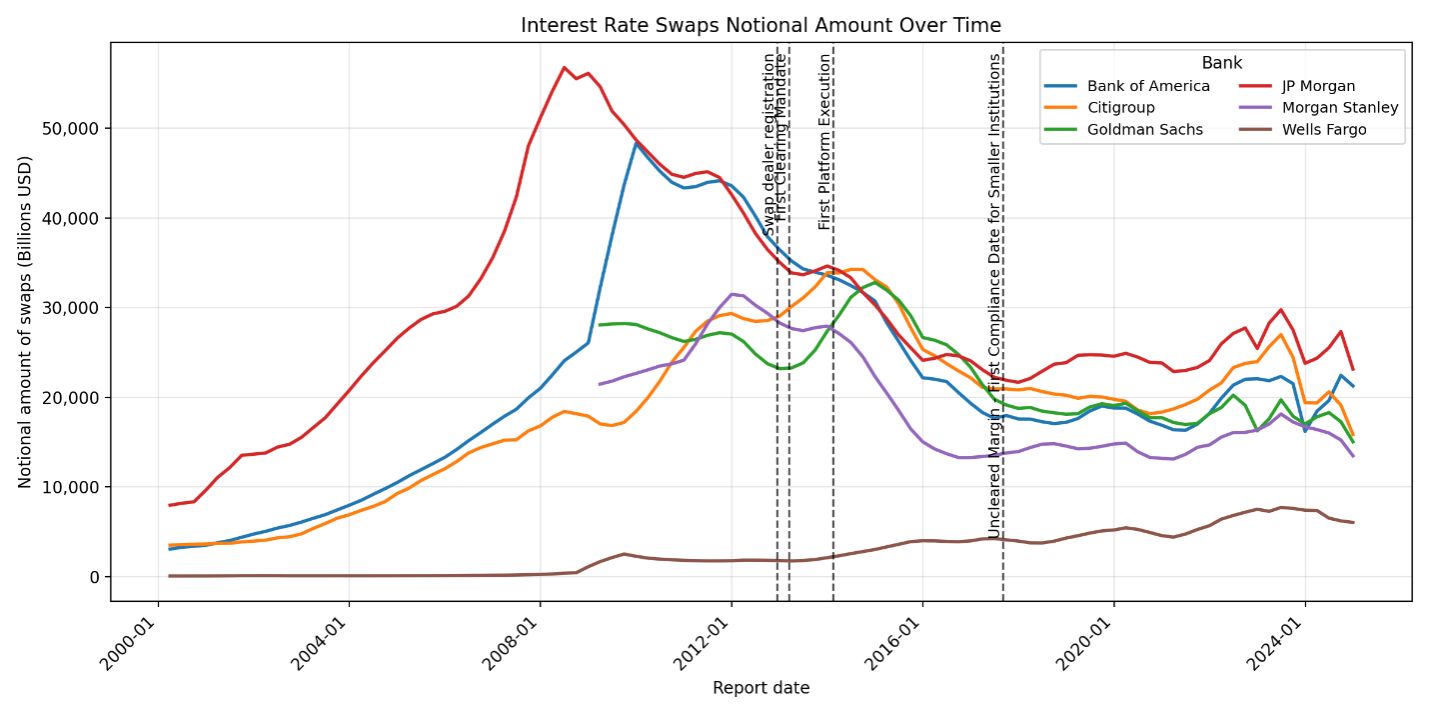
Figure 1
Several observations may be made concerning IRS notional trends among the largest banking organizations. Consistent with a negative impact of regulation on swap dealing, the notionals tend to decline. Using any number of cutoffs for a “before regulation” and “after regulation” analysis, an assessment could conclude that regulation had a deleterious effect on swap dealing. Such a conclusion, however, would be premature. The declines start at different times for different banks. These idiosyncrasies suggest that more forces are driving the trends than ubiquitous regulation. Furthermore, the declining trends for JPMorgan and Bank of America begin well before any regulation takes effect, while Citigroup and Goldman Sachs peak after regulation takes effect. Finally, there are factors independent of regulation that can explain the declines in notional amounts. Mandates to engage in portfolio compression (Jan 2013) and clearing requirements (March 2013) take effect roughly in this period, which can reduce notional amounts for chains of swaps involving the same counterparties. For highly interconnected dealers, these effects substantially qualify the implications of declining notionals.
Figure 2 provides outstanding notional values for foreign exchange (FX) swaps. This is the second largest category of swaps. FX swaps are subject to only a subset of swap regulations.[3] Notably, FX swaps show no signs of being adversely affected during the observation period. Instead, their usage grows significantly over time. The growth in FX swap notional is sufficient to outweigh any decrease in notional due to compression mandates and any increases in clearing.
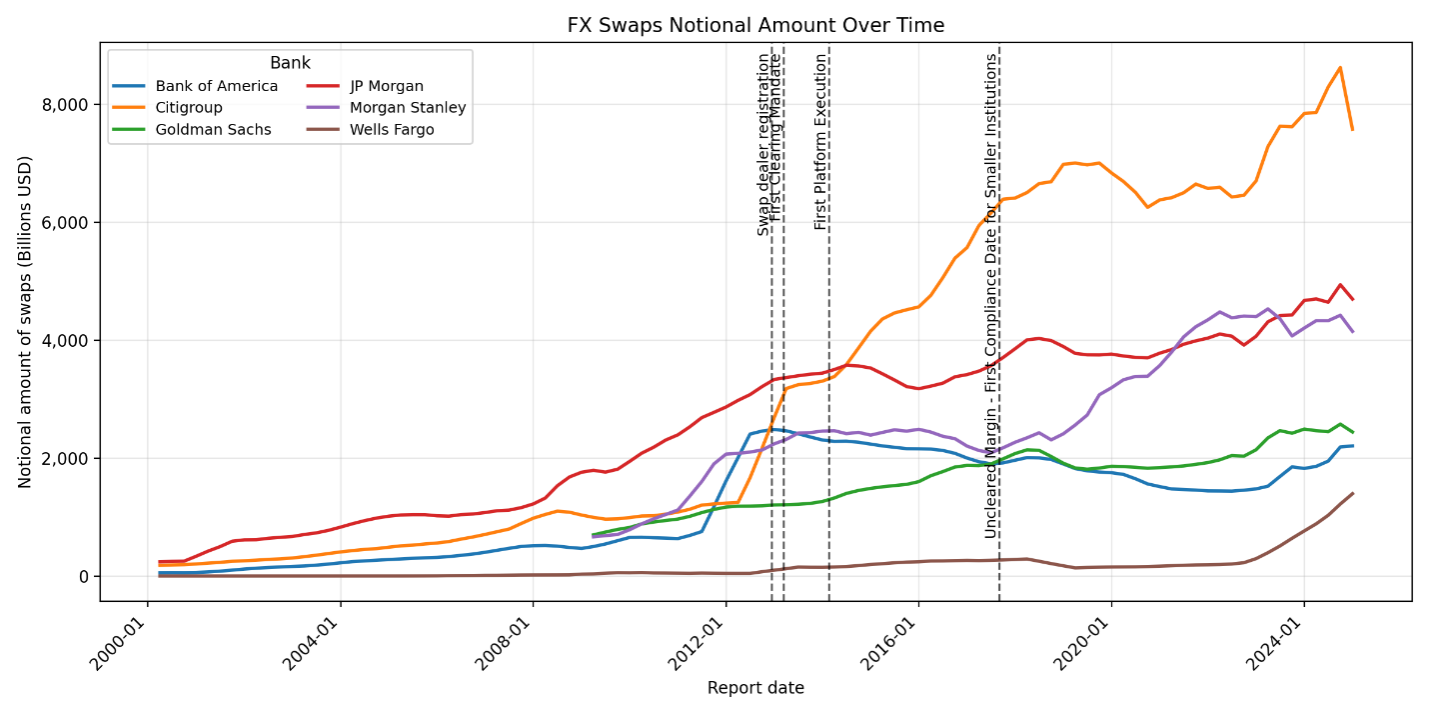
Figure 2
Trends in CDS show substantially the same patterns as IRS.[4] Equity swaps show substantially the same patterns as FX swaps. A simple cross-asset class comparison may be used to argue that the asset classes subject to clearing and platform execution requirements (i.e., IRS and CDS) suffered declines following the onset of regulations. The discussion that follows identifies reasons to doubt those arguments in addition to those already mentioned. Moreover, trends among commodity swaps are inconsistent with those arguments because commodity swaps show declines in the period of regulation similarly to IRS and CDS.
Cross-Instrument Perspective
The following analysis looks only at banking firms that are outside of the top-50 U.S. banking firms in every year between 2000 and 2025. These banking firms are presumptively using IRSs to hedge risk. Dealing requires a large balance sheet. These firms are too small to be dealing. I also expect these firms to speculate using derivatives minimally, particularly after the onset of the Volcker Rule. Accordingly, the study of swap usage in this group is a study of whether the core use of swaps, i.e., risk management, has been interfered with.
Federal Reserve data on bank holding companies provide not only swap notional outstanding across asset classes but also the outstanding notional of other risk management instruments (i.e., futures, options and forwards). If regulation negatively affected risk management using swaps, then the use of other instruments relative to swaps should go up after the onset of regulation. On the other hand, if swap regulation had no appreciable effect, swaps should not become less popular after onset.
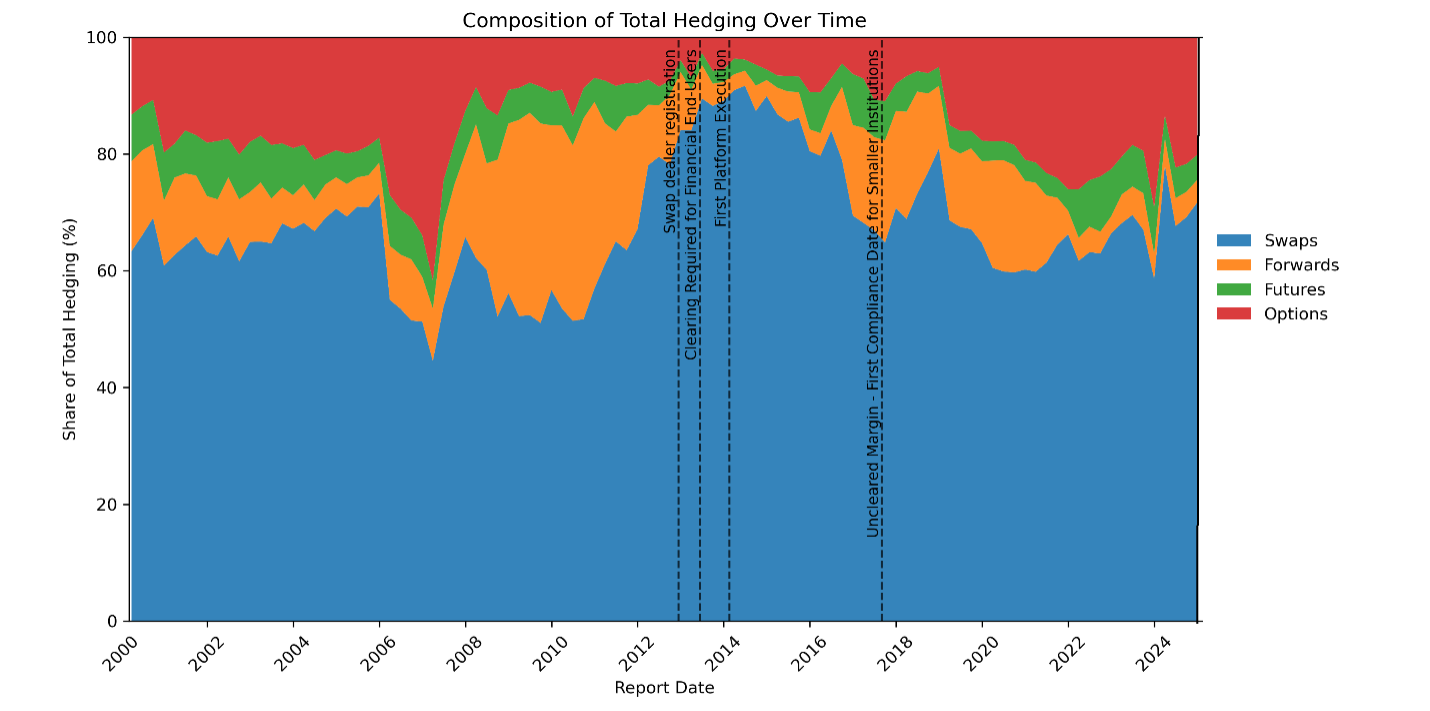
Figure 3
The popularity of IRSs increased in the period following their regulation relative to the period preceding their regulation. On average, swaps represent 63% of hedging instrument notional before January 1, 2013 and 73% of hedging instrument notional after. The observation that Figure 3 enables is particularly powerful because the graph implicitly controls for factors affecting the demand for risk management. If there is firm-specific or general change in a factor driving interest-rate risk management, that change generally applies across all instruments and does not affect their relative popularity. The decline in IRS usage observed in Figures 1 above may be due to the persistent low-interest rate environment that followed the financial crisis.
It is possible that concurrent with the onset of swap regulation there were orthogonal developments that favored swaps over alternative instruments (i.e., forwards, futures, and options). To test for that possibility, a third perspective is taken. Swap market reform included an important exemption for smaller banking organizations. Smaller banking organizations, i.e., those with under $10 billion in assets, were eligible for an exemption from the clearing and platform execution mandates as well as the margin requirements applicable to uncleared swaps. These requirements represent some of the costliest regulatory interventions in swap markets. If the interventions depressed swap activity, the related decline would be expected to be greater among institutions with over $10 billion in assets than among institutions that meet the threshold for the exemption.
Figure 4 presents a comparison between firms eligible for the exemption and larger firms. If regulations did not matter, we would expect similar changes in propensities to use swaps as opposed to other instruments between the exempt and the larger banking organizations. If the regulations did impose appreciable costs, we would expect that in the treatment period (i.e., post January 1, 2013), the propensity to use swaps would rise more (fall less) among exempt firms than among the larger firms.
A simple analysis of the data indicates that regulation does not matter for swap usage. The average difference in relative swap usage between larger firms and exempt firms is 12.4% in the pre-regulatory period and 12.7% in the treated period. Larger firms increase their preference for swaps a bit more, notwithstanding that they are subject to substantially more regulation. This simple view indicates that regulation did not interfere with hedging.
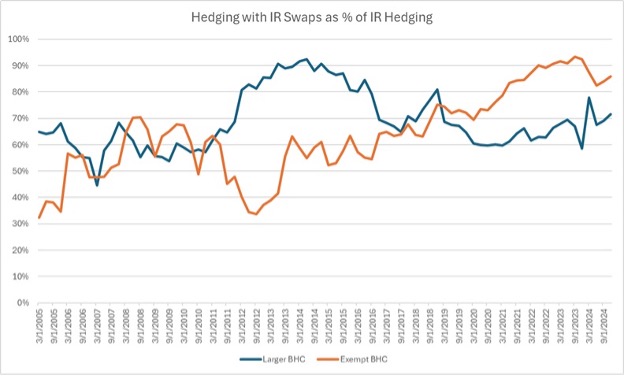
Figure 4
Once the chronology is considered, the trends in Figure 4 defy easy interpretation. Prior to late 2018, non-exempt firms are likelier to use swaps when hedging than exempt firms. This goes against the view that regulation imposes substantial costs on swaps. However, starting in late 2018, exempt firms become likelier to use swaps than non-exempt firms. The cross-over results from opposing trends among exempt and larger institutions. Exempt firms increasingly prefer swaps over other instruments beginning in 2017. Because this is a trend within exempt firms, it does not say much about regulation in itself. However, it provides a baseline for assessing changes in the period among larger firms. In early 2016, preferences for swaps among larger firms begin to decline. It is hard to explain why preferences for swaps among larger (i.e., non-exempt) firms would decline, particularly while preferences for swaps are increasing among a control-like group of exempt firms. These contrasting time trends make it difficult to say with great certainty that regulation did not have an adverse effect, particularly given the imposition of costly margin regulations roughly in the 2016-2017 period.
Looking at the data on swap notional before and after the onset of regulations, basic questions related to the massive legislative intervention in swap markets remain unresolved.
ENDNOTES
[1] Scholars in finance have approached forms of this question, albeit primarily from the perspective of whether the regulatory changes have made swaps more or less expensive to trade in (i.e., how regulation affected swap liquidity) rather than from the perspective of transaction volumes. See, e.g., Yee Cheng Loon & Zhaodong Zhong, The Impact of Central Clearing on Counterparty Risk, Liquidity and Trading: Evidence from the Credit Default Swap Market, 112 J. Fin. Econ. 91 (2014); Michael Fleming et al, An Analysis of OTC Interest Rate Derivatives Transactions: Implications for Public Reporting, Federal Reserve Bank of New York Staff Report 557 (2014); Yee Cheng Loon & Zhaodong Zhong, Does Dodd-Frank Affect OTC Transaction Costs and Liquidity? Evidence from Real-Time CDS Trade Reports, 119 J. Fin. Econ. 645 (2016); Tobias Adrian et al, Market Liquidity After the Financial Crisis, 9 Annual Rev. Fin. Econ. 43 (2017); Evangelos Benos, Richard Payne & Michalis Vasios, Centralized Trading, Transparency, and Interest Rate Swap Market Liquidity: Evidence from the Implementation of the Dodd–Frank Act, 55 J. Fin. Quant. Analysis 159 (2020); Pierre Collin-Dufresne, Benjamin Junge & Anders Trolle, Market Structure and Transaction Costs of Index CDSs, 75 J. Fin. 2719 (2020); Gregor Helmut Schoeneman, The Man in the Middle—Liquidity Provision Under Central Clearing in the Credit Default Swap Market: A Regression Discontinuity Approach, 42 J. Futures Mkts.446 (2022); Wenxin Du et al, Counterparty Risk and Counterparty Choice in the Credit Default Swap Market, 70 Mgmt. Sci. 3381 (2023).
[2]The data for the table are taken from the Bank for International Settlements and are current as of June 2025. Interest rate, foreign exchange and equity data is taken from https://data.bis.org/topics/OTC_DER/tables-and-dashboards/BIS,DER_D5_1,1.0. Credit and commodity data is taken from https://data.bis.org/topics/OTC_DER/tables-and-dashboards/BIS,DER_D5_2,1.0.
[3] Equity swaps and commodity swaps are also subject to only a subset of regulations, which exclude clearing and platform execution requirements. Certain FX swaps and forwards are exempt from a broader set of regulations than equity swaps and commodity swaps.
[4] The full paper explores notional trends of the six largest banking organizations across all asset classes. The full paper also examines profitability of interest rate derivatives and credit derivatives.
Ilya Beylin is an associate professor at Seton Hall Law School. This post is based on his recent paper, “Regulatory Burden or Market Reconfiguration? What Post-Dodd-Frank Swap Data Shows,” forthcoming in the University of Pennsylvania Business Law Journal and available here.