 Columbia Law School
 Sky Blog
When a corporation cancels your shares in a cash-out merger you did not support, it is exercising a form of governmental power. Your personal property is taken without your consent through a legislative act, and you are handed a check for whatever price someone else decided those shares are worth.
Our legal system has an analogue for this problem in another context. When the government condemns personal property through eminent domain, the Fifth Amendment requires the government to pay “just compensation,” determined, if the owner insists, by a court rather than by the taker.
Delaware’s appraisal statute, 8 Del. C. § 262, does the same work for stockholders. As Vice Chancellor Lamb explained in In re Unocal Exploration Corp., 793 A.2d 329 (Del. Ch. 2000) — a Section 253 short-form squeeze-out case — the appraisal remedy traces directly to the legislative bargain struck when Delaware’s General Corporation Law replaced the common-law unanimity requirement for mergers with a majority-vote rule. When individual stockholders could no longer block a merger but still be forced to sell their shares, the General Assembly created a new right: to dissent from the merger and receive a judicially determined fair value. See also Chicago Corp. v. Munds, 172 A. 452 (Del. Ch. 1934). Appraisal is the corporate analogue of just compensation — a check on the state’s power to take private property without paying fair value for it.
That statutory guarantee is now under direct assault. On September 21, 2026, Endeavor Group Holdings and its controlling stockholder, Silver Lake, filed a declaratory-judgment complaint in the Delaware Court of Chancery (C.A. No. 2026-1238) seeking to bar dozens of investors — merger arbitrageurs and hedge funds — from pursuing appraisal in connection with Silver Lake’s roughly $25 billion take-private of Endeavor. This is the largest appraisal proceeding in Delaware history: roughly 149 million shares, representing about 80% of Endeavor’s public float, were submitted for appraisal. Silver Lake’s theory is that petitioners should not be allowed in the courthouse at all.[1]
The Facts Make This the Prototype Appraisal Case
The classic case for appraisal is a deal priced fairly upon announcement but certain core assumptions — such as material expenses — shift between signing and closing through nobody’s fault. When gas prices or interest rates plummet between signing and closing, for example, the statute entitles stockholders who did not consent to the merger to receive fair value as of the closing. This is the very feature that gave rise to the Unocal Exploration court’s observation that appraisal was designed as compensation for the loss of the unanimity veto, not as a remedy for wrongdoing.
Silver Lake, controlling about 74% of Endeavor, agreed in April 2024 to cash out the minority investors at $27.50 per share. The merger announcement touted a headline 57% premium to Endeavor’s unaffected trading price, negotiated by a special committee that met more than twenty times. Silver Lake dictated the vote, not giving the minority a chance to block the deal, which was approved by written consent the same day the deal was signed.
Awaiting regulatory approval for nearly a year, the deal finally closed on March 24, 2025. Even assuming, for arguments’ sake, the fairness of the merger price when the merger agreement was executed, Endeavor’s inherent value objectively skyrocketed during the interim before closing. Endeavor’s principal asset was its 51% stake in TKO Group Holdings — the owner of UFC and WWE. That stake increased to about 61% by closing. Valued at a market capitalization of roughly $14.8 billion just before signing, TKO’s market capitalization roughly doubled to about $30.5 billion by closing, increasing the value of Endeavor’s stake to about $18.6 billion. In plain terms, because neither Endeavor’s stockholders nor its board had the ability to stop the deal, Silver Lake was set to enjoy a windfall, buying out Endeavor’s minority for less than the value of Endeavor’s TKO stake alone, practically getting the rest of Endeavor for free.
As Bloomberg’s Matt Levine put it, this is “the simplest possible appraisal story”: objective, publicly traded market prices, not dueling discounted-cash-flow models, show that even if the deal price was fair upon signing, it was self-evidently too-low by the time of closing. A judge need not navigate a battle of valuation experts. The market’s own valuation of TKO tells enough of the story.
Silver Lake Effectively Seeks to Abolish Delaware Appraisal
Silver Lake’s lead argument is that § 262 is merely a “safety net” for a single stockholder involuntarily cashed out, and that investors who bought after the merger was announced are “opportunistic arbitrageurs” trying to “buy a lawsuit” and not “dissenters” protected by the statute. Dressed up as a modest limit based on standing to exercise a statutory remedy, Silver Lake’s argument is in fact a demand to gut the statute for everyone.
Why the Remedy Depends on Transferability
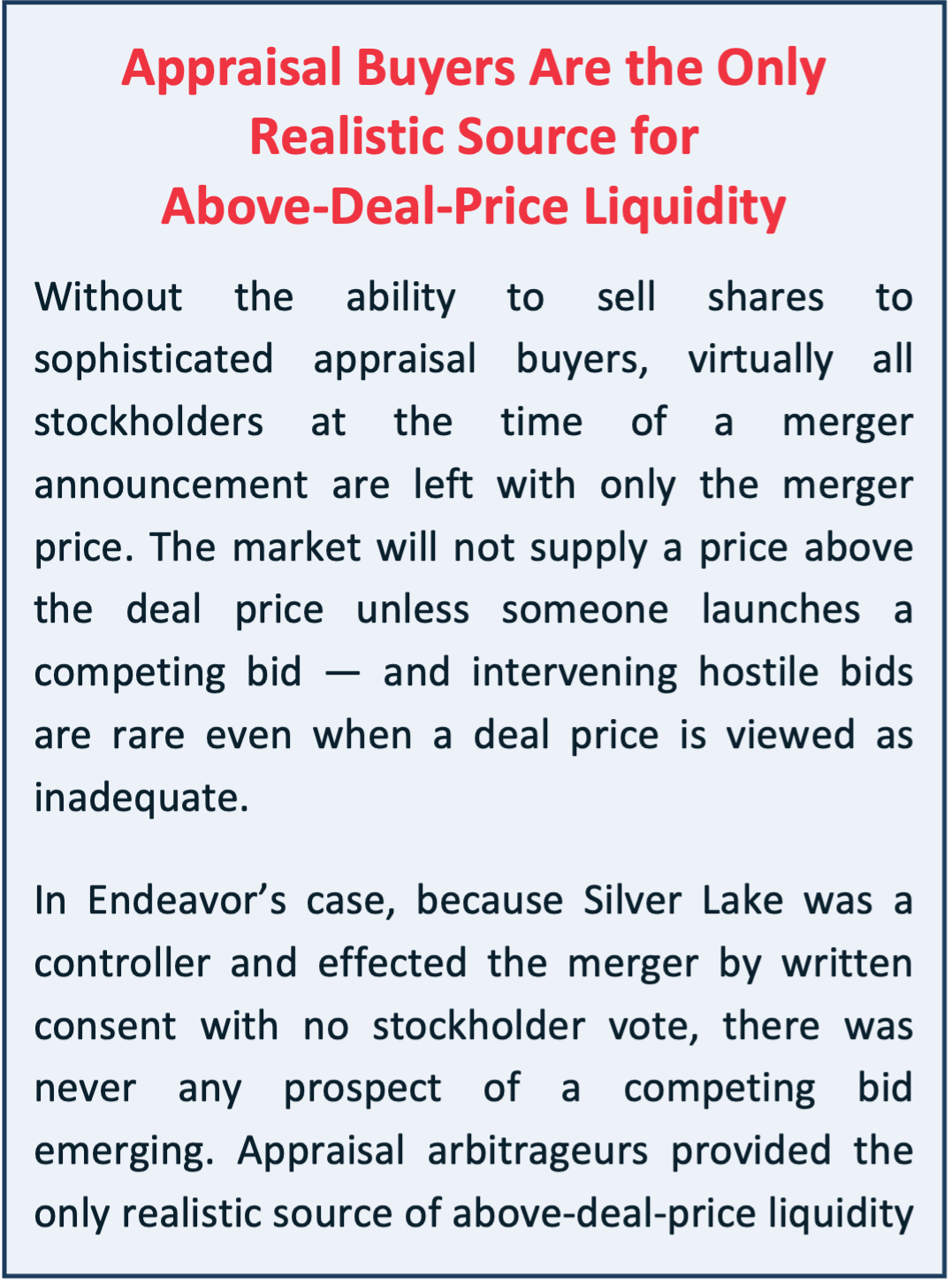
The premise of the appraisal remedy is to allow a dissenting investor to seek judicial determination of a value higher than the merger price. But the investor at the time a merger is announced has to hold its shares until the closing despite the merger itself providing a functional cap on price appreciation, forego the merger consideration at the time of closing, comply with complex dissent and filing requirements, bear the formidable cost of prosecuting an increasingly complex and challenging litigation, and wait for what is necessarily several years to receive a final and binding judicial determination of “fair value.” For most retail and institutional investors alike, the modern appraisal remedy is not a realistic alternative.
The existence of a market for shares that will be entitled to appraisal preserves the value of this critical statutory remedy for all invstors. As long as appraisal is available to whoever holds shares at closing, a stockholder who received what she believes is inadequate consideration in the merger announcement retains the ability to sell her shares to a sophisticated buyer who is positioned to endure the cost, complexity, and risk of a full appraisal proceeding. That buyer will pay a risk-adjusted price reflecting a discount off the buyer’s assumed fair value for the shares, giving the original stockholder a meaningful exit above the deal price without requiring her to litigate.
An active appraisal market for post-announcement but pre-closing shares also informs the pre-announcement investors about the fairness of the merger price itself. Consider what happens if no buyer in the open market agrees with the would-be dissenter’s view of value: While the dissenter retains the statutory right to pursue appraisal, no one will pay above the deal price and she is unable to monetize superior value through market sales without occupying scarce judicial resources. On the other hand, when an announced merger so clearly fails to achieve fair value that sophisticated market participants are willing to pay some amount above the deal price in order to realize fair value in subsequent litigation, the original stockholder gains the ability to sell to that fund at a “fairer value,” albeit one still discounting for litigation risk.
To be sure, there are many scenarios where adjudicated appraisal should result in a fair value determination exceeding the merger price even though nobody buys the shares at higher than the deal price between signing and announcement. Poor disclosures or structural trading impediments are just two of the reasons why even a robust appraisal claim buying market may not drive prices upwards in every inadequately priced deal. Nevertheless, good policy supports giving the usual long-term investor an option to sell rather than litigate when a deal is so clearly underpriced.
The evidence in Endeavor proves the point. Endeavor traded above $28 for six months before the deal closed, reaching as high as $35.50 per share on February 13, 2025. Those premiums came from appraisal arbitrageurs — investors willing to buy shares above $27.50 because the appraisal remedy gave them a credible path to a higher judicially determined fair value. Ordinary, long-term Endeavor holders who believed the deal price was too low did not need to file appraisal petitions to benefit; many simply sold into the arbitrageur bid at a premium and walked away with a fairer price, immediately, in cash.
Strip the Specialists and the Remedy Disappears
Strip the arbitrageurs of standing and that whole mechanism collapses. If post-announcement buyers cannot seek appraisal, the deal price becomes the effective trading ceiling for target shares from announcement through closing. Retail holders, index funds, and most institutions do not have the scale, specialized counsel, or appetite for multi-year litigation to perfect appraisal themselves. If arbitrageurs are locked out of exercising the statutory appraisal right historically available to any stockholder as of the closing who did not vote in favor of the deal, the remedy itself becomes illusory for almost all stockholders as of the announcement date.
Markets specialize for a reason. Take away the arbitrageurs, and appraisal for public companies does not become narrower; the “fair value” lynchpin of permitting the non-unanimous merger effectively ceases to exist. Silver Lake’s “safety net” catches no one.
Appraisal Standing Is Not Class-Action Standing — Two Remedies, Two Frameworks
Much of Silver Lake’s rhetoric borrows from a genuinely different question: who may serve as a lead plaintiff representing a class in a breach-of-fiduciary-duty action. Silver Lake’s complaint conflates these two doctrines together, hoping that legitimate questions about class leadership will justify dismantling an unrelated statutory right. This cynical blurring should be identified and rejected.
Appraisal: A Valuation Right, Not a Tort
Appraisal under Section 262 requires no proof of wrongdoing. The statute does not reference the date the merger agreement was executed or announced, and that date has no legal significance under § 262. The statute simply requires the court to independently value the shares, at the closing date, that are being involuntarily taken from their holder by the acquirer. As then-Chancellor Chandler wisely ruled two decades ago, any properly dissenting holder of shares that were not voted in favor of the merger and that are being acquired at closing is entitled to seek a judicial fair-value determination — regardless of when they acquired those shares. In re Appraisal of Transkaryotic Therapies, Inc., No. 1554-CC, 2007 WL 1378345 (Del. Ch. May 2, 2007).
Sure enough, the Court of Chancery rejected the very argument Silver Lake now advances nearly two decades before Transkaryotic. In Salomon Bros. Inc. v. Interstate Bakeries Corp., 576 A.2d 650 (Del. Ch. 1989), the appraisal respondent argued that a risk arbitrageur that bought its shares after the merger was announced could not pursue appraisal. The Court found nothing in the history of § 262 supporting “IBC’s argument that the statute was designed to protect only those stockholders who purchased their shares prior to the announcement of a merger. Rather, its purpose was to replace the stockholder’s veto power with a means of withdrawing from the company at a judicially determined price.” As noted, appraisal is an outgrowth of the law of eminent domain.
Class Actions: A Tort Remedy with Two Key Dates
Unlike an appraisal action, a class action for breach of fiduciary duty is a tort remedy. When identifying the proper class representative to prosecute this tort claim, two dates have historically been legally pertinent. The first is the date of the tort. In the merger context, the tort occurs with the board’s wrongful execution of the merger agreement and/or the wrongful issuance of the proxy statement. The second is the closing date, which determines which shares participate in any eventual settlement or damage award distribution. Unlike in the appraisal context, damages for breach of duty are not necessarily tied to the closing date, and in various instances may be more appropriately weighed at the date of the alleged breach.
An investor seeking to represent the class traditionally had to be similarly situated to the class as a whole. A stockholder at announcement who sold before closing cannot represent the class because it has no economic interest in the outcome. An investor who acquires shares after announcement and holds through closing can be a passive class member entitled to receive a pro rata share of a settlement or judgment. Historically, however, the post-announcement purchaser could not claim to have suffered any disappointed expectation of fiduciary compliance, i.e., the tortious conduct giving rise to the claim. While judicial exceptions can be made to appoint the representative best situated to benefit the class in any given situation, tort principles inapplicable in the appraisal context explain why multiples dates matter in the class action context while only one should matter in an appraisal.
Why These Rules Are Each Correct
Permitting post-announcement buyers to pursue appraisal is precisely what gives the remedy its practical force. It is what enables the liquidity mechanism described above: the ability of original stockholders to sell to specialists who can bear the cost and risk of proving fair value. It is what allows the appraisal statute to fulfill its critical statutory purpose of ensuring dissenting stockholders receive either the market’s or a judge’s determination of fair value for shares taken without their consent. Limiting appraisal to petitioners who held their shares at signing would sever the investors best positioned to deploy the remedy from providing pre-announcement holders with the market pricing that provides them the most realistic protection, leaving the statute effectively a dead letter.
The Closing-Date Rule and the TKO Windfall
Delaware measures fair value as of the closing date — not signing, not announcement. That is a deliberate legislative choice, and it is the crux of the Endeavor appraisal. Because appraisal captures value as of closing, stockholders are entitled to share in appreciation that accrues between signing and closing. Here, that appreciation is enormous and objectively measurable: TKO’s value roughly doubled while the deal sat in regulatory limbo.
Why Silver Lake Should Not Keep the Windfall
This frames the real normative question. Why should Silver Lake — the controlling buyer that locked in $27.50 before TKO’s run-up — pocket the entire windfall from a post-signing development that made the acquired enterprise far more valuable? The closing-date rule reflects the legislature’s judgment that this increment belongs, at least in part, to the stockholders whose shares are being taken, and not exclusively to the acquirer simply because it fixed the price earlier. Notably, Silver Lake’s argument that TKO’s own rise reflected “artificial” arbitrage inflation ignores that TKO kept climbing in value long after closing. TKO increased in value, and the judicial system should determine whether stockholders of any term get to participate in that windfall.
Why This Matters Now
A Broader Retreat from Shareholder Protection
None of this arises in a vacuum. Over the past decade, Delaware has already made appraisal harder and less rewarding, by deferring heavily to deal price (despite arguably conflicted processes) and unaffected market price, tightening the treatment of statutory interest, and narrowing the remedy through both decisions and amendments to § 262. While Endeavor induced a massive number of appraisal petitions, the remedy remains risky and realistic only in limited circumstances. The risk runs both ways: Delaware courts have recently appraised fair value below the deal price, meaning a petitioner can forgo the merger consideration and walk away with less. In Fir Tree Value Master Fund, LP v. Jarden Corp., No. 454, 2019 (Del. July 9, 2020), the Delaware Supreme Court affirmed a fair value of $48.31 per share — Jarden’s unaffected market price — against deal consideration of $59.21, roughly 18% below what petitioners would have received had they simply taken the deal, and held that the deal price did not act as a floor where the price likely included synergies. These developments make it all the more important to preserve the one feature that provides ordinary investors why any value from the appraisal remedy: the ability of specialized capital to acquire and perfect claims through closing.
For funds that pursue appraisal and for the institutions and pensioners whose capital ultimately depends on a credible fair-value backstop, the stakes are direct. If Silver Lake prevails, the controlling-stockholder buyer sets a price the minority cannot vote on, and the courthouse door closes behind it. Appraisal would join a growing list of shareholder protections that face increasing challenges from corporate interests. Endeavor is the case to hold that line. The facts are objective, the valuation gap is proven by the market itself, and the principle at issue is the same one that forbids taking property without paying for it.
To be clear, choosing to pursue appraisal requires a nuanced analysis of the underlying facts and circumstances of the transaction and a cautious and clear-eyed risk-reward assessment. While Endeavor and a few other transactions in the past two years clearly warrant exercise of this statutory right by those who can afford the risk and complexity of doing so, we continue to counsel exercising caution when deciding whether to pursue appraisal.
ENDNOTE
[1] This memo addresses only Silver Lake’s standing arguments affecting Delaware appraisals generally. We offer no comment on Silver Lake’s federal securities law-based theories of relief.
This post is based on a Bernstein Litowitz Berger & Grossmann LLP memorandum, “Taking Shares, Taking Rights: The Endeavor Appraisal Fight and the Future of Fair Value,” dated October 8, 2026.