 Columbia Law School
 Sky Blog


It’s probably safe to say that the Federal Reserve is the most closely studied central bank in the world. Scholars have written at length about its monetary policy, its balance sheet, and its governance and independence. But far less attention has been paid to the Federal Reserve’s role as a federal law enforcement agency. Yet as one of four U.S. federal banking agencies, the Federal Reserve supervises more than 3,000 banking organizations, collectively holding trillions of dollars in assets.
How does the Federal Reserve actually use its enforcement powers? In a new working paper, we try to answer that question in a systematic way by hand-collecting and cleaning all 350 public enforcement actions the Federal Reserve brought against a banking organization between 1995 and 2025. We coded each action by statutory authority, violation type, penalty, and target before matching the targets to regulatory filings and to daily stock returns.
What we see raises important questions about how the Federal Reserve allocates its scarce enforcement resources, and how well its enforcement strategy supports its core price and financial stability mandates.
The Federal Reserve Enforces Along Two Tracks
The data reveal that, in effect, the Federal Reserve runs two parallel enforcement programs. By volume, its enforcement docket is dominated by actions targeting community banks. While banks with less than $10 billion in assets hold under 15 percent of total banking-sector assets, they are the targets of almost 65 percent of actions. By dollar amount, however, banks with more than $100 billion in assets account for about 97 percent of total penalties.
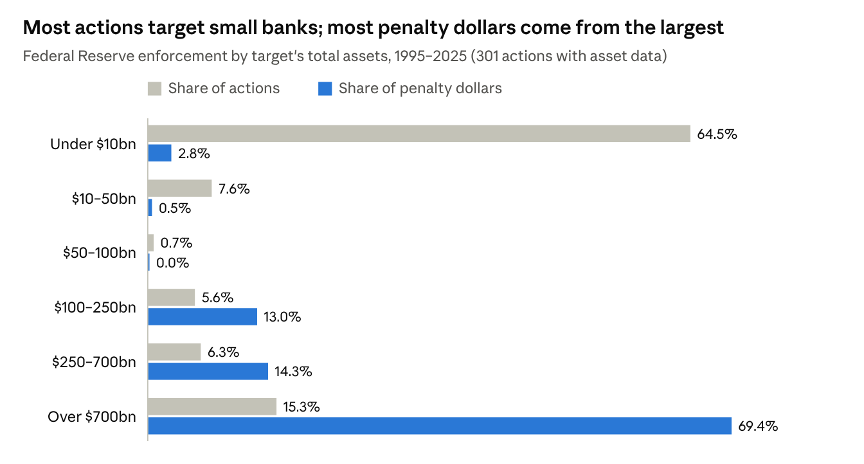
Source: Awrey and Zhang, Money Cop, Table II-3.
The principal driver behind the volume statistic is flood insurance. A total of 149 actions, or 43 percent of all actions, involve enforcement of the Flood Disaster Protection Act. What is that, you may ask? It’s a law that bars banks from lending against uninsured property in designated flood zones. The median flood insurance penalty is $9,500.
In comparison, only about a third of all actions rest on the Federal Reserve’s core safety and soundness powers. At the same time, several important statutes that the Federal Reserve is charged with enforcing—including the Truth in Lending Act, the Electronic Fund Transfer Act, and the PATRIOT Act—have not been used as the basis of a single public action across all three decades of our sample. Moreover, we find that the headline fines are also relatively small. For instance, when measured against the target’s Tier 1 capital, the median penalty is 0.024 percent—effectively a parking ticket.
Crises, Not Politics, Drive Enforcement Cycles
We also find that the Federal Reserve brought just over 11 actions a year under both Democratic and Republican presidents. Setting aside flood insurance, Democratic administrations saw somewhat more substantive actions, but we see that the president’s political party has no statistically significant effect on penalty size.
Instead, we find a clearer cyclical pattern in our data. Substantive—i.e., non-flood insurance— enforcement averaged 3.9 actions and about $31 million in penalties per year before 2008. After the financial crisis, these figures rose to 9.0 actions and about $545 million a year from 2008 to 2015. Actions against banks above $100 billion roughly halved after the Federal Reserve’s post-2019 “tailoring” framework before rising again after the 2023 regional bank failures. In other words, we find evidence in support of Professor John Coffee’s “regulatory sine curve,” with enforcement intensifying immediately after a crisis and then fading with the memory of it.
Do Markets and Depositors Care?
We then asked whether anyone cares about these enforcement actions. For the 72 actions whose targets had a publicly traded parent, we find that the average share-price reaction around the announcement is small and not statistically significant. There is one notable exception to this observed indifference: We see a statistically significant (and negative) reaction in the subsample of banks above $250 billion.
We also report two additional findings in this vein. First, 12 banking organizations with three or more actions account for approximately 56 percent of all penalty dollars, and the market reacts less to their repeat actions than to first offences. This is perhaps because the market has already identified and priced them as “problem” institutions. Second, depositors do not react at all. Across 337 enforcement actions linked with deposit data from institutional call reports, we find no signs of depositor outflows.
Is the Federal Reserve a Money Cop or a Mall Cop?
We acknowledge that our results are descriptive. Indeed, much of the Federal Reserve’s supervisory pressure is applied confidentially, through Matters Requiring Attention, Matters Requiring Immediate Attention, CAMELS ratings, and other supervisory actions that we simply cannot see. With that in mind, we think it’s worth highlighting four points:
- Effective bank supervision is part of the Federal Reserve’s monetary and financial stability mandate. Encouraging flood insurance is a worthy goal, but we think the $8.1 million collected in flood insurance penalties over 30 years is a drop in the bucket. It is fair to ask whether the Federal Reserve’s scarce enforcement staff would do more good by policing safety and soundness.
- The Federal Reserve may get more deterrence from cease-and-desist orders, asset caps, and mandatory leadership changes than from headline fines. This matters most for repeat offenders.
- Market Discipline. Bank regulation has long counted on market discipline by shareholders and creditors as a complement to supervision. But our evidence suggests that this approach is weaker than expected, especially among community, regional, and mid-size banks. Unsurprisingly, depositors are unlikely to fill the gap.
- We find very little that suggests the White House has swayed the Federal Reserve’s enforcement tempo, targets, or sanctions. That may reflect robust institutional independence or simply that enforcement has not been politically salient. Whether it holds after the Supreme Court’s 2026 decisions in Trump v. Slaughter and Trump v. Cook on the nature and scope of the president’s “for cause” removal powers remains to be seen.
Dan Awrey is the Beth and Marc Goldberg Professor of Law at Cornell Law School. Jeffery Zhang is an assistant professor at the University of Michigan Law School. This post is based on their paper, “Money Cop,” available here.