 Columbia Law School
 Sky Blog


On September 16, 2026, under Chairman Paul Atkins, the Securities and Exchange Commission published a statement on its proposals to rescind Rule 14a-8 and amend Rule 14a-4. It said the rescission would not end shareholder proposals, but that Congress has not given the Commission authority to decide which matters are proper subjects for a shareholder vote.
The proposing release does not rest on authority alone, and also sets out independent policy reasons for rescission.
We wrote the rule’s history, from its adoption in 1942 to the proposal now pending, building it from the primary record and above all from the printed transcript of the 1943 hearings. We filed the paper with the Commission as a comment and have not yet taken a position on the proposal itself.
Historical Context
Two questions about shareholder proposals are being fought over in American corporate governance right now. The first is who should be allowed to put a proposal in front of a company’s shareholders at the company’s expense. The second is what counts as a relevant subject.
Neither question is new. Both were put to the Commission in June 1943, at the first congressional hearings ever held on the shareholder proposal rule, and both have been reopened and re-decided roughly every decade since. They keep reappearing because Congress never said who decides.
Congress Never Said Who Decides
Rule 14a-8 requires a public company to print a qualifying shareholder’s proposal in its own proxy materials, at its own expense. Section 14(a) of the Exchange Act makes it unlawful to solicit a proxy in contravention of such rules as the Commission may prescribe, bounded only by the public interest and the protection of investors. In Section 12(b) of the same Act, Congress listed 11 categories of information a registration application must contain, but on proxies it listed nothing.
Five documents of the period were examined for any reference to a shareholder placing a matter before a meeting. They were the two committee reports, the staff’s history of the market, the bill as introduced, and Ferdinand Pecora’s 1939 account of the U.S. Senate investigation that produced the Exchange Act, for which he was counsel. Not one contains such a reference. In all of them the shareholder receives information and votes on questions somebody else decided to ask.
The Commission Said So Itself, in 1943
The obligation came before any rule created it. In 1939 the Commission advised Bethlehem Steel that leaving the Gilbert brothers’ bylaw amendments out of its meeting notice rendered the solicitation false and misleading. Rule text followed in 1940 and took its modern shape in December 1942.
Congress had adjourned two days before that adoption. Three bills to suspend the Commission’s proxy authority followed, and the hearings held on them in June 1943 were the first ever held on this rule. Chairman Ganson Purcell, a Democrat appointed by President Roosevelt, testified that the proxy rules had been promulgated principally and almost entirely on a disclosure theory, and he conceded that requiring a ballot space for someone else’s proposal could not fairly be described as disclosure. Baldwin Bane, who ran the Division of Corporation Finance, said the same and located the justification in the committee reports.
Ten members spoke across the three days, and not one defended the rules. The sharpest statement came from the majority. Oren Harris (D-Ark.) put it to Purcell that “if there is something lacking in the law, the general law, that it is not an emergency proposition, then, of course, the proper way, in my opinion, is to come to Congress and get authority.” Purcell answered that rulemaking was a process of evolution, and that he did not think Congress meant the Commission to come back to it each time it saw a new situation that needed a rule.
The libel problem led to the same place. Committee Chairman Clarence Lea (D-Calif.) asked whether a company forced to publish a shareholder’s false charge could be sued, and said that shielding it raised “the question as to whether or not the Commission has any such power.” Robert Crosser (D-Ohio) added that unless Congress could override state libel law, “certainly the Commission could not,” and called that “the whole question here.” Charles Wolverton (R-N.J.), who had sat on the subcommittee that drafted the bill, said that in his opinion Congress never intended the Act to reach as far as the Commission had taken it. He asked that the language be clarified so there could be no doubt, and Bane agreed that clarification was undoubtedly warranted. Both sides asked Congress to settle it.
Congress did not. The operative language of Section 14(a) is unchanged from 1934, and neither of the subsection’s two amendments since, in 1964 and 2010, addressed shareholder proposals. Eighty-three years have passed since the request for clarification was made.
The Federal Rule Carries, State Law Decides
The 1942 rule required that a proposal be a proper subject for shareholder action, and the Commission made the law of the company’s state of incorporation the standard for what was proper. It did so first in testimony in 1943, then in a Division letter of January 1945, then in the rule text in 1954.
What shareholders may decide remains a question of state corporate law, and the federal rule cannot create an entitlement that state law withholds.
Louis Loss, formerly the Commission’s associate general counsel, wrote in 1961 that the Commission, while purporting to find and apply a generally nonexistent state law, had been building a common law of its own. Roughly 98 percent of proposals are precatory, a form the Commission itself created when its 1976 release added a note advising that a proposal directing board action might intrude on the board’s authority, while a recommendation would not. At a Commission roundtable in 2007, Leo Strine, then a vice chancellor of the Delaware Court of Chancery, said that the Commission had invented the precatory proposal and that Delaware did not object, because such a proposal was only precatory. Whether state law recognizes the precatory proposal as a shareholder right at all is now contested. Kyle Pinder argues it does not, while Jill Fisch, Sarah Haan, Ann Lipton, and Amelia Miazad answer that the power is incidental to the stockholder’s statutory power to elect and remove directors.
Who Gets to File, and Who Decides
The 1942 rule imposed no qualifications for filing a proposal other than to be a shareholder. At the 1943 hearings the Commission was pressed on what to do about one filer who had submitted 29 proposals at seven companies in which he had invested a total of $4,426.13. Bane floated the remedy still on the table today, which was to limit the right to a holder of a certain percentage of stock or require that a certain number of stockholders join him. He then attached the objection to his own suggestion. Such a limit would violate, to some extent, the principle that one stockholder has a right to present to his fellow stockholders anything he wants to.
In 1957 the Commission told a Senate subcommittee there was no limit on the number of proposals a stockholder might file, adding that management had as much or more advantage through its control of the proxy machinery and corporate funds. In 1976, urged to impose a minimum holding period and a minimum investment, the Commission found no sufficient justification, noting that the existing requirements generally had not been abused.
Seven years later, the SEC changed its mind. The 1983 amendments required a proponent to have owned 1 percent or $1,000 in market value of the company’s shares for at least one year. A majority of commenters addressing the question supported those requirements, arguing that a proponent who puts the company and other shareholders to the expense of including a proposal in a proxy statement should hold a minimum economic stake. The Commission found merit in those views. It did not say what had changed since 1976.
The same 1983 release raised the resubmission thresholds from 3 percent and 6 percent to 5 percent and 8 percent, giving as its reason the increased voting activities of institutional investors. Shareholder proponents connected with religious institutions sued, and in September 1985 a federal district court vacated the increase for inadequate notice. Sixty-six comments had addressed the thresholds and 43 came from issuers. Not one proposed raising them because institutions were voting more. Exactly one commenter even mentioned institutional investors, and that commenter proposed lowering the thresholds. The court concluded that the decision to raise the thresholds rested on assumptions the Commission had formed earlier and had not disclosed.
The 1998 amendments raised the ownership minimum from $1,000 to $2,000 to adjust for inflation and left the one-year holding requirement in place. Eligibility was tightened again in 2020, and that change was challenged too. A federal district court upheld the 2020 change in June 2025 in Interfaith Center on Corporate Responsibility v. SEC, holding that the Commission had authority to limit who may use the rule. It did not decide whether Congress authorized the rule itself.
One feature of these requirements cuts against the account given by both sides. Ownership thresholds, holding periods, and resubmission standards have no source in state corporate law. Fisch and her co-authors make the point directly. The federal rule already departs from state law, and it does so by restricting shareholder rights rather than enlarging them.
The Instrument That Decided Everything
Every one of the 13 grounds on which a company may omit a proposal was adopted by formal amendment, with notice and comment. Application was another matter. Since 1947 a company asserting a right to omit a proposal has had to file its reasons with the Commission, and the staff’s answer was advisory correspondence that bound nobody. That correspondence was nonetheless the operative standard, because litigation was the only alternative, and almost nobody sued. Alan Palmiter, whose 1994 study called the rule a failed experiment in merit regulation, counted 13 reported decisions through 1990.
In the 1976 release, the Commission abandoned a proposal to narrow the ordinary business exclusion to routine matters, concluding that there was no reasonable means of distinguishing routine business from important business. It kept the old language and announced that matters carrying significant policy implications would in the future fall outside ordinary business, and that future interpretive letters of the staff would reflect that view.
The significant policy exception has never appeared in the rule text. It entered as an instruction about what staff correspondence should say.
The Cause of Policy Swings
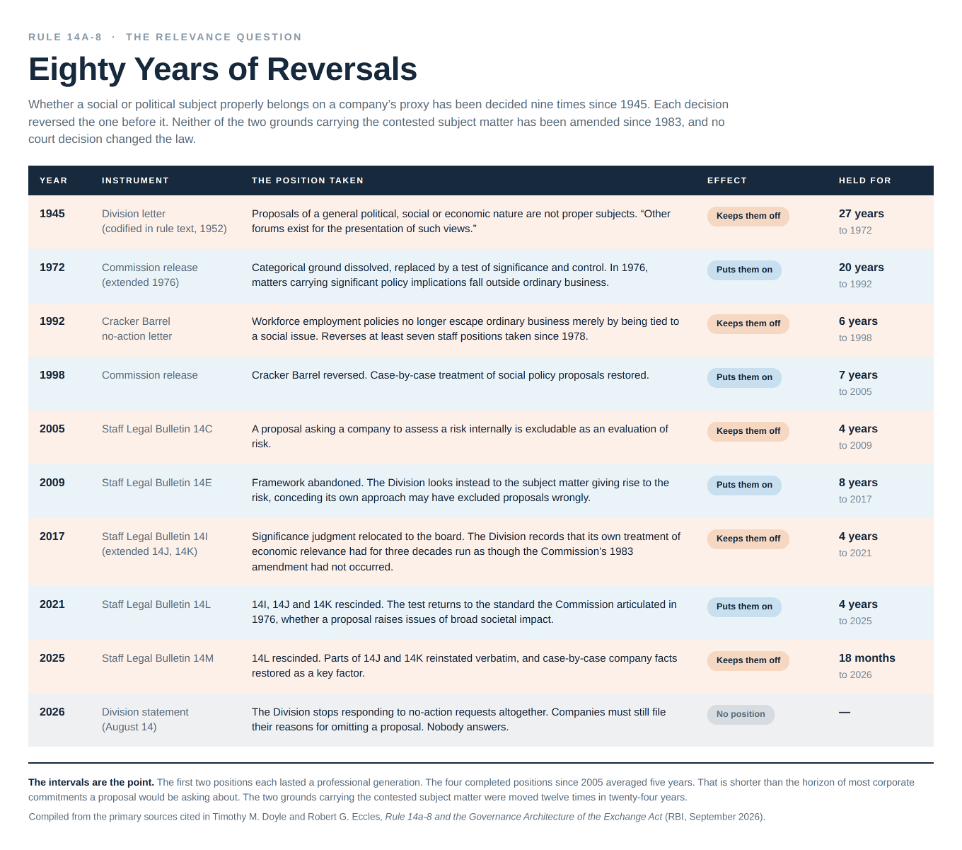
Whether a social or political subject is properly before shareholders has been decided nine times since 1945, and each decision reversed the one before it.
In January 1945, under President Roosevelt (D), the SEC Director of Corporation Finance wrote that the rule was not meant for proposals on matters of a general political, social, or economic nature. In 1952, under Truman (D), that view entered the rule text as an express ground for omission.
In 1972 and 1976, under Nixon (R) and Ford (R), the Commission dissolved the 1952 ground and announced that matters carrying significant policy implications fall outside ordinary business. In October 1992, under George H. W. Bush (R), the Division said in its Cracker Barrel no-action letter that workforce employment policies would no longer leave ordinary business merely because they were tied to a social issue. In May 1998, under Clinton (D), the Commission reversed Cracker Barrel.
Then the pace changed, as Staff Legal Bulletins moved the line in 2005 under George W. Bush (R), 2009 under Obama (D), 2017 under Trump (R), 2021 under Biden (D), and 2025 under Trump (R).
There were, in total, nine positions. The first two held for 27 years and 20 years, respectively. The four completed since 2005 lasted an average of five years. Neither of the two exclusion grounds at issue, ordinary business and economic relevance, has been amended in substance since 1983, and none of the bulletins cites an intervening decision that changed the law. Staff guidance changed how those two grounds were applied 12 times in 24 years.
Since 2001, whether such a subject belongs before shareholders has been decided by Staff Legal Bulletins, of which 14 were issued through 2025. A bulletin requires no Commission vote, no notice and comment, and none of the reasoned explanation behind a rulemaking.
The 2025 bulletin states the consequence plainly. Asked how it would treat pending requests, the Division answered that the staff will consider the guidance in place at the time it issues a response. The standard governing a company’s request is therefore not the one in force when the proposal arrives, nor when the request is filed, but the one in place on the day the staff happens to reply.
Read as staff overreach, this gets it backwards. The Commission conferred the discretion the staff has been exercising. In 1976 the SEC said future staff interpretive letters would carry the new standard. In 1998 it declined to reduce its own role and said it would keep making case-by-case determinations. Congress’s silence is the cause, and the swings are the effect.
Fifty-Four Years of Trying to Exit
The Commission has repeatedly considered getting out of deciding which proposals companies must include. In 1972 it considered leaving those decisions to the courts and decided against it. In 1982 it asked the public whether shareholders’ access to company proxy statements should rest on federal law at all or be left to the states, and in 1983 it kept both the federal rule and its staff’s role. In 1997 it asked about withdrawing from the field entirely, and in 1998 it declined to reduce its role. In 2019 it asked again whether the states were better suited, and in 2020 it left the structure in place.
On November 17, 2025, the Division suspended substantive responses to requests to exclude shareholder proposals, and on August 14, 2026, it discontinued responding altogether. A month later the Commission proposed to rescind Rule 14a-8. An agency that asked the public three times whether it should be administering the rule at all has now answered its own question.
Litigation has filled the void. Law firm Cooley counts six proponent suits over exclusions in the 2026 season. On that record, who gets a proposal into a proxy statement now turns on who can afford to sue, not on the thresholds the rule sets.
What the Record Leaves
Whether the proposed rescission of Rule 14a-8 is one more swing depends entirely on its basis. If a rescission rests on policy, it is reversible by policy. If it rests on statutory authority, and a court agrees, no later Commission can restore it, because only Congress could. The proposal offers both grounds, so the ground a reviewing court relies on will decide whether the swing can come back.
After the Supreme Court’s 2024 decision in Loper Bright, a court owes the Commission’s new reading of Section 14(a) no more deference than its old one. The Court left in place its 1944 decision in Skidmore, so staff guidance is still measured by the validity of its reasoning and its consistency with earlier and later pronouncements. On the record set out above, the staff’s guidance does not meet that measure.
What the record does establish is that the choice is not between a rule and no rule. Congress can authorize a shareholder proposal mechanism and set its outer limits or decline to do so and leave the subject to state corporate law. Either is a settlement, and either would give companies and investors a foundation that does not move with an election. What has not worked is the silence.
Timothy M. Doyle is a co-founder of the Responsible Business Initiative (RBI) and the founder and principal of Doyle Strategies. Robert G. Eccles is a co-founder of RBI and a visiting professor of management practice at the University of Oxford. This post is based on their article, “Rule 14a-8 and the Governance Architecture of the Exchange Act A Historical and Institutional Account of the Shareholder Proposal Rule,” available here.