 Columbia Law School
 Sky Blog




Boards advise on strategy, risk, and a variety of leadership, organizational, and geopolitical topics. While individual directors are selected with these specific skills in mind, it is unlikely that any begin or complete their tenure with full knowledge to resolve the issues they will face. Where do directors go for advice? Whom do they turn to for perspective?
Recently, we surveyed 79 directors of public and private corporations to understand the size, composition, and contribution of the individuals—paid and unpaid—whom directors turn to for advice.
We find widespread use of information networks. Ninety percent of directors rely on paid coaches or informal “kitchen cabinet” advisers, with most of the informal advisers being unpaid. The prevalence of advice networks suggests that important knowledge relevant to board oversight resides outside the boundaries of the firm and cannot be fully replicated through formal board processes alone.
Below is a brief summary of our findings:
Coaching reflects a continuous learning mindset.
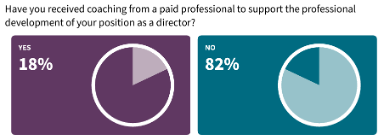
Only 18 percent of directors use a paid coach—a low percentage. Directors join boards to add value through their accumulated professional experience. To some, hiring a professional coach is unnecessary. To others, it is counter to expectation that a director recruited to provide advice would themselves require advice. Those who retain a paid professional tend to do so of their own volition (see Exhibit 1). It requires a mindset of continuous learning, coupled with a degree of humility, to commit to structured learning.
Exhibit 1

Coaching is most valuable in the ramp-up phase.
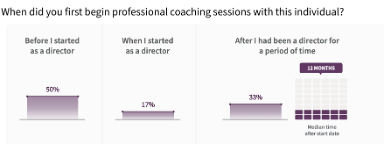
We find heightened use of paid coaches in the early period of a board member’s first directorship. Two-thirds of directors who use a paid coach begin working with them either before or when they first become a director. Relative to being an executive, the role of director requires a different style and approach, with new skills. A director is expected to advise and guide rather than lead and execute. Many first-time directors discover this is not a natural role.
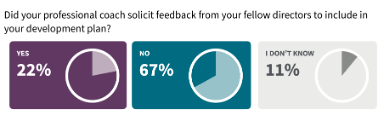
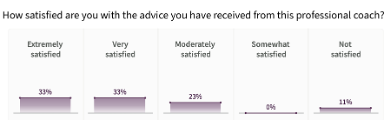
Their education with paid coaches is a personal endeavor. Only 22 percent of directors who use a coach ask the coach to solicit feedback from their fellow board members for inclusion in their development plan. Directors are pleased with the results. Eighty-nine percent express satisfaction with the training they receive from their coach (see Exhibit 2).
Informal advisers are the true support system.
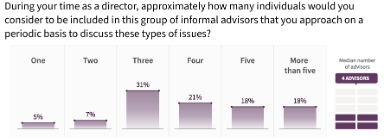
The vast majority of directors (86 percent) rely on a kitchen cabinet of informal advisers as their primary support network. These relationships span decades and are built on trust, shared history, and common understanding. A typical kitchen cabinet includes between three and five advisers, with some numbering more than 10.
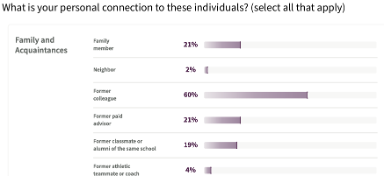
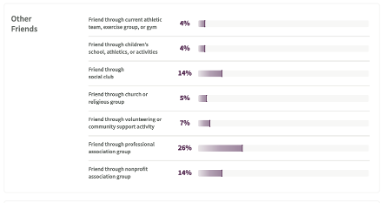
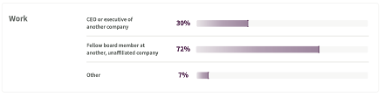
The backgrounds of these individuals are varied: fellow board members at unaffiliated companies (72 percent), former colleagues (60 percent), executives of other companies (30 percent), and friends through professional associations (26 percent). They also include former paid advisers, classmates, and friends made through social clubs, nonprofits, and volunteer activities (see Exhibit 3).
Exhibit 3
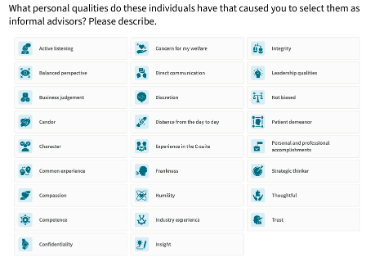
The words directors most frequently use to describe their advisers are competence, strategic, experience, candor, character, and discretion—reflecting both the business expertise and personal integrity of these individuals. These are important attributes for people who serve as a sounding board for complicated or sensitive issues.
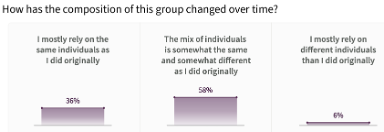
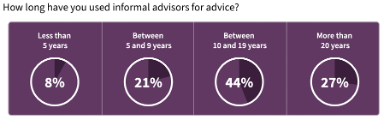
Not surprisingly, the composition of this group holds steady over time, with 36 percent of directors relying on mostly the same individuals as they did when they first sought outside advice, and 58 percent relying on a mix of individuals that are somewhat different. Three-quarters (71 percent) have relied on informal advisers for more than 10 years (see Exhibit 4).
Exhibit 4
Directors distinguish “on-the-job” and “big picture” topics.
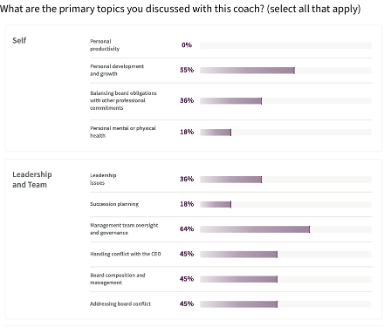
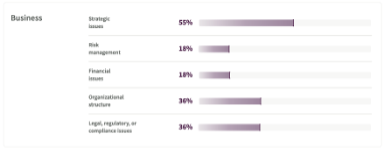
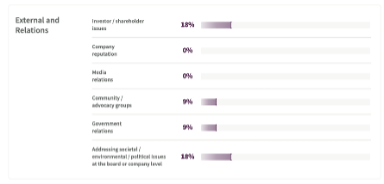
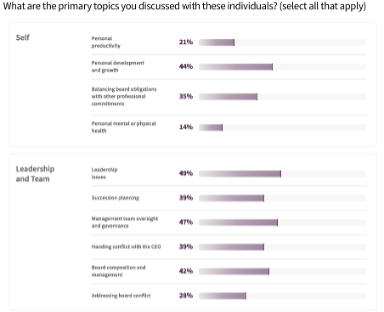
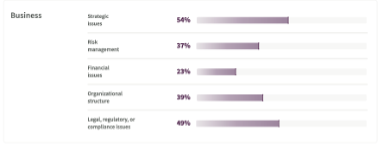
Directors take a portfolio approach to their advice network, directing questions to the individual or individuals best situated to address them. With professional coaches and paid advisers, directors are more likely to discuss on-the-job issues, like satisfying their role as director and overseer, managing boardroom dynamics, and interfacing with management.
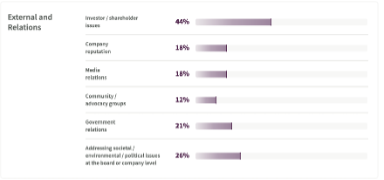
They turn to their kitchen cabinet for “big picture” questions of strategy, risk, dealing with stakeholders, and company reputation. In these matters, they appear to prefer the counsel of long-time acquaintances who have gone through similar experiences and with whom they can discuss nuanced and sensitive topics with trust and confidence (see Exhibit 5).
Exhibit 5
Directors leverage their networks to help their companies.
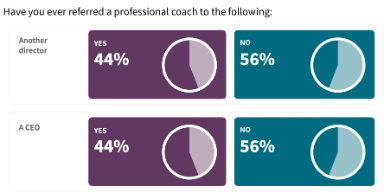
Directors use their advice networks to support management and fellow board members through introductions and referrals, in addition to information flows. Approximately half of directors (44 percent) refer a coach to other directors for their professional development. The same percentage (44 percent) refer a coach to the CEO (see Exhibit 6).
Exhibit 6
Directors leverage their advisory networks to solve an average of 7.5 issues for the benefit of their companies, and a quarter (26 percent) leverage their networks more than 10 times.
This demonstrates that directors create value not only through their individual expertise but also through access to broader networks of information and relationships.
Conclusion
How corporate directors use professional coaches and informal advisers is a greatly underexplored area of research. Advice networks—both formal and informal—can be viewed as governance mechanisms that supplement the information available through official board processes. They allow directors to acquire knowledge, reduce uncertainty, and access specialized expertise that may improve oversight and decision-making. The widespread use of such networks suggests that effective board governance depends not only on the human capital directors bring into the boardroom, but also on the external relationships through which that human capital is continually refreshed and expanded.
Paid and unpaid advisers are both important elements of these networks. First-time directors, in particular, rely on paid coaches for guidance through the transition phase and to help them acquire new skills.
Unpaid advisers serve as a more expansive, longer-term reservoir of information that directors tap into repeatedly throughout their tenure, reflecting a lifetime of personal achievement. The breadth of knowledge and diverse experience of these advisers contribute to the value a director brings to the firm in addressing governance matters.
These benefits, however, must be weighed against potential costs. Reliance on a stable group of trusted advisers may reduce exposure to diverse viewpoints and reinforce existing beliefs. Advice obtained through personal networks may also be shaped by experiences that are not transferable to a firm’s particular circumstances. More generally, directors face a tradeoff between expanding their sources of information and preserving confidentiality, independence, and accountability in decision-making.
David F. Larcker is the James Irvine Miller Professor of Accounting, Emeritus at Stanford Graduate School of Business. Stephen A. Miles is founder and CEO of The Miles Group. Amit Seru is the Steven and Roberta Denning Professor of Finance and Senior Associate Dean for Academic Affairs at Stanford Graduate School of Business. Brian Tayan is a researcher at Stanford Graduate School of Business. This post is based on their recent paper, “When Directors Need Direction: Whom Do Board Members Go to for Advice?” available here.