 Columbia Law School
 Sky Blog


Raising a first-time private fund is extraordinarily difficult. Incumbent managers have long-held and significant advantages in fundraising, and the challenge of breaking into the industry has only grown steeper in recent years as fundraising has slowed and capital has consolidated among the most established firms.[1]
In a new article, we argue that these well-known entry challenges are a product of the industry’s core governance mechanism. Private investment funds are lightly regulated but tightly disciplined by reputation, and a vast literature praises the incentive-aligning virtues of this arrangement. Reputation substitutes for law and investor control, allowing investors to overcome the severe agency problems inherent in these opaque, discretionary vehicles by relying on managers’ track records. But a market governed by reputation requires a mechanism for reputation to emerge in the first place, and aspiring managers face a classic chicken-and-egg problem: they cannot raise capital without a track record, yet they cannot build a track record without first raising capital. We call this the private fund “reputation paradox,” and we show how it reinforces existing power structures in an industry that controls much of the global economy and whose consolidation of wealth and power has been called out as a potential threat to the legitimacy of American capitalism.[2]
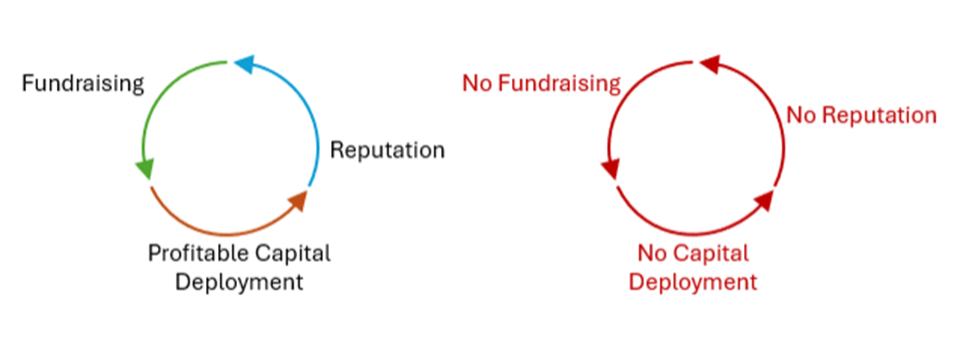 Figure 1. The Reputation Paradox
A Framework for Understanding Reputational Barriers
While similar “cold start” problems can arise in many settings, including labor markets, credit markets, and online platforms, they are unusually severe and resistant to policy responses in private funds. Our article offers an integrated framework for identifying the factors that determine the severity of the reputation paradox across different types of private funds.
The first factor is the time to track record. Shrewd investing leads to a stellar reputation only if investors can observe it, and the time it takes for a reputation to develop varies dramatically across asset classes. Hedge fund performance is marked to market and can sometimes be evaluated within months. Private equity funds hold portfolio companies for three to five years. Venture capital investments often take seven to 10 years or more to reach a liquidity event. The longer it takes to judge performance, the harder it is for even an exceptionally talented new manager to build a reputation.
The second factor is deployment constraints—the obstacles that prevent a manager from converting access to capital into access to attractive investments. Here we distinguish two components. One is the power of portfolio companies to select which funds invest in them. In venture capital, top founders choose among competing investors and strongly favor firms with elite reputations, which means that a new manager with money to invest may still be shut out of the best deals. The other is scale. Private equity buyouts typically require a large, one-time equity commitment to acquire a mature business, so the amount of capital needed to compete constrains investment choices.
The third factor is limited partner risk aversion. The institutional investors that dominate private fund capital—pension funds, endowments, and the like—are themselves managed by employees with their own career incentives. Backing a well-known incumbent is a safer bet than backing an unproven manager, and less likely to harm an employee’s career. This internal agency problem raises the bar for emerging managers across all private fund types.
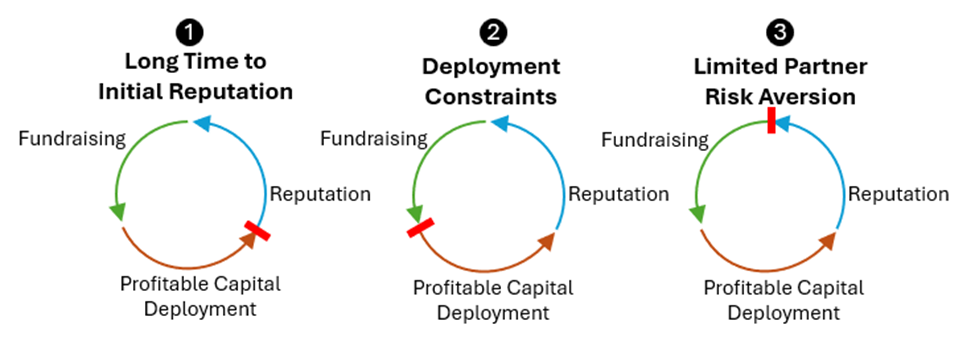 Figure 2. Three Sources of the Reputation Paradox
Explaining Performance Persistence
Our framework also helps explain one of the most consequential empirical patterns in the private funds literature: why top-tier venture capital managers exhibit remarkably persistent outperformance, while persistence is much weaker in private equity and weaker still in hedge funds.
For hedge funds, reputational barriers are comparatively low, since performance is observable quickly and strategies can be replicated in liquid markets, and thus abnormal returns are erased through competition. Feedback takes longer for private equity and venture capital, but the forms of their deployment constraints are different. Private equity’s barriers are based primarily on size, but size is subject to diminishing returns: A fund that grows larger can exploit investment opportunities unavailable to funds with less capital but tends to find its performance erodes with its scale. Venture capital’s barriers, by contrast, are access-based, with new managers having to overcome the preference that founders have for partnering with elite firms. Instead of diminishing over time, elite firms’ access to top founders only improves as their reputations strengthen. Initial success improves deal flow, which improves subsequent performance, which further improves deal flow. Incumbency advantages in venture capital are therefore both unusually durable and resistant to policy intervention. With venture capital allocations directly shaping the pace and direction of technological innovation, this finding has important implications.
Why Market Solutions Fall Short
Market participants have sought to overcome these challenges, but their efforts fall well short of resolving the underlying paradox. Institutional “emerging manager” programs earmark capital for smaller managers, but they typically require a verifiable track record and institutional-grade operations—meaning they help managers who have already cleared the initial reputational hurdle. Fund “seeding” arrangements, whereby investors provide early capital in exchange for a share of a smaller manager’s future fees and carried interests, similarly work best for managers with strong reputations, such as senior professionals spinning out of well-known firms. Seeding is rare in venture capital, where unpredictable revenue and high failure rates make such investments relatively unattractive. Special purpose vehicles in venture capital and independent sponsors in private equity allow deal-by-deal investing without a dedicated fund. While these give aspiring fund managers an opportunity to start building a track record before raising a blind-pool fund, they have not yet become proven on-ramps for those ultimately seeking to raise blind pool funds.
The dominant path into the industry remains the apprenticeship and spin-out model: developing a track record inside an established firm before departing to launch one’s own. This helps explain the outsized role of pedigree and networks in determining who attracts capital, and raises questions about whether capital flows to incumbents because they are the most skilled, or because they are the best-known and best-connected. It also highlights the importance of garden leave requirements, non-solicitation covenants, limits on the use of track record, and other contractual terms commonly used to restrict departing employees’ activity. Such terms have received surprisingly little scholarly attention despite the important role apprenticeships play as the primary on-ramp into the industry.
The INVEST Act and the Limits of Policy
Policymakers have attempted to address these challenges. Most recently, in the last session, the U.S. House of Representatives passed the INVEST Act, a bipartisan securities package now before the Senate that has been described as the most ambitious capital markets legislation in decades. Among its core provisions are measures designed to help emerging venture capital managers raise capital from new sources, including less affluent investors and funds of funds.
While we think the act’s goal of easing entry into private funds is well placed, our framework suggests that skepticism is warranted. Easing capital access addresses only one of the three barriers we identify. Even if an emerging manager can gain access to capital, he or she still must overcome access-based deployment constraints—top founders will still prefer elite incumbents—and the agency problems that make limited partners overly-averse to risk. For that reason, we are not persuaded that the act will, by itself, make it dramatically easier to form early-stage funds.
Other policies are no better. Direct government funding on the model of Small Business Administration lending is a poor fit, because beginning fund managers do not have assets and cash flows to lend against. Tax incentives for institutional investors don’t work because the largest private fund investors are predominantly tax-exempt. And regulatory relief offers little leverage in an industry that is already lightly regulated; managers below $150 million in assets are already exempt from SEC registration, and venture capital managers enjoy a similar exemption regardless of size.
Tying these observations together, we argue that the reputation paradox is structural, not regulatory. Reputation performs real work in private fund markets, mitigating agency costs where legal protections and investor control are deliberately thin. The entry barriers that accompany those benefits are better understood as tradeoffs than as failures of law and policy. As a result, interventions aimed at easing entry can be expected to yield incremental gains with offsetting costs.
Implications
A central lesson of our analysis is policy modesty. Yet while policymakers should be realistic about the limits of their influence, the stakes are undoubtedly high. Private fund managers act as gatekeepers to enormous power and economic opportunity, and when reputational barriers keep talented outsiders from entering, the costs fall not only on would-be managers but on the broader economy, in the form of misallocated capital and foregone innovation. The paradox also raises questions that extend beyond financial regulation to earlier points in the professional pipeline, including the educational institutions, apprenticeships, and early-career roles that determine who becomes a fund manager. While these questions of access deserve serious consideration and have important fairness and equity implications, they are not a solution to the underlying paradox. Developing a comprehensive understanding of reputation that accounts for both the benefits and drawbacks of this approach to governance is an essential step toward any serious effort to shape the future of private capital markets.
ENDNOTES
[1] See Alexandra Heal, Big Private Equity Firms Pull in More Cash as Winners Take All, Fin. Times (July 11, 2026); Kate Clark, U.S. Venture-Capital Fundraising Falls 35% as Firms Stay Private Longer, Wall St. J. (Jan. 7, 2026) (“Fundraising for U.S. venture-capital firms dropped 35% in 2025, the most anemic stretch in at least six years, with money flowing primarily to the most trusted investment firms as companies stay private longer.”).
[2] See John Coates, The Problem of Twelve: When a Few Financial Institutions Control Everything (2023) (“[W]hen you get twelve people who can . . . in the case of private equity funds, totally run a third of the economy, [which] is where we’re headed, that’s not politically a stable place.”).
William W. Clayton is a professor at BYU Law School, and Jonathon Zytnick is a professor at Georgetown University Law Center. This post is based on their recent article, “The Reputation Paradox: Private Funds, New Managers, and the Allocation of Investment Capital,” forthcoming in the Journal of Corporation Law and available here.