Categories
Securities Regulation White Collar Crime

The Senator Traded While His Constituents Died: A Legal Analysis of Insider Trading by Public Officials

The coronavirus’ impact across the United States will make an epic, even Tolstoyan, saga, sweeping across all levels of American society and featuring brave heroes and tragic victims. But so far, this story has lacked one figure that every drama needs: a clear villain – someone the public can despise. No, President Trump cannot play this role. Reckless, ignorant, and delusional as he may be, he can only play the fool of the story, but not the villain, because he has not been profiting off the tragedies of others.

A true villain would be useful. In the 1930s, much of the New Deal’s securities legislation did not pass Congress until the president of the New York Stock Exchange was convicted and jailed for looting his clients’ trust funds.[1] Such a figure is now emerging. Senator Richard Burr (R-N.C.) appears to have unloaded much of his stock portfolio the day after receiving a February 13 briefing about the coronavirus from high-level White House officials. If a Hollywood studio were writing this script, this is the figure that its central casting office would be searching for to give life to the script.[2] Accordingly, this brief column will leave the morality issues to others and focus simply on the legality of the senator’s conduct. Can prosecutors convict him?

Other scholars have debated this issue, but unsuccessfully in my judgment, because they have been subject to a tunnel vision focused only on Rule 10b-5.[3] Today, federal prosecutors have learned that they have better and more effective weapons than Rule 10b-5 (although that will work as well). These alternative weapons include: (1) the STOCK Act; (2) wire fraud (18 U.S.C. §1343); (3) conversion of governmental property (18 U.S.C. §641); and (4) a new securities fraud charge (18 U.S.C. §1348).

Here, the case that best shows the reach of these weapons (and why prosecutors need not rely on Rule 10b-5) is United States v. Blaszczak.[4] Decided by the Second Circuit on December 30, 2019, it upheld convictions of insider traders who acquired confidential information from a government agency on several of these theories. Moreover, because the jury acquitted the defendants in Blaszczak of the Rule 10b-5 counts in the indictment, while convicting on the other charges, the message to prosecutors could not have been clearer: Use these other charges and avoid the complexity in Rule 10b-5.

Why is it harder to convict under Rule 10b-5? The answer involves the growing complexity of the legal standard announced in Dirks v. SEC,[5] and extended in United States v. Newman[6] and later cases. Dirks requires that there be a fiduciary breach and that the tippee have paid a “personal benefit” to the tipper. The critical holding in Blaszczak is that these criteria do not apply for purposes of charges brought under Title 18 of the United States Code. Put more simply, prosecutors do not need to show a fiduciary breach or a personal benefit under these latter charges. That makes life much simpler for prosecutors.

Accordingly, let’s examine what would have to be shown under the most likely charges that could be filed:

1. The STOCK Act. Passed in 2012 after some empirical studies had found that trading by congressmen yielded extraordinarily high returns, it had become obvious that either most congressmen who traded were smarter than Warren Buffett or they had access to material nonpublic information. The STOCK Act (which is an acronym for “Stop Trading On Congressional Knowledge”) sought to restrict such trading on material nonpublic information by creating a new fiduciary duty that they would owe (along with their staff and all Executive Branch employees and the judiciary) to “the Congress, the United States Government and the citizens of the United States… with respect to material, nonpublic information derived from such person’s position… or gained from the performance of such person’s official responsibilities.” Incidentally, this statute passed the Senate by a vote of 96-3, with Senator Burr being one of the three dissenters. Now set forth in §21A(g) of the Securities Exchange Act, this duty is the functional equivalent of the common law fiduciary duty owed by corporate officers and directors to their shareholders. Because a senator is a fiduciary under this statute (and not a tippee), issues such as “personal benefit” do not arise, because that issue is applicable only to the tipper/tippee relationship.

To be sure, a defendant can claim that the information he or she received was not material (but the senator was an expert on pandemics, having sponsored 2006 legislation on this topic[7]). Possibly, a defendant such as the senator could claim that while he “possessed” such information, he did not “use” it. SEC Rule 10b5-1 requires only that the defendant be “aware” of the material, nonpublic information. Although one can doubt whether this rule applies in a criminal case, this issue is overshadowed by the fact that §32(a) of the Securities Exchange Act requires that the prosecution prove that the defendant “willfully” committed the violation. Overall, Second Circuit law is favorable to the prosecution on all these points. Also, the fact that the senator made a large number of trades, dumping a variety of stocks (including stocks in hotel and resort companies that were predictably likely to drop) the day after his briefing from White House officials, strengthens the prosecution’s case substantially.

2. The Wire Fraud Statute. In Carpenter v. United States,[8] a Wall Street Journal reporter was convicted on wire fraud charges where he showed his future columns for the Journal to a broker who traded on them, splitting the profits with the reporter. According to a unanimous Supreme Court, it was sufficient to violate the wire fraud statute that the reporter deprived his employer of “exclusive possession” of confidential business information. No competitive injury to the Journal had to be shown because its property was being embezzled by such use. Blaszczak reached a similar conclusion (with one judge dissenting) with respect to information possessed by a government agency about planned changes in its reimbursement rates.[9] Unless Blaszczak is reversed by the Supreme Court, the wire fraud charge sounds like a slam dunk for the prosecution.

3. Section 641. Section 641 applies to anyone who “knowingly converts” any “thing of value of the United States.” Blaszczak found that intangible property (such as confidential information) can be a “thing of value” (as have earlier Second Circuit decisions).[10] By taking information given to him for a governmental purpose and using it for a personal purpose (i.e., trading), the senator arguably converted a “thing of value.” The case law here is on the prosecution’s side.

4. Section 1348. This relatively new provision covers any “scheme…to defraud” that the defendant pursues in either the securities or commodities markets, and it has been used to convict persons engaged in “spoofing.” Again, Blaszczak found that the prosecution did not need to show a Dirks-style fiduciary breach to convict under this statute, but only that material nonpublic information was “embezzled” or “misappropriated.” Here, a defendant might plausibly argue that §10(b) of the Securities Exchange Act and §1348 should be read “in pari materia” as they apply to insider trading, but Blaszczak expressly rejected this argument, finding that Congress wrote §1348 to simplify the law and ease the prosecution’s burden.

5. SEC Jurisdiction. The SEC has standing only to enforce provisions in Title 15 and not Title 18. Hence, it cannot use §1343, 1348 or 641. But it can use the STOCK Act to show a violation of Rule 10b-5.

Conclusion

Will prosecutors dare to indict a senator, particularly when political control of the Senate might be affected? Because the governor of North Carolina is a Democrat (Roy Cooper), Senator Burr’s departure could affect that control. In theory, either the U.S. Attorney for the District of Columbia (where the tipping occurred) or the U.S. Attorney for the Southern District of New York (where the trading occurred) has jurisdiction and venue. Possibly, prudent prosecutors will wait to see what information the Senate Ethics Committee develops and what conclusions it reaches (and will keep a low profile in the interim).

But the challenge is there. Even if political pushback is possible, the “Sovereign District” of New York has long prided itself on its independence. This could be the test case of whether it is the “Sovereign” or “Servile” district.

ENDNOTES

[1] Richard Whitney was president of the New York Stock Exchange (from 1930 to 1935) and remained on its Board of Governors until 1938, when he was charged with embezzlement (to which he pleaded guilty). He was sentenced to a term of five to 10 years, and newspaper reports indicate that a crowd of 6,000 showed up at Grand Central Terminal to see him, in handcuffs, be placed on a train to Sing Sing. Major federal securities litigation was passed in 1940.

[2] Think of the villainous banker, played by Lionel Barrymore, in “It’s a Wonderful Life” who cheats honest Jimmy Stewart.

[3] Here, I must respectfully disagree with Professor Andrew Verstein, who argued in a recent Blue Sky Blog column, “Senator Richard Burr and Mixed Motives for Insider Trading” (March 21, 2020), that the “use/possession” issue could prevent Senator Burr’s conviction in some circuits. While I disagree somewhat with his analysis of Rule 10b-5, my real point is that Rule 10b-5 and fiduciary duties are no longer central to criminal liability for insider trading.

[4] 947 F.3d 19 (2nd Cir. 2019).

[5] 463 U.S. 646 (1983).

[6] 773 F.3d 438 (2nd Cir. 2014).

[7] Senator Burr co-sponsored the Pandemic and All-Hazards Preparedness and Advancing Innovation Act (PAPAI), which was enacted in 2019, extending an earlier statute he had also co-sponsored and that was enacted in 2006. Within the Senate, he is the expert in this field, and thus had to appreciate that the new information he was receiving was material.

[8] 484 U.S. 19 (1987).

[9] Judge Amalya Kearse dissented in Blaszczak on the ground that confidential information possessed by a governmental agency did not constitute “property” in her view. This is indeed an interesting issue, but beyond the scope of this modest column.

[10] See United States v. Girard, 601 F.2d 69 (2d Cir. 1979).

This post comes to us from John C. Coffee, Jr., the Adolf A. Berle Professor of Law at Columbia University Law School and Director of its Center on Corporate Governance.

Categories
Securities Regulation

Wachtell Lipton Discusses Disclosure Issues Relating to COVID-19

Among the many issues facing public companies as a result of the COVID-19 pandemic is how to handle disclosure.  The pandemic is having a material impact on most companies.  While in a few cases the crisis may actually be increasing demand for a company’s products or services, in the overwhelming number of cases, the business impact is negative.  The pandemic may affect operations, employees, customers, supply chains, outlook, stock trading, risk factors, and a variety of other aspects of a company’s business, results and prospects.  Internal disclosure controls should also be reviewed to ensure that the company is eliciting and assessing the right information in order to make the right decisions.  Almost every company will need to decide what it is going to say about this impact and when it is going to say it.  The right answers will be very company-specific, but factors to be considered include:

Substance of disclosures

  • Risk Factors. A company should consider what are the primary risks to its business and operations presented by the COVID-19 pandemic.  A number of companies have recently issued releases or made filings that have added one or more risk factors addressing the pandemic and its possible economic impact.  While these may provide useful examples, each company should fully consider the risks that apply specifically to it and its situation  in crafting such  risk factor disclosure.  In light of the unprecedented uncertainty, it may be appropriate to take a more conservative approach to risk factor disclosure.
  • MD&A. To the extent COVID-19 has had an impact on a company’s business and results by the time the company is filing its next periodic report, the impact should be discussed in sufficient detail in the MD&A.  Similarly, any impact on trends and uncertainties may need to be discussed.
  • Guidance. Given the rapidly evolving landscape of the COVID-19 pandemic, where information, impacts and even the regulatory environment can change in a matter of hours, the future is extremely uncertain.  Companies may be considering what should be done about existing financial guidance.  This is an extremely fact-specific and delicate question, especially because many issuers lack the clarity and visibility (including, for example, into such basic areas as how their business is doing, how their supply, channel and customer chain has been disrupted, and how long disruptions will continue) to draw conclusions.  For companies that are uncertain about their prior guidance but are not ready to withdraw guidance or issue new guidance, it will be important to, at a minimum, not take actions or make statements that could be interpreted as “adopting” or re-affirming the prior guidance.  Companies that choose to withdraw prior guidance, without issuing revised guidance, will usually focus on the uncertainty of the impact of COVID-19.  Some may indicate that they intend to provide revised guidance at such time as the company is able to do so.  Whether or not there is a “duty to update” is a fact-specific and complicated judgment that will be made by companies on a case-by-case basis and which depends, among other things, on what has previously been said, what is currently known, and whether the company is engaged in an activity, such as being in the market for shares, that have a heightened disclosure obligation.

Timing of disclosures

  • Earnings Releases and Periodic Reports. A company will need to decide on appropriate disclosure to be included in its next earnings release and periodic report on 10-K or 10-Q.  As noted, disclosure may be appropriate in the company’s Risk Factors and MD&A sections, and potentially other sections, and the company should consider appropriate disclosure about its guidance in its earnings release.
  • Earlier and Other Disclosures. Various circumstances may cause a company to consider disclosures relating to the impact of the COVID-19 pandemic prior to its next earnings release or periodic report, including if it wants to buy or sell its own securities.  Similarly, if a company becomes aware of COVID-19 related information that could be deemed to be material to investors, it should consider whether to keep trading windows closed prior to disclosure of information to investors.  Even if not legally required, a company may also want to consider whether early disclosure would be beneficial from an investor relations and credibility perspective.  Some companies will also choose to address in the proxy statement and related materials (such as the CEO or Board letter) matters concerning the company’s response and risk oversight processes.
  • Selective Disclosure / Regulation FD. Companies need to continue to be vigilant on Regulation FD issues through training, coordination and approval of communications.  As highlighted by the SEC in its March 2020 statement, “[w]hen companies do disclose material information related to the impacts of the coronavirus, they are reminded to take the necessary steps to avoid selective disclosures and to disseminate such information broadly.”  This cautionary note regarding ensuring continued compliance with Regulation FD will also apply to material non-public information concerning financial results, business impacts, guidance, and other material issues.

Because of the company-specific nature of both the substance of disclosures relating to the COVID-19 pandemic and the timing of those disclosures, it is not possible to provide generic advice that applies across the board on what a company should say and when it should say it.  But all public companies should be considering these questions and consulting with counsel as appropriate.

This post comes to us from Wachtell, Lipton, Rosen & Katz. It is based on the firm’s memorandum, “Disclosure Issues Relating to Covid-19,” dated March 20, 2020.

Categories
Securities Regulation

Private Company Fraud and Enforcement

Companies can get big without going public. The number of U.S. listed companies is down by half, and the last few years have seen more capital raised on the private side than on the public side. Despite this well-documented shift to raising capital privately, public companies are still the focus of securities law and enforcement. A major exception is that anti-fraud provisions apply to all companies, public or private. My article Private Company Fraud examines the SEC’s securities fraud actions against private companies – including unicorns – as a way of analyzing information loss from the shift to private capital.

The key securities fraud provisions apply broadly to all companies, whether private or public. In particular, Section 10(b) of the Securities Exchange Act and SEC Rule 10b-5 contain a broad prohibition on the use of “any manipulative or deceptive device … in connection with the purchase or sale of any security.” Moreover, the SEC’s anti-fraud power against private companies is useful in the context of garden-variety fraud, where one shady character moves money around entities, some of which are private.

The more important category when thinking about the shift towards raising money privately is that of companies like Theranos or Zenefits. In what came to be called the SEC’s Silicon Valley Initiative, the SEC announced in 2016 that it was turning its attention to Silicon Valley startups. Then-Chair Mary Jo White declared that “It is axiomatic that all private and public securities transactions, no matter the sophistication of the parties, must be free from fraud” and that “we must be vigorous in ferreting out and punishing wrongdoers wherever they operate.” Law firms warned that unicorns were newly in the SEC’s “line of sight.”

Are unicorns really in the SEC’s “line of sight”? The short answer is that the number of SEC unicorn enforcement actions is very low. My article provides a chart of the SEC’s securities fraud actions against private companies from SEC FY 2016 to FY 2019, highlighting the actions against unicorns, but also providing the broader context of enforcement actions against private companies of various sorts. A few themes emerge from the SEC’s attention to the newly private universe of big companies: the unicorn-plus size of some of the companies; actions that protect employee-investors; and the presence in some cases of a private secondary market.

Although anti-fraud provisions reach both private and public companies, something is lost in the move to private capital. In particular, the anti-fraud regulatory tool is unaccompanied by mandatory disclosure and information from the market and the price, affecting the ability to detect and punish fraud. The shift to private capital can be seen as a shift from a disclosure ecosystem with a range of regulatory tools to a low-information regime where the only regulatory tool is anti-fraud.

The information gap between public and private companies means that it is important to pay attention to, and even cultivate, information sources that continue to be available when companies are private. Informational substitutes are needed in this world where the companies being policed are not public companies. The article concludes by putting forward one prescription to address the loss of information needed for detection and anti-fraud enforcement. It advocates an extension of whistleblower protections from the currently different treatment of employees of public and private companies.

This article’s look at the SEC’s unicorn enforcement is one piece of an emerging legal literature that addresses the gap between U.S. regulatory structures and the world of startups, tech unicorns, private secondary markets, and other innovations – good and bad – that reflect a fundamental shift in how businesses raise money.

This post comes to us from Professor Verity Winship at the University of Illinois College of Law. It is based on her recent article, “Private Company Fraud,” available here.

Categories
Corporate Governance M & A

Davis Polk Discusses Whether Companies Should Play Strong Defense in Hostile Times

Extreme dislocation and a major sell-off in global equity markets have led to many public companies finding their stock prices at severely depressed levels, often over 50% off last twelve month highs.

While most companies and investors are in crisis management mode, these markets may nevertheless present attractive opportunities for strategic or financial bidders. Moreover, we expect that campaigns from well-known activists will continue at a reasonable pace in the current market.

Many companies prepare for the possibility of a hostile campaign by having a shareholder rights plan (often called a “poison pill”) “on the shelf” and ready for adoption if needed. In normal market conditions, companies mostly leave their rights plan “on the shelf” and don’t adopt until an actual threat arises.

The current dislocation gives rise to the question of whether the conventional playbook makes sense. For many it does. However, these times are different in that:

  • The market dislocation may allow for rapid accumulation of positions at materially depressed prices.
  • The company and its shareholders may not get timely and complete notice of stock positions. HSR or Schedule 13 filings have built-in gaps and delays, and potential bidders or activists may use derivative positions that would not be disclosed.
  • A meaningful stock position can have a disproportionate impact given the large positions held by passive index funds.
  • An opportunistic party may therefore be able to achieve a position of substantial influence or control without paying a control premium to other shareholders, with the result that “the horse may be out the barn” before a rights plan could be adopted.

In considering whether to adopt a rights plan before an actual threat emerges, a Board will want to consider:

  • The over-arching question of whether such an action is in the best interests of its shareholders in light of the company’s situation.
  • How that logic will be communicated to its shareholders.
  • How that logic will be communicated to ISS and other proxy advisory firms.
  • That adopting a rights plan before a threat arises will be protected by the business judgment rule.
  • The appropriate terms of the rights plan tailored to the current extenuating circumstances:
    • Percentage trigger threshold. Most plans are at 15%, but a meaningfully lower threshold maybe appropriate now.
    • Duration.
    • Scope of derivatives to be covered.
    • Exemption for passive (including 13G) investors.

The reality is that adopting a rights plan will draw scrutiny and some criticism. However, Boards understand that their role is to be protectors of the long-term best interests of the shareholders and should consider what actions may be appropriate in that light and given the company’s particular circumstances.

This post comes to us from Davis, Polk & Wardwell LLP. It is based on the firm’s memorandum, “Should Companies Play Strong Defense in These Hostile Times?” dated March 20, 2020, and available here.

Categories
Bankruptcy and Restructuring International Developments

COVID-19: A Global Moratorium for Corporate Bonds

The alarming prospect of widespread defaults by viable firms caused by the COVID-19 pandemic has prompted various proposals for financial assistance from states. But firms might face financial distress before these measures become effective. Smaller firms with concentrated debt may be able to informally negotiate an extension of maturity with their lenders. Debtors with bonds outstanding may not be able to arrange workouts so easily. What they need is a novel form of relief.

More than half of European corporate bond issues are governed by UK or U.S. law. We suggest that emergency legislation be introduced to extend the maturity of outstanding bond debt. The basic idea would be to buy time for bond issuers, reducing the risk of premature insolvency filings and fire sales. In the UK context, we envisage primary legislation providing that, whatever the provisions in the bond contracts, English law-governed bond debt cannot fall due for payment within, say, 180 days of entry into force of the legislation. Acceleration clauses would similarly have no effect in this period, nor would debtors be required to create a sinking fund or post (additional) collateral. However, debt due to mature after 180 days would be unaffected. Debtors who could pay would not be prevented from paying. But a saving provision might need to be included to avoid penalties for early payment where debt contracts provide for this. Other jurisdictions, including, most importantly, New York, could introduce the same rule to deal with debt governed by their law.

An obvious objection to our proposal is that most jurisdictions already have a formal mechanism for shielding debtors from enforcement action by creditors in times of crisis. Under such procedures, debtors can obtain a stay with a view to negotiating a restructuring with creditors. The law typically provides that, where a court agrees, a minority of creditors can be bound to the will of the majority.

But conventional reorganization procedures are ill-suited to deliver value-maximizing outcomes for a large number of debtors in multiple sectors of the real economy who become financially distressed at the same time. Reorganization procedures are complex to administer and require extensive court involvement. The experience of other large-scale corporate crises suggests that bankruptcy courts can quickly become overburdened. This seems a particularly acute risk in the current crisis, given that COVID-19 is also straining courts in other ways: Court closures are highly likely, and any virtual equivalents will not be ready soon. Most important, the negative signal associated with court-supervised insolvency procedures causes the value of financially distressed firms to fall. Hence, non-court solutions should be preferred.

Our proposal would have much greater impact if the courts of other jurisdictions would treat the bond contracts as validly altered by the emergency statute, for a great deal of English law-governed debt has been issued by non-UK corporates. The concern would be that the statutory amendment amounts to an impermissible interference with property rights protected under international human rights law. However, there must surely be a powerful case that this time-limited measure is fully justified in the public interest, as permitted by the European Convention on Human Rights, given the extraordinary economic imperative for the measure.

Our proposal may not be sufficient to avoid unnecessary bankruptcy filings: If directors are subject to a mandatory filing rule, this would also need to be relaxed. English law does not impose a mandatory filing rule on directors. Instead, directors run the risk of personal liability for “wrongful trading” if they keep running firms destined to end up in balance-sheet insolvent liquidation or administration without taking appropriate steps to minimize loss to creditors. Our proposal would indirectly, and we suggest beneficially, affect the operation of this rule by giving directors greater comfort that their companies can avoid the unnecessary opening of insolvency proceedings.

The moratorium will mean that some businesses that should have deleveraged already will be given more time than they deserve. But the ex ante effects of being overly generous to these debtors should be limited, given the highly exceptional nature of the crisis.

This post comes to us from Horst Eidenmüller, Freshfields Professor of Commercial Law at the University of Oxford; Luca Enriques, Professor of Corporate Law at the University of Oxford; and Kristin van Zwieten, Clifford Chance Associate Professor of Law and Finance at the University of Oxford. A version of this post appeared on the Oxford Business Law Blog, here.

Categories
Finance & Economics

Cleary Gottlieb Discusses Fed’s Final “Stress Capital Buffer”

On March 4, the Federal Reserve finalized a significant integration of its stress testing regime with its ongoing supervisory capital requirements, by introducing a new “stress capital buffer” requirement for firms subject to the Federal Reserve’s CCAR supervisory stress tests.  An institution-specific stress capital buffer will be determined for each CCAR firm as part of the 2020 CCAR exercise and is intended to take effect October 1, 2020.  However, given the uncertainty and stress in the market caused by COVID 19 mitigation measures, it remains to be seen whether the Federal Reserve could modify the implementation timeline.

The Federal Reserve’s supervisory stress test regime is, and almost certainly will continue to be, the binding capital constraint on most CCAR firms.  The Federal Reserve touts the stress capital buffer and related changes as “simplifying” and part of its “recent efforts to improve the efficiency and risk-sensitivity of its regulations”.

One key simplification is the elimination of the “pass/fail” quantitative assessment. Accordingly, CCAR now becomes primarily an exercise in calculating a CCAR firm’s stress capital buffer.  Beginning October 1, 2020, the stress capital buffer will become a day-to-day ongoing capital requirement in order for CCAR firms to avoid restrictions on capital distributions. This ends the prior CCAR regime’s single-point-in-time approach to evaluating capital plans, which allowed CCAR firms’ pre-stress-test capital to decrease (within bounds) in between the CCAR supervisory stress tests.

The final rule generally adopts the proposal released in April 2018, but includes several welcome modifications.  Significantly, the Federal Reserve formally discarded the proposed “stress leverage buffer” that would have applied to the Tier 1 leverage ratio and eliminated post-stress leverage capital requirements.  CCAR firms no longer must maintain Tier 1 capital above the minimum Tier 1 leverage ratio or minimum supplementary leverage ratio throughout the nine quarters of the hypothetical stress scenario in order to avoid restrictions on their capital distributions.  But one anticipated modification to eliminate the requirement to “prefund” one year of common stock dividends was not incorporated into the final rule, despite Vice Chair Quarles’ stated support in recent remarks.  Other modifications, such as permitting CCAR firms not to incorporate material business plan changes into the calculation of their stress capital buffer and elimination of the pre-approval requirement for capital distributions above a CCAR firm’s original planned distributions, will provide more flexibility to make distributions.

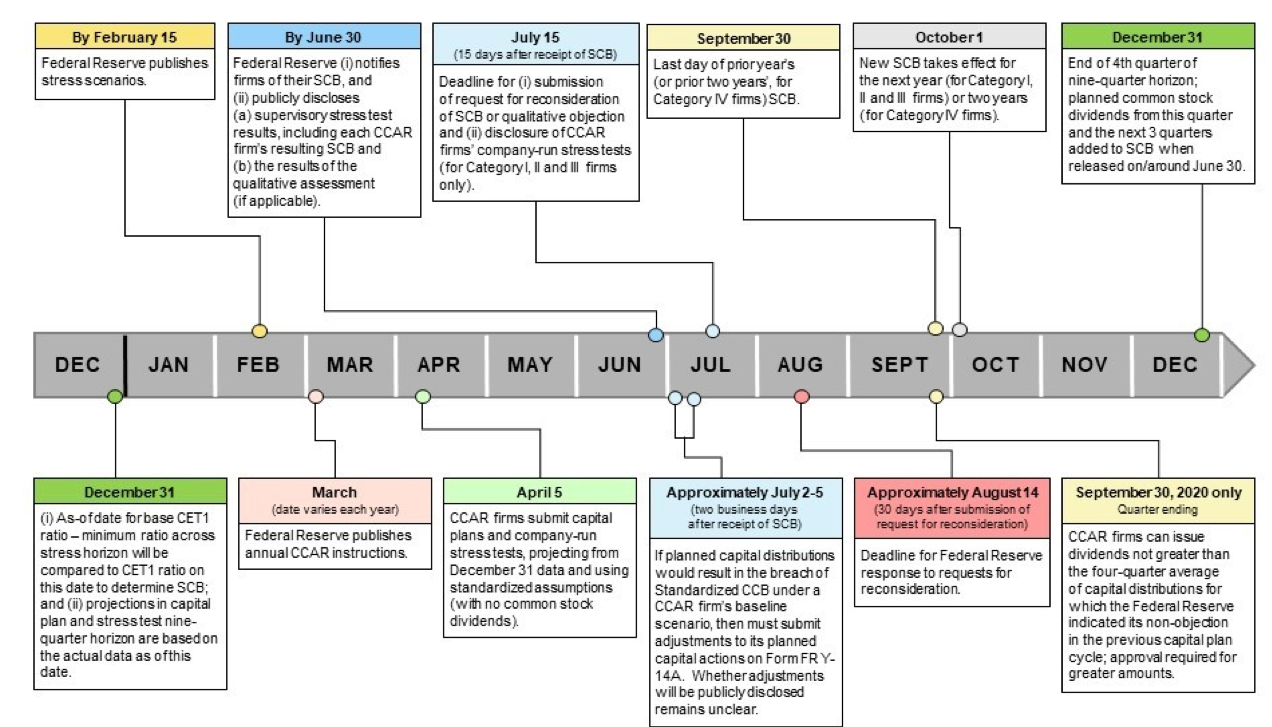
Included below are (i) an illustration (Figure 1) of the U.S. risk-based total capital and buffer requirements (including the stress capital buffer) as they compare to the Basel capital framework, (ii) a graphical timeline (Figure 2) for the annual implementation of the stress capital buffer and (iii) a summary of and certain key observations on the final rule.

Figure 1 – Stress Capital Buffer Comparison (maximum ratios shown)

Figure 2 – Stress Capital Buffer Timeline

Overview of the Final Rule

The stress capital buffer rule (“SCB rule”) purports to simplify the Federal Reserve’s current capital and stress testing requirements by tailoring the capital conservation buffer (“CCB”) to incorporate the post-stress losses of a subject firm (“CCAR firm”) under the Federal Reserve’s Comprehensive Capital Analysis and Review (“CCAR”).

  • Scope of Application. The SCB rule is relevant only for CCAR firms, e.:
    • bank holding companies (“BHCs”) with total consolidated assets of $100 billion or more; and
    • intermediate holding company subsidiaries (“IHCs”) of foreign banking organizations (“FBOs”), if the IHC has total consolidated assets of $100 billion or more.

These are the BHCs and IHCs identified in Categories I through IV under the Federal Reserve’s recently revised enhanced prudential standards.  Non-CCAR firms are not materially impacted by the SCB rule.  For non-CCAR firms, the capital conservation buffer remains a fixed 2.5% of common equity tier 1 (“CET 1”).

  • The Stress Capital Buffer and its Calibration. The SCB rule redesigns the CCB for CCAR firms by replacing the fixed 2.5% CCB with a dynamic and bespoke “stress capital buffer” (“SCB”).  A CCAR firm’s SCB will be recalibrated with each CCAR supervisory stress test (annually for Category I, II and III firms, and every other year for Category IV firms).  The SCB is the sum of:

(i)  the maximum projected decline in a CCAR firm’s CET 1 capital ratio (starting with the actual ratio as of December 31 immediately prior to the CCAR nine-quarter horizon) under the CCAR supervisory severely adverse stress scenario (expressed as a percentage of risk-weighted assets (“RWA”)), and

(ii) a CCAR firm’s planned common stock dividends for the fourth through seventh quarters of the nine-quarter CCAR planning horizon (expressed as a percentage of projected RWA for the quarter in the CCAR horizon in which the firm’s projected CET 1 capital ratio reaches its minimum under the supervisory severely adverse scenario).

The SCB would have a 2.5% floor.  Based on 2019 Dodd-Frank Act Stress Test (“DFAST”) results, the SCB for CCAR firms could have ranged between 2.5% and over 8%, although the median decline in CET 1 for all CCAR firms was approximately 3%.[1]

  • Elimination of the Quantitative “Pass/Fail”.
    • Under the SCB rule, the CCAR process largely becomes an exercise to establish and re-calibrate a CCAR firm’s SCB (each year for Category I, II and III firms, and every other year for Category IV firms), because it eliminates any quantitative objection or pass/fail component as a result of CCAR.
    • In this way, however, the rule transforms the “single-point-in-time” quantitative objection based on stressed forecasts into a day-to-day ongoing capital requirement. As a result, the CCAR quantitative assessment effectively remains, operationalized through the SCB as a daily requirement for CCAR firms to maintain their risk-based capital ratios above their post-stress buffer requirements in order to avoid restrictions on capital distributions.
    • The elimination of the quantitative objection is significant from a leverage capital perspective, as discussed in greater detail in the Key Observations below. Elimination of the quantitative assessment effectively removes the post-stress Tier 1 leverage and supplementary leverage ratio (“SLR”) requirements because a CCAR firm may breach these minimum requirements (4% and 3%, respectively) in the supervisory adverse stress scenario without “failing” CCAR, without being required to revise its planned capital distributions and without needing to increase its buffers.
    • In March 2019, the Federal Reserve eliminated the qualitative objection for most CCAR firms, including all U.S. BHCs. IHCs that are in the Large Institution Supervision Coordinating Committee portfolio or that are “large and complex” firms remain subject to the qualitative assessment for the 2020 CCAR cycle.  If most of these IHCs successfully pass the qualitative evaluation this year, they will no longer be subject to a potential qualitative objection.
  • Reconsideration Procedure.
    • Any CCAR firm will be able to submit a request for reconsideration of its resulting SCB (or qualitative objection, if any) within 15 calendar days of receipt of its SCB and CCAR results. The Federal Reserve intends to respond within 30 days of a request for reconsideration, but since a CCAR firm’s SCB will not take effect until October 1, the procedure could effectively give the Federal Reserve approximately three months to render its determination.
    • Prior to October 1, a CCAR firm will be able to continue to make capital distributions that were included in its last annual capital plan to which the firm received a non-objection.
  • What Happens After CCAR Calculation of the SCB?
    • Incorporation of the SCB into a Standardized Capital Conservation Buffer. The SCB will be incorporated into a broader buffer named the “standardized approach capital conservation buffer” (“Standardized CCB”).  All CCAR firms must calculate their risk-based capital ratios under the standardized approaches, including Category I and Category II firms that are subject to the advanced approaches and the so-called Collins Amendment.
    • The Standardized CCB calculation would be the aggregate of a CCAR firm’s:

(i)    SCB (floored at 2.5%);

(ii)  any countercyclical capital buffer (“CCyl  Buffer”) that may be in effect (for Category I, II and III firms); and

(iii) for global systemically important BHCs (“GSIBs”) only, the greater of the firm’s GSIB surcharge under method 1 (which aligns with the Basel capital framework’s GSIB surcharge) and method 2 (which reflects a firm’s reliance on short-term wholesale funding and generally results in a higher surcharge) (“U.S. GSIB Surcharge”).

    • Post-CCAR Adjustments to Planned Capital Distributions. Each CCAR firm must then review its own BHC baseline scenario and assess whether its planned capital distributions could still be accomplished, taking into account its new Standardized CCB.

If any planned distribution would cause a CCAR firm to dip into its Standardized CCB under its baseline scenario, the firm must:

(i)  reduce its capital distributions to ensure they would be permitted based on its baseline scenario; and

(ii) notify the Federal Reserve of such adjustments within two business days of receipt of its SCB by resubmitting the Form FR Y-14A summary schedule reflecting the SCB requirement and its reduced planned capital distributions.

Whether a CCAR firm’s adjustments to its planned capital actions would be subject to public disclosure is not clear from the 2020 CCAR instructions or the SCB rule, which provides that the Federal Reserve “may” release information related to such adjustments but does not require such disclosures.[2]  Under the current CCAR process, the Federal Reserve releases the post-stress capital ratios of all of the CCAR firms (both without and with a firm’s modifications to its planned capital actions to avoid a CCAR “fail”).

  • Ongoing Application of the Standardized CCB.
    • On a daily basis, CCAR firms are required to maintain the Standardized CCB above their minimum CET 1 risk-based, Tier 1 risk-based and total risk-based capital requirements. If any one of a CCAR firm’s risk-based capital ratios dips into the Standardized CCB zone, the firm will become subject to increasing restrictions on its capital distributions and discretionary bonus payments.
    • The rule applies the Standardized CCB only at the level of the top-tier consolidated BHC and/or IHC, and thus does not change the application of the current static 2.5% CCB to a CCAR firm’s insured depository institution (“IDI”) subsidiaries. In addition, non-CCAR firms will continue to apply the static 2.5% CCB.
    • The nine CCAR firms that are subject to the “advanced approaches” capital calculation methodologies (e., the U.S. GSIBs in Category I and the U.S. institution subject to Category II) are also subject to an advanced approaches capital conservation buffer (“Advanced CCB”) above their advanced approaches minimum requirements. The calibration of the Advanced CCB is identical to the Standardized CCB, but instead of incorporating the SCB, the Advanced CCB includes a fixed 2.5% CET 1 requirement (i.e., the current CCB).   The maximum payout ratios are consistent across the various capital buffers, including the Standardized CCB, Advanced CCB and enhanced supplementary leverage ratio buffer.
  • Restrictions on Distributions Applicable in the Buffer Zone.
    • The SCB rule does not alter the general framework that requires incremental restrictions on distributions and bonus payments as a firm falls further into the Standardized or Advanced CCB range.
    • However, the SCB rule revises the definition of “eligible retained income” in an effort to address the potential for a dip into the buffer zone to result in an immediate decrease in distributions and bonus payments to a very low amount or to zero, primarily in the scenario where a banking organization has distributed all or a significant amount of its retained earnings over the last four quarters.
      • For a CCAR firm with an SCB greater than the 2.5% floor, its potential restrictions on distributions and bonus payments will be based on the firm’s average net income for the preceding four quarters (without regard to distributions or tax effects) as calculated in accordance with the FR Y-9C instructions (rather than the aggregate of the previous four quarters of net income, adjusted to reflect distributions and associated tax effects not already reflected).
      • A CCAR firm subject to a 2.5% SCB or a non-CCAR firm will not benefit from this change.
  • Elimination of Prior Approval for Distributions. In a change from the proposal, the SCB rule provides CCAR firms with flexibility to increase their planned capital distributions in excess of the amount included in their capital plans without prior approval, provided that such distributions would not cause the firm’s capital ratios to breach its buffers.  However, CCAR firms must notify the Federal Reserve of any distribution not previously included in its capital plan within 15 calendar days following the distribution.  In addition, the rule would not change the prior approval requirements that continue to apply to redemptions of Additional Tier 1 or Tier 2 capital instruments.
  • Income Limitation on Dividends Revised. The rule also clarifies that the Federal Reserve will no longer apply heightened scrutiny to planned dividends that would exceed 30% of a CCAR firm’s after-tax net income available to common shareholders, primarily because CCAR firms must effectively prefund their dividends, through their SCB, for the intervening year between CCAR cycles.  This limitation was not part of the stress testing regulations, and had previously only been highlighted in the Federal Reserve’s instructions and guidance to CCAR firms.
  • Distinction Between CCAR and DFAST Collapsed. The SCB rule collapses the prior distinction between the DFAST and the CCAR supervisory stress tests in several ways:
    • As a procedural matter, the SCB rule eliminates the current multi-step process whereby the Federal Reserve (i) runs the DFAST supervisory stress test based on assumed standardized capital actions, (ii) discloses the DFAST supervisory stress test results publicly, (iii) discloses confidentially to the CCAR firms their CCAR stress test results incorporating planned capital actions, (iv) provides the CCAR firms with the opportunity (typically over a weekend) to modify their planned capital actions and submit revised data and (v) later discloses publicly the CCAR stress test results (including both the “before” and “after” results from the CCAR firms’ modifications to planned capital actions).
    • Under the SCB rule, a new timeline for CCAR results applies, as illustrated in Figure 2 above. CCAR firms will continue to submit their planned capital actions for the nine-quarter stress horizon, but the Federal Reserve will:
      • run its supervisory stress test in the severely adverse scenario using only the DFAST assumptions (which have been modified under the SCB rule by, among other things, including an assumption that no common stock dividends are issued during the nine quarters), and
      • use the result of its supervisory stress tests to size a firm’s SCB requirement.[3]
    • The SCB rule places more responsibility in the hands of each CCAR firm, particularly because there is no pass/fail component. Each CCAR firm will, as noted above, take its SCB and apply it to its own planned capital actions under its own baseline scenario to determine if the capital actions could be undertaken without causing the firm to breach its new buffers.
  • Revisions to CCAR Assumptions.
    • Capital Actions. By collapsing the DFAST and CCAR stress tests, the SCB rule does not incorporate planned capital actions into the stress test, thus eliminating an irrational assumption in the CCAR test that a firm would carry out nine quarters of its planned capital actions even under stress and even when applicable buffer requirements would make such distributions impossible.

A CCAR firm will, however, include in its SCB and its Standardized CCB (i.e., “prefund”) four quarters of planned common stock dividends (but not repurchases or redemptions).  However, as with the current DFAST assumptions, the Federal Reserve will assume that payments (equal to the stated dividend or contractual interest or principal due in a quarter) on all outstanding Additional Tier 1 and Tier 2 capital instruments will continue uninterrupted.  Therefore, in effect, these payments will be enveloped within the capital reductions that become part of the firm’s SCB, and effectively prefunded across the nine-quarter horizon through a different mechanism.

    • Static Balance Sheet. In CCAR exercises up to this point, the Federal Reserve has projected each firm’s balance sheet in the supervisory stress test using models that assume that banks will respond to increased credit demand in a stress scenario, typically by increasing lending and thereby increasing a firm’s total assets.  Recognizing the unrealistic nature of this assumption, the SCB rule revises the models to include an assumption that firms maintain a constant level of assets over the stress test horizon.

Additionally, the rule provides an assumption that a firm’s leverage ratio denominator and total RWA would generally remain unchanged over the planning horizon.

    • Material Business Plan Changes. In a simplifying change from the proposal, the SCB rule does not incorporate material business plan changes in a firm’s SCB requirement. For example, planned issuances of common or preferred stock in connection with a planned merger or acquisition (and their associated dividends) need not be included in a firm’s nine-quarter projections.  A firm’s capital plan should nevertheless describe the changes.  The Federal Reserve indicated that such issuances will be taken into account when they actually occur, and a CCAR firm may be required to resubmit its capital plan (with the potential for a recalibrated SCB) if the changes are material.
    • Different Assumptions for Company-Run Stress Tests. The 2020 CCAR instructions provide that for the 2020 company-run stress tests, firms should follow the capital action assumptions set forth in the stress test rules as of the April 6, 2020 submission date of their capital plans.  However, for the supervisory stress tests, the Federal Reserve will use the capital action assumptions set forth in the SCB rule. Accordingly, the CCAR instructions and the preamble acknowledge that, for 2020, the results of the company-run and supervisory stress tests will not be comparable.[4]
  • Revisions to Regulatory Reports. The SCB rule also modifies two reports, the Consolidated Financial Statements for Holding Companies Report (FR Y-9C) and the Capital Assessments and Stress Testing Report (FR Y-14A), to collect information regarding the SCB requirement.
    • FR Y-9C. The proposal would add line items to collect the information necessary to monitor a firm’s performance quarterly, including information regarding a firm’s SCB, U.S. GSIB Surcharge, CCyl Buffer, Standardized CCB, Advanced CCB, eligible retained income and capital distributions.
    • FR Y-14A. The SCB rule adds line items to collect (generally annually) similar information necessary to evaluate planned capital actions under a firm’s baseline scenario.  A firm is required to report its capital distributions on the FR Y-14A filed under its initial capital plan on April 5 and, if the firm decides to reduce its planned distributions as a result of its review of its SCB, the firm will use the FR Y-14A to resubmit adjusted numbers within two business days.
  • Effective Dates.
    • A CCAR firm’s SCB requirement will be effective on October 1 of each year and remain in effect for a full calendar year for Category I, II and III firms. The Federal Reserve stated definitively that the SCB rule will be effective by the time of release of CCAR results in June 2020, and therefore each CCAR firm’s first SCB will be in effect from October 1, 2020.
    • Because Category IV firms are subject to CCAR only every other year, their SCB remains effective for two years. This year (2020) is a CCAR year for these firms, so their first SCB will also be in effect from October 1, 2020.
    • The new annual CCAR cycle timeline is depicted in Figure 2 above.

Key Takeaways

  • Stress leverage buffer and post-stress leverage requirements eliminated. As Vice Chair Quarles previewed in a September 2019 speech, the final rule does not include the proposed stress leverage buffer requirement.  However, perhaps more significantly, the final rule eliminates Tier 1 post-stress leverage requirements that currently apply to CCAR firms as a function of the quantitative assessment, which is eliminated under the final rule.
    • Elimination of Tier 1 post-stress leverage requirements may allow firms to reduce their Tier 1 management buffers. Because the final rule eliminates the quantitative pass/fail assessment, and the SCB will not include any leverage component, a CCAR firm that does not maintain a Tier 1 or SLR above the minimum requirements (4% and 3%, respectively) under the CCAR supervisory severely adverse stress scenario would not face any self-executing restrictions on its ability to make capital distributions.  Accordingly, the SCB rule would appear to permit firms to reduce their management buffers with respect to Tier 1 requirements as Governor Brainard suggests in her dissent—in other words, if a CCAR firm’s Tier 1 capital fell below the Tier 1 leverage or SLR requirements under the prior CCAR regime, it would have “failed” CCAR on quantitative grounds and therefore would have been required to resubmit its capital plan with commensurate reductions in its planned capital distributions.
    • However, Federal Reserve Vice Chair Quarles notes in his statement supporting the rule that “eliminating the post-stress leverage measure removes [incentives to hold riskier assets], but does not reduce the amount of [required] common equity capital by one jot.”
    • In addition, the rule would not change the enhanced supplementary leverage ratio (“eSLR”) requirements that apply to GSIBs (a 2% buffer, resulting in a 5% SLR requirement at the parent holding company level, and a requirement at the IDI subsidiary level to maintain an SLR of 6% to be considered “well-capitalized”). The eSLR may only be satisfied with Tier 1 capital. The eSLR proposal that was released in conjunction with the SCB proposal in April 2018 would replace the current static 2% eSLR buffer with a dynamic measure based on 50% of the firm’s U.S. GSIB surcharge (the higher of method 1 and method 2).  The Federal Reserve has yet to indicate a timeline for when or whether these proposed modifications to the GSIB buffer will be finalized.
  • SCB should reduce Tier 1 capital requirements for most CCAR firms although CET 1 requirements for GSIBs will increase. The impact assessment accompanying the SCB rule generally indicates required Tier 1 capital levels will decline in the aggregate across CCAR firms in Categories II, III and IV by approximately $49 billion (a 12% decrease relative to current requirements) and CET 1 levels will decline in the aggregate by $35 billion (a 10% decrease).  For the U.S. GSIBs, Tier 1 capital levels are not expected to change, while aggregate CET 1 levels are expected to increase by $46 billion (a 7% increase).  Governor Brainard’s dissent attributes projected declines in required Tier 1 and CET 1 capital to “the rule’s substantial reduction in the requirement to prefund distributions [other than four quarters of dividends] and, to a lesser extent, the elimination of any stress leverage requirement (for tier 1) and the assumption of a flat balance sheet.”
    • The increase for GSIBs arises because the rule effectively incorporates the U.S. GSIB Surcharge as an additional buffer over and above the SCB. In contrast, the current approach does not require CCAR firms to satisfy the GSIB buffer in stress conditions—a CCAR firm must only maintain its capital above the Basel III minimum levels across the nine-quarter horizon.  Therefore, in past CCAR exercises, the capital maintained to keep a CCAR firm’s ratios above those minima “counted” toward satisfaction of the U.S. GSIB Surcharge from a day-to-day compliance perspective.  Under the final rule however, the U.S. GSIB Surcharge will effectively be applied “post-stress” since it sits “atop” the SCB as a component of the new Standardized CCB—in other words, capital needed to satisfy the SCB on a day-to-day basis will now be in addition to capital needed to satisfy the U.S. GSIB Surcharge.
    • The Federal Reserve rejected commenters’ concerns that the SCB would be redundant with the U.S. GSIB Surcharge. The Federal Reserve also dismissed commenters’ requests to consider changes to the U.S. GSIB Surcharge as part of the SCB rulemaking.
  • Dividend prefunding requirement preserved. The dividend prefunding requirement remains unchanged from the proposal despite prior remarks by Vice Chair Quarles that indicated he supported its elimination in favor of either (i) activating the CCyl Buffer in a manner similar to the 1% CCyl Buffer that is currently applicable under standard risk conditions in the United Kingdom, or (ii) raising the floor of the SCB from 2.5% to 3%.  Neither of these alternatives was adopted, or even alluded to, in the preamble.
    • Adverse Impact for IHCs Disregarded. Moreover, the SCB rule summarily dismissed commenters’ concerns regarding the dividend prefunding requirement and its particularly punitive impact on IHCs, which unlike the publicly traded CCAR firms, often deploy dividends instead of share repurchases (which are not subject to the prefunding requirement) because of their nature as subsidiary organizations.  For that reason, an IHC’s dividends to its parent also tend to be significantly larger relative to its capital base than a domestic BHC’s ordinary dividends to public shareholders.  Therefore, the dividend prefunding requirement has the potential to inflate inappropriately the SCBs of IHCs.
  • Interplay with the CCyl Buffer. Although Vice Chair Quarles had indicated in prior statements that the Federal Reserve had been considering the implementation of a non-zero CCyl Buffer in the United States as an alternative to the dividend prefunding requirement, the preamble includes no discussion of the level of CCyl Buffer, which is generally determined on an interagency basis annually.  No announcement has been made confirming that the CCyl Buffer will remain at 0% for 2020, although a statement regarding the level of the CCyl Buffer for the coming year is generally made in the first quarter.[5]  The Federal Reserve rejected commenters’ requests to eliminate the CCyl Buffer if the SCB is adopted and dismissed assertions that the CCyl Buffer is redundant with the SCB.  The preamble reiterates that the CCyl Buffer is a macroprudential tool intended to strengthen the resiliency of financial firms and the financial system, by allowing the Federal Reserve to raise capital standards when credit growth in the economy becomes excessive, a prospect that seems increasingly unlikely in the near term given the adverse economic impacts of COVID 19,[6] particularly with the Federal Reserve’s recent announcement encouraging banks to dip into their capital buffers as they lend to borrowers affected by COVID 19.[7]  It is unclear how and whether this announcement will affect the ultimate implementation and effectiveness timeline of the SCB rule.
  • Mandatorily convertible LTD issued under the TLAC rule not recognized for purposes of SCB requirements. The Federal Reserve declined commenters’ requests to permit recognition of eligible internal long-term debt issued by IHCs to satisfy TLAC requirements as CET1 for purposes of the SCB, given its mandatory conversion feature.  The preamble notes that “providing [such IHCs] greater flexibility to satisfy the buffers would be inconsistent with the general principle that larger and more systemic firms be subject to more stringent and risk-sensitive requirements.”  In addition, the Federal Reserve noted that “the loss-absorbing capacity of long-term debt issued under the [Federal Reserve’s] TLAC rule is not identical to the loss-absorbing capacity of CET1 capital as the way in which long-term debt could absorb losses varies by circumstance.”

However, the preamble did not address the potential for convertible instruments more generally to be deemed CET 1 for purposes of CCAR if such instruments were issued by a broader set of institutions.  While the Federal Reserve could have used the preamble to shut down entirely the possibility that convertible instruments could be recognized on an as-converted basis in future supervisory stress tests, it seems notable that the preamble did not take that approach.

The SCB rule does not alter the TLAC buffers for U.S. GSIBs and IHCs that have been in place since 2019.  If covered firms breach these buffers, they would also become subject to restrictions on capital distributions (even while remaining above the applicable SCB).       

ENDNOTES

[1] Federal Reserve, Dodd-Frank Act Stress Test 2019: Supervisory Stress Test Methodology and Results, p. 27.

[2]  12 CFR 225.8(h)(5).

[3] The SCB rule provides that the Federal Reserve “will provide a [BHC] with notice of its stress capital buffer requirements … by June 30” which is also same date the CCAR instructions provide as a deadline for the Federal Reserve’s publication of the CCAR results.  Accordingly, it is unclear whether CCAR firms will be notified of their SCB before its publication in the CCAR results.

[4] 2020 CCAR Instructions, p. 15; Preamble to the SCB rule, p. 34.

[5] The Federal Reserve policy statement on the CCyl Buffer indicates it expects to consider at least once per year the applicable level of the U.S. CCyl Buffer.  12 CFR Part 217, Appendix A.  The Federal Reserve’s most recent determination to maintain a CCyl Buffer of 0% was made in March 2019. See https://www.federalreserve.gov/newsevents/pressreleases/bcreg20190306c.htm.

[6] For example, on March 11, 2020, the Bank of England cut its CCyl Buffer from 1% to 0%, (after previously announcing a target of for its CCyl Buffer of 2% by the end of 2020). The Danish Finance Ministry has announced a similar reduction in its CCyl Buffer from 1.5% to 0%.

[7] Federal Reserve Actions to Support the Flow of Credit to Households and Businesses (Mar. 15, 2020), https://www.federalreserve.gov/newsevents/pressreleases/monetary20200315b.htm.

This post comes to us from Cleary, Gottlieb, Steen & Hamilton LLP. It is based on the firm’s memorandum, “Federal Reserve Finalizes “Stress Capital Buffer,” dated March 16, 2020, and available here.

Categories
M & A

A “Majeure” Update on COVID-19 and MAEs

Beyond the extraordinary human toll it continues to exact, the coronavirus has thrown a pall of uncertainty over hundreds of corporate transactions that were signed and waiting to close at the pandemic’s onset. As we noted in our previous Blue Sky Blog post, an important factor for understanding the fate of these deals is the structure and scope of their force majeure provisions, known in transactional jargon as MAC/MAEs (henceforth ‘MAEs’). Our analysis utilized text analysis tools to evaluate historical data of MAEs in a population of M&A deals spanning more than a decade and a half (January 2003 – March 2018). Readers interested in reviewing our initial results or additional background information should refer to that original post.

Because our prior analysis made use of historical data from an unrelated project, it did not permit us to look directly into the estimated half-trillion dollars’ worth of pending transactions that are currently waiting to close. Fortuitously, however, multiple shelter-in-place mandates have materially shocked our own opportunity costs of time; and we made use of the current lull to update our data set (reluctantly forgoing other worthy pursuits). In this follow-up post, we present results from an extended data set, now spanning 2003 through March 20, 2020 (and consisting of 1702 announced transactions).

We focused our instant data collection efforts on transactions announced after the end point of our original sample (March 2018), limiting our query (as before) to deals with transaction values exceeding $100 million. Our primary source for candidate deals (FactSet) rendered 745 such transactions over that time span, including several for which transaction documents were not publicly available. From this group, we located the definitive agreements and MAE terms for 574 announced deals. In turn, this subgroup includes just under 80 pending deals signed since October 1, 2019 and representing over $250 billion in value. (There are also well over 200 more pending transactions with no filed deal documentation as of this writing).

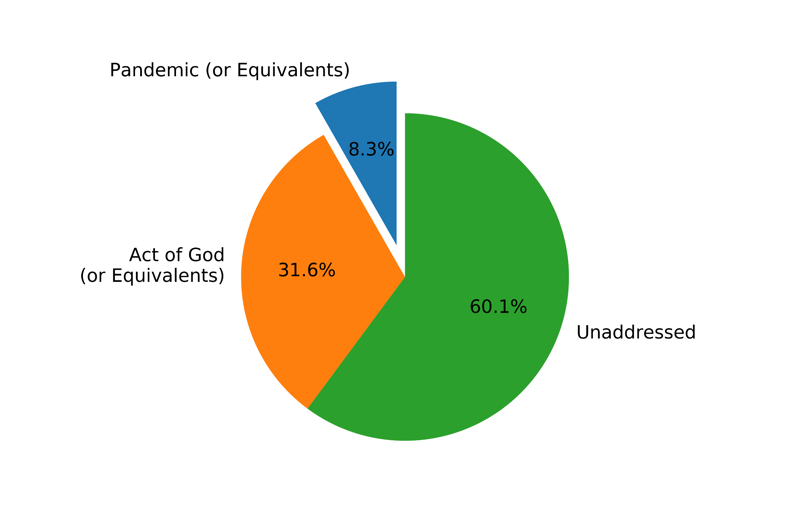
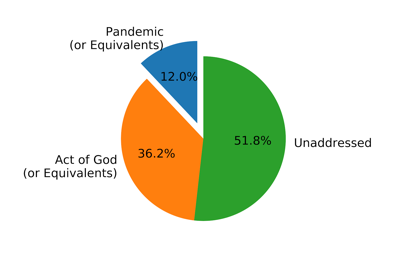
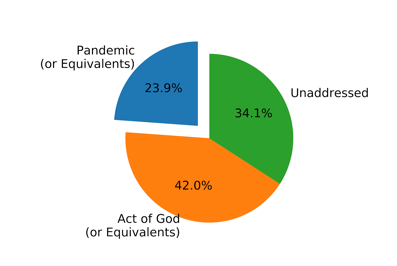
A key area of inquiry in our prior post was the fraction of MAE provisions that either (a) explicitly carve out “pandemics” (and semantic equivalents) or (b) arguably do so using general language (such as “act of god”). Our original post’s breakdown is reproduced in the left panel of the figure below; the center panel reflects our full updated data set in its totality; and the right panel reflects currently-pending deals.

A. Original Data Set (2003-18) B. Updated Data Set (2003-Pres.) C. Currently Pending Deals

As the sequence of panels illustrates, both explicit and general carve-outs have grown to comprise a larger share of MAEs in our updated data set: Fully 12% of deals overall carve out pandemic (or pandemic-like) contingencies explicitly, and just over 36% provide general carve-outs (compared with 8% and 32%, respectively, in our original analysis). The burgeoning role of carve-outs is even more pronounced in pending deals, where explicit and general carve-outs account for 24% and 42% of the MAEs, respectively. Significantly, and in stark contrast to our original post, fewer than 40% of provisions have neither type of carve-out.

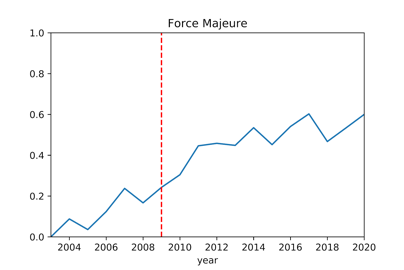
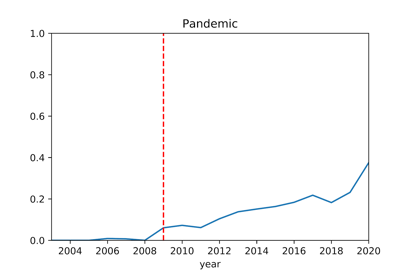
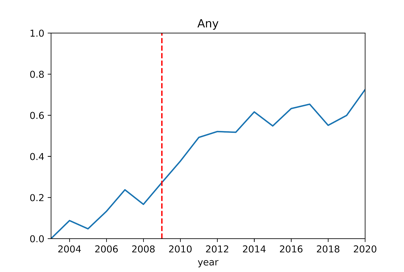
Digging a little deeper, it becomes evident that the shift in carve-outs betrays a longer trend whose seeds were sown over a decade ago. The time series charts below track the year-by-year prevalence of general carve-outs (left panel), pandemic-specific carve-outs (center panel), and their union (right panel) since 2003. General force majeure carve-outs became significantly more prevalent around 2009 − coinciding with the emergence from the great recession (well, at least the last one). But note that pandemic-specific carve-outs also started to go viral at around the same time (having been virtually non-existent prior to 2009). Although global economic conditions had much to do with the rapid adoption of general force majeure language, the pandemic-specific trend was more likely a byproduct of the contemporaneous H1N1 crisis that unfolded during the spring of 2009. And this fraction continued to rise through the two waves of the MERS crisis (first in 2012 and then again in 2015). By 2019, fully 23% of deals specifically carved out pandemics from coverage in the MAE.

A. General Carve-Outs B. Pandemic-Explicit Carve-Outs C. General or Explicit Carve-Outs

As we noted in our previous post, carve-outs (both general and pandemic-specific) come with a sizable grain of lawyerly salt: for even as they purportedly exempt a laundry list of enumerated risks, most carve-outs proceed to carve back in aspects of those same risks through “disproportional effects” language − whereby an excluded contingency still counts as a force majeure if the target suffers hardships that are disproportionate to those of its industry peers. Although we are still in the process of identifying all such carve-ins in the new data (whilst continuing to shelter in place), preliminary analysis suggests that carve-in patterns have largely remained stable. The figure below measures the prevalence with which MAE terms invoke a “disproportional effects” modifier after an enumerated carve-out. The left panel represents our original data, while the right panel illustrates our full data set of deals from 2003-present. The relationships appear highly comparable; if anything, disproportional effects carve-ins appear to be mildly more prevalent in the updated data set than in our original data set. Thus, while carve-outs have no doubt become more prevalent over time, a portion of their impact has been blunted mechanically by carve-ins that are typically riding shotgun.

A. Disproportional Effects Carve-In Original Data Set (2003-18) B. Disproportional Effects Carve-In Updated Data Set (2003-Pres.)

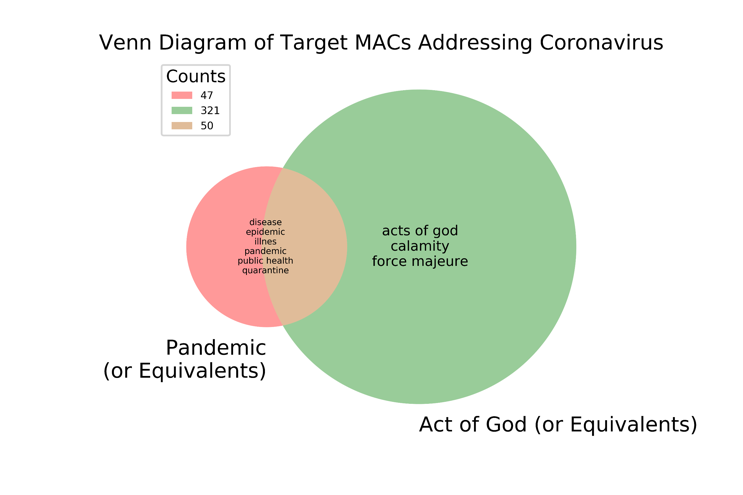
On a related front, our prior post documented that when a pandemic-specific carve-out is invoked in an MAE, it is accompanied about 50% of the time by a general provision (such as “act of god;” see left panel below). The overlap between specific and general carve-outs has also mutated somewhat in recent years. Of the MAE definitions in the deals of our updated data set that have a pandemic-specific carve out, 57% are also chaperoned by more general force-majeure language. This observation suggests that when pandemic-specific language is invoked, it is increasingly being used to exemplify a general carve-out rather than as an independent, stand-alone risk.

A. Original Data Set (2003-18) B. Updated Data Set (2003-Pres.)

Although it is easy to get caught up in the semantic structure of MAE provisions (and the three of us are admittedly hip deep), it is important not to lose sight of the broader institutional setting that frames these disputes. Some relevant considerations include the following:

  • Judicial Reticence. By any account, common-law courts aren’t pushovers when it comes to nullifying contractual obligations. Contract law has long resisted the temptation to rescue a regretful party once foundational risk allocation decisions seem locked in. This canonical attribute of contract law carries over to M&A, too: for at least two decades, Delaware courts have consistently held that buyers wishing to bail out of a deal “ought to have to make a strong showing to invoke a Material Adverse Effect”.
  • Burdens of Proof.  Consistent with the foregoing view, MAEs are generally interpreted by courts to constitute conditions subsequent to the obligation to close (rather than as conditions precedent, as many often mis-label them). The key upshot of this designation is that the initial burden of proof to invoke an MAE rests squarely on the shoulders of the party alleging excuse (almost always the buyer). And if the underlying evidentiary case is unclear, or if competing arguments produce an approximate stalemate on the merits, then the case is resolved in favor of the party seeking enforcement of the contract (usually the seller).
  • Durational Significance. One of the few consistent lodestars in existing MAE jurisprudence is that the target’s unanticipated hardship must be durationally significant, and not merely a hiccup in revenues or earnings over a quarter or two. But the economic dislocation caused by COVID-19 is so fresh and unfamiliar that reliable forecasts of long-term implications are largely impossible. (The historic and careening volatility in the financial markets of late ably attests to this fact.) And thus, as of this writing at least, most buyers are likely to find themselves unable to scare up the evidence needed to carry their burden of proving a durationally significant adverse effect in the post-COVID world.
  • Precedential Tea Leaves. Finally, as we noted in our prior post, the time span of our original data set also coincided with an era in which no Delaware opinion had ever found an MAE to have been triggered. Like many other hot streaks, however, this one eventually came to an end in the fall of 2018, with the Chancery Court’s Akorn v. Fresenius opinion. The precedent has no doubt bolstered the confidence of rueful buyers in pending deals who are now contemplating invoking their MAEs. (And we note in passing that the MAE in Akorn specifically carved out pandemics, subjecting the exclusion to a “disproportionate effects” carve-in.) Nevertheless, it is important to understand that while Akorn no doubt sent a message that the “MAC is Back” as a front-line issue for M&A doctrine, the underlying facts of the case diverge considerably from current circumstances (involving highly target-specific issues pertaining to regulatory clearance and outright regulatory fraud).

In the light of above points, we conjecture that the average buyer will face a heavy slog in asserting that COVID-19 represents a deal-killing force majeure, even when the MAE contains no carve outs for pandemics (general or specific). The odds grow longer still, of course, in the presence of such carve-outs.

So this must imply that savvy acquirors need to abandon all plans to declare an MAE, right? Not so fast: notwithstanding the uphill battle (and long odds) faced by buyers asserting MAEs, we can think of several reasons why rational and sophisticated parties might still pursue this strategy:

  • First, pressing the MAE issue can buy precious time for the acquiror. Although MAE litigation moves substantially faster in Delaware Chancery Court than does commercial litigation in other venues, the process is still far from instantaneous. Moreover, the temporary closure of courthouses in Delaware and potential delays in litigation schedules due to the outbreak may well lead to unusually protracted timelines. That, in turn, could afford buyers an opportunity to amass additional evidence about the durational significance of the COVID-19 crisis (while preserving the option to abandon the strategy down the road).
  • Second, even if the current saga proves to be short-lived, it is already raising fears of a medium-term liquidity crunch. The potential delaying effect of an MAE kerfuffle can also be a hidden source of liquidity for cash buyers, at least until the current market tumult resolves and a greater sense of order returns to capital markets.
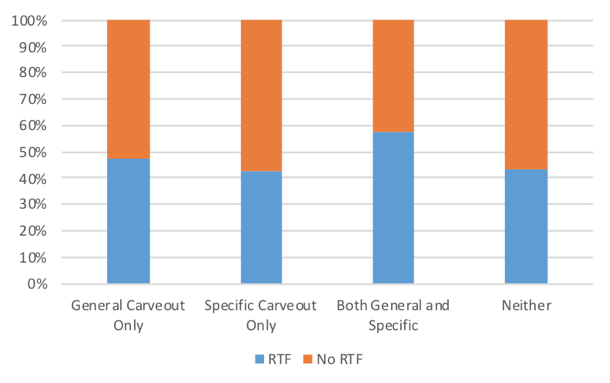
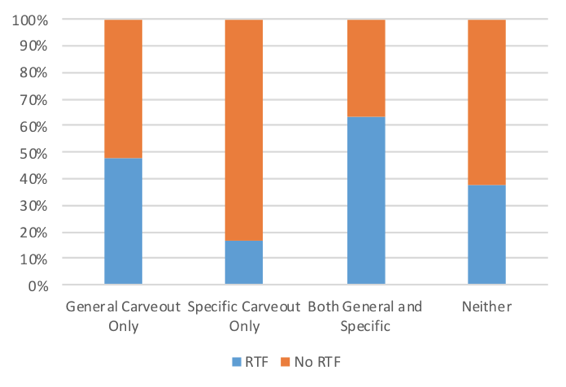
  • Finally, invoking the MAE may be part of a larger portfolio of strategies that buyers might deploy in attempting to walk from − or potentially restructure − a signed deal. Several other strategies suggest themselves too, including asserting the failure of other closing conditions (related to, inter alia, financing, regulatory clearance, solvency, and tax status). Moreover, in many deals acquirors could conceivably threaten a backup strategy of using a “reverse termination fee” (“RTF”) to permit them to exit a deal in exchange for paying what amounts to liquidated damages to break away. The figures below plot the prevalence of reverse termination fees as a function of each type of MAE carve-out, concentrating on both all deals in our data set (left panel) and pending deals (right panel). As illustrated in the figures, RTFs appear to be most common in deals where there are both general and specific carve-outs − i.e., those deals that would (all else held constant) be least amenable to granting force majeure walking rights. Moreover, the deals that have neither general nor specific carve-outs for pandemic risks tend on the whole to be less likely to offer RTFs to compensate.
A. Prevalence of RTFs by Carve-Out Type (2003-Pres) B. Prevalence of RTFs by Carve-Out Type (Pending Deals; 3/2020)

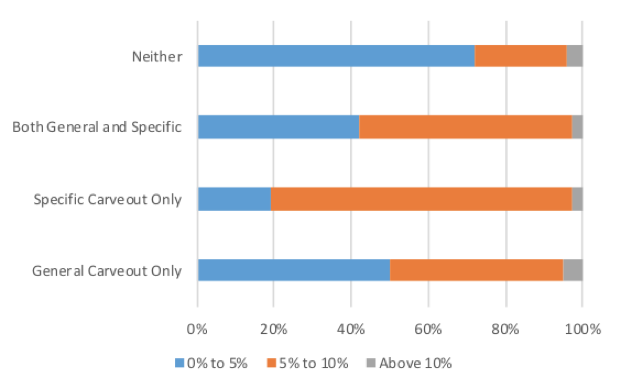
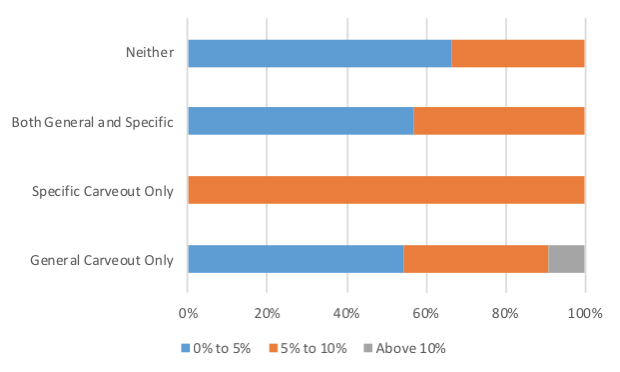
For the deals that include RTFs, one can drill further to assess the relative size of the RTF (as a percentage of the transaction value) by carve-out type. As the figures below demonstrate, RTFs tend to be the lowest when there is neither a general nor a specific carve out. Recall that this same group as a whole was relatively less likely to have an RTF to begin with. On the whole, then, RTFs and MAEs tend to operate as weak substitutes for one another; but there is still ample room for many buyers to use them together as part of a multi-pronged approach to busting up a deal (or, more likely, to get it restructured).

A. Size of RTF by Carve-Out Type (2003-Pres.) B. Size of RTF by Carve-Out Type (Pending Deals, 3/2020)

We close by reminding readers that notwithstanding the seductive allure of hard statistics to describe MAE provisions, this area of law remains − much like force majeure terms themselves − relatively opaque and open to competing arguments. We doubt that this core feature (or is it a bug?) will resolve itself any time soon. Unless and until that happens, practitioners and observers should continue to pay close attention not only to the internal coherence of their own MAEs, but also to how they compare with the overall landscape of rapidly mutating contractual practices.

This post comes to us from professors Matthew Jennejohn at Brigham Young University Law School, Julian Nyarko at Stanford Law School, and Eric Talley at Columbia Law School.

Categories
Securities Regulation

SEC Chairman on the Essential Connections Among Markets, Businesses, and Workers in the Time of Covid-19

Over the past several weeks, my colleagues at the SEC, other regulators, elected officials, market participants and others have asked my views on the functioning of our capital markets, and the importance of those markets, in the context of our fight against COVID-19.[1]  In response, I have stated that, to the extent possible, our markets should function through challenging and uncertain economic times.  In certain cases, I have elaborated on the basis for my views.  Because we are being called upon to make various decisions and provide advice to other decision makers in response to COVID-19, I believe it is appropriate to share broadly my perspective on our ongoing efforts to navigate this complex national challenge.

* * *

The Securities and Exchange Commission and other financial regulators are focused on two overriding and interrelated issues.  First, we are facing an unprecedented national challenge—a health and safety crisis that requires all Americans, for the sake of all Americans, to significantly change their daily behavior and, for many, to make difficult personal sacrifices.  Second, the recognition that the continuing, orderly operation of our markets is an essential component of our national response to, and recovery from, COVID-19.

The interrelationship between these issues cannot be overstated.  Our health care, pharmaceutical, manufacturing, transportation, telecommunications and many other private-sector industries are critical to our collective response to COVID-19.  The thousands of firms and entrepreneurs in these industries — and the millions of employees and contractors — that are working around the clock to fight COVID-19 depend on continued access to payments and credit.  More specifically, each hospital system, personal protective equipment manufacturer, trucking company, grocery chain, gas station and cleaning service must make and receive countless payments.  In the vast majority of cases, these payments—and the confidence that they will be received—depend on the provision of credit from our banks and our capital markets which, in turn, depend on flows of capital more generally.

This dynamic between consumers and essential industries, on the one hand, and financial services and markets, on the other hand, does not stop with the private sector.  Many state and local governments, who play pivotal roles in the provision of health care, transportation, and public services, including  supplying our doctors, nurses, first responders and other heroes on the front lines, depend on continued access to financing through our banking system and the municipal finance markets.

The importance of market function in this time of collective commitment goes beyond our health care, pharmaceutical and medical research activities.   To most effectively respond to COVID-19, as we shift vast resources to our healthcare and related industries to address those in need, we are simultaneously pulling back from many other businesses and industries to limit those who will be in need.  Air transportation, lodging, restaurants and live entertainment are among the industries most acutely affected.  Employees and contractors in these and many other sectors, and their loved ones who depend on them, are facing hardship and uncertainty.  Today, through no fault of their own, many of these individuals and businesses will need assistance to meet rent, payroll and many other cash needs.  We all recognize the potential personal and societal fallout if these needs are not addressed and I welcome the efforts of the Administration and Congress to provide funds to workers and businesses to bridge this funding gap.  Bridging those gaps, and doing so while keeping as many workers connected to their employers as is practicable, will enhance our efforts to fight, and recover from, COVID-19.

To be sure, we also are mindful of tomorrow.  An immediate, effective response to COVID-19 requires substantial portions of our economy to function at full throttle, other sectors to function in different ways (e.g., telework) and more moderately, and some sectors to stand down.  Our markets, and our policies, should support this tailored, multi-faceted, time-limited approach.  And, just as COVID-19 has caused us to alter our economic activity by industry and region, we must, consistent with a continuing commitment to health and safety, prepare to thoughtfully and incrementally increase economic activity by industry and region.  When that time comes—and here we should take our cues from health authorities and local and national leaders—we will benefit from maintaining the continuing function of our financial markets, and preserving the interconnections among of our industries and our workers, throughout this period of shared responsibility.

In short, preserving the flows of credit and capital in our economy – to businesses and individuals alike — will help us better fight COVID-19, as well as speed and strengthen our recovery.

ENDNOTE

[1] I have previously stated that the effects of COVID-19 on our society, our economy and our markets are unprecedented and uncertain. This statement provides my current, personal views which I expect will continue to evolve as we learn more about COVID-19 and its effects.  I thank the women and men of the SEC for their devotion to the Commission, its mission, our markets and our investors during this challenge, and I have benefited greatly from their experience, analysis and counsel.

This statement was issued on March 24, 2020, by Jay Clayton, chairman of the U.S. Securities and Exchange Commission.

Categories
Finance & Economics

Operational Failures and Financial Crises

Past financial crises have been characterized by panics, runs, and restrictions on the availability of credit, and our crisis prevention measures (including capital regulation, deposit insurance, and the lender of last resort) have been adopted in light of this historical experience.[1]  These forms of financial stability regulation pay limited attention to operational risks, however, and as the technologies by which financial services are delivered become increasingly complex, operational risks may become a transmission mechanism as well as a source of financial distress.  In the future, financial crises may look more like a rolling blackout than a bank run.

Take the processing of retail payments, for example.  Increased attention is being devoted to the possibility that a cyberattack could incapacitate payment processing, but not enough attention is being paid to the fact that the same outcomes could arise from the interactions of technological glitches – even in the absence of nefarious actors.  Imagine, for example, that a payments provider succumbs to a software bug that prevents it from transmitting payment instructions from payer to payee – that provider might try to route its customers’ payment orders to a second payments provider while the bug is being fixed, but the second provider may simultaneously be suffering the same problem (financial services providers are increasingly obtaining their technology from the same third-party vendors, so such an outcome is becoming more and more likely).  Or the second provider might have been functioning well initially, but its systems could buckle under the increased load of payment instructions it receives as a result of the first provider’s technological problem (experience with power grids tells us that stressed infrastructure is more vulnerable to failure).   If payments providers are compromised by an increased load of instructions routed from other struggling providers, the remaining payments system could become overloaded – even across national borders – to the point where people are unable to transact.  If such a situation were to persist for several days, the economic fallout could be significant – and there would be nothing that a lender of last resort could do to remedy the situation.

In my forthcoming paper, Payments Failure, I argue that our current regulatory regime largely treats the management of operational risks as an internal matter for financial institutions and assumes that problems arising from operational risks can only be transmitted to other institutions through credit-related channels like runs.  Existing regulations generally fail to anticipate that operational risks at different institutions can interact with one another to cause problems even in the absence of any run (although of course it is quite possible – even likely – that runs will accompany a cascade of operational failures).  The inadequacy of the current approach to regulating operational risks can be illustrated by way of analogy to the inadequacies of microprudential regulation.  Before the last crisis, it was assumed that, so long as individual banks were safe and sound, the financial system as a whole would also be robust.  However, steps that individual banks took to preserve their own solvency – most notably, selling assets at fire sale prices – weakened the financial system as a whole.  It is similarly possible that leaving operational risk management to individual firms will make the retail payments system as a whole more fragile, if the steps taken internally to manage operational risk have consequences for other payments providers. The influx of complex new payments processing technologies (ranging from blockchain to cloud computing) could increase the likelihood of compounding operational complications. Payments Failure therefore makes the case for “macro-operational” regulation, designed to deal with a potential new breed of financial crises that could arise from systemic interactions of technological operational risks.

Macro-operational regulation should be rooted in complexity theory, rather than in our historical experience of financial crises (most of which occurred when finance was not so deeply dependent on complex technologies).  Complexity theory tells us that, to make a system more robust, policymakers should prioritize the system’s ability to scale and evolve with changed use and to reorganize and reconfigure when needed (potentially at the expense of the system’s efficiency and, perhaps somewhat counterintuitively, at the expense of the reliability of the individual components of that system).[2]  The practical implementation of a macro-operational approach to regulating the retail payments system might include measures to promote some redundancies in that system (perhaps even mandating the acceptance of cash).  Policymakers should also work towards developing sensors that can detect when the system is likely to be compromised by changes in the type and scale of use (perhaps by simulating scenarios of failures of different components of the retail payments system).  Measures along the lines of circuit breakers or mandated outages also need to be considered, so that policymakers are prepared to contain and mitigate the fallout if cascading operational failures begin.

To be clear, complexity science is somewhat pessimistic about our ability to entirely contain cascade failures within complex systems, and we should not expect macro-operational regulation to be a silver bullet.  However, well-designed regulation can make the retail payments system more robust to such failures.  Significant work needs to be devoted to fleshing out the contents of a macro-operational approach to regulation, but even at this early stage, it is clear that the expertise of complexity and data scientists will be critical to macro-operational regulation.  Exploring the best way to integrate these types of expertise into the current financial regulatory apparatus is an important subject for future research.

ENDNOTES

[1] As an example of this credit-channel perspective on financial crises, see Ben Bernanke, The Real Effects of Disrupted Credit: Evidence from the Global Financial Crisis, BROOKINGS PAPERS ON ECONOMIC ACTIVITY (Sept. 13, 2018).

[2] For an accessible discussion of the complexity science framework, see J.B. Ruhl, Managing Systemic Risk in Legal Systems, 89 IND. L. J. 559 (2014).

This post comes to us from Professor Hilary J. Allen at American University’s Washington College of Law. It is based on her recent article, “Payments Failure,” available here.

Categories
Uncategorized

Simpson Thacher Discusses Covid-19 and Insurance Coverage

As the respiratory illness known as coronavirus disease 2019 (“COVID-19”) spreads across the globe, so too are its major impacts on businesses, financial markets, and international trade and commerce.  Business are confronting a range of losses related to the World Health Organization-declared pandemic and will look to insurance to cover those losses.  While insurers’ coverage decisions will be fact-specific and based on the terms and conditions of the relevant policy, whether there has been physical damage caused by a covered peril is likely to be at the forefront of early disputes.

Business Interruption Coverage

Policyholders will reflexively look to business interruption coverage when normal business operations are interrupted.  Commercial property insurance policies often insure against a loss of business income caused by covered physical damage to the insured’s own property.  In the context of COVID-19-related losses, disputes may arise as to whether the loss of use of property that has become uninhabitable or unusable because of COVID-19 contamination sustained a “physical loss” for purposes of business interruption coverage.  In instances where a facility is quarantined or closed down in an attempt to minimize the spread of COVID-19, policyholders are likely to argue that the “physical loss or damage” requirement has been satisfied for business interruption coverage purposes.

In other contexts, courts have ruled that property contamination caused by harmful airborne particles are sufficient to constitute direct physical loss.  See, e.g., Sullivan v. Standard Fire Ins. Co., 956 A.2d 643 (De. 2008) (mold contamination constitutes a physical loss under property policy); Farmers Ins. Co. of Oregon v. Trutanich, 858 P.2d 1332 (Or. Ct. App. 1993) (pervasive odors from amphetamine laboratory are a direct physical loss); Matzner v. Seaco Ins. Co., 9 Mass. L. Rptr. 41 (Mass. Super. Ct. 1998) (direct physical loss or damage encompasses carbon monoxide contamination); Motorists Mut. Ins. Co. v. Hardinger, 2005 WL 1163426 (2d Cir. 2005) (presence of E. coli in water well of residence, which caused physical illness to inhabitants, could constitute physical loss or damage to property); Gregory Packaging Inc. v. Travelers Prop. Cas. Co. of Am., 2014 WL 6675934 (D.N.J. Nov. 25, 2014) (release of ammonia in building constituted direct physical loss because it “physically transformed” the air and rendered the property unusable).  These courts have reasoned that “physical loss or damage” may include changes or alterations to property that are intangible and/or invisible to the naked eye.

However, this body of case law is not necessarily controlling in the context of COVID-19-related closures.  The question of whether the presence of COVID-19 in insured property is deemed to constitute “physical loss or damage” will ultimately depend several factors, including most significantly, the particular facts related to the property at issue, applicable policy language, and governing law.  Additionally, the question of whether COVID-19 contamination can be classified as “physical” will turn on the scientific consensus that develops around the virus and its transmission.  To the extent that contamination has occurred through accumulation of microscopic viral particles on surfaces, such as floors, desks and equipment, or through ventilation systems, a policyholder will make a case for “physical loss or damage.”  Conversely, where business closures have occurred preventatively prior to any actual contamination, or where policies limit the scope of insured property in important respects, coverage may be unavailable.  See Universal Image Productions, Inc. v. Federal Ins. Co., 475 F. App’x 569 (6th Cir. 2012) (insured did not suffer “direct physical loss or damage” as a result of mold and bacterial contamination in ventilation system because premises were not rendered completely uninhabitable and because policy defined “building” and “personal property” to exclude “air, either inside or outside of a structure”).

In addition to the physical loss condition, most policies will require the damage to be caused by a “peril not otherwise excluded” in order to trigger business interruption coverage.  Therefore, policy exclusions may preclude coverage for business interruption losses, even where such losses arise from physical loss.  Moreover, if losses are arguably caused by a combination of multiple factors, coverage decisions will become significantly more complicated, likely involving application of ensuing loss and concurrent causation provisions.  Finally, regardless of causation, valuation issues relating to proof and extent of business interruption loss are likely to create complicated litigation issues.

Contingent Business Interruption Coverage

Property insurance policies also typically include provisions that insure against a loss resulting from interruption to a policyholder’s supply chain or network because of damage to the supplier’s property.  Contingent business interruption coverage insures against losses sustained by an insured’s supplier, distributor or customer, rather than the policyholder itself.  Given the reality of today’s global economy, contingent business interruption provisions are likely to be implicated in losses stemming from COVID-19-related closures.  All of the same issues that are likely to arise in the context of business interruption coverage are similarly present in the contingent business interruption coverage context.

The outcome of any such COVID-19 litigation will undoubtedly be fact-dependent, based on an evaluation of applicable policy language as applied to the record presented, and in accordance with governing jurisdictional law.  Overall, early on industry observers do not foresee a major effect on the property insurance market from insured claims.  According to Moody’s, “global P&C commercial lines exposure is limited with modest insured losses relative to economic losses.”  With respect to the domestic market, Fitch Ratings predicts that COVID-19 is unlikely to have an “adverse impact on financial results reported by U.S. P&C companies, nor their ratings,” explaining that “the nature of insured commercial exposures, along with restrictive language embedded in policy contracts, will likely limit U.S. P&C companies from a material level of claims.”  See https://www.propertycasualty360.com/2020/03/13/u-s-pc-insurers-face-limited-exposures-from-coronavirus/?slreturn=20200214150727.

This post comes to us from Simpson, Thacher & Bartlett LLP. It is based on the firm’s memorandum, “COVID-19 and Insurance Coverage: ‘Physical Damage’ By a Covered Peril,” dated March 17, 2020, and available here.
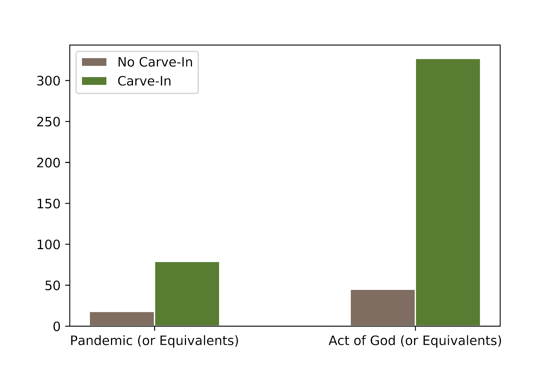
Categories
Finance & Economics

Congress Should Endorse the Federal Reserve’s Extraordinary Measures

The rapid spread of Covid-19 and massive change in behavior required to curb it have transformed the trajectory of the world’s economy.  Just a few short weeks ago, the United States was basking in the longest period of sustained economic growth on record.  The country now faces what could be the steepest decline in economic activity in its history.  The long-term health of the country and the economy remain fluid and will be determined in part by how policymakers respond.  The Federal Reserve quickly recognized the unprecedented nature of the threat and has intervened aggressively to stem the pain this crisis will inflict on the long-term health of the real economy.  Congress should now authorize the Fed’s most creative interventions and give the Fed explicit, albeit time limited, authority to go even further.

The Fed has been at the forefront of the government’s efforts to soften the tremendous economic blow of Covid-19.  There is no way to avoid much of the suffering to come.  Public health officials are rightfully driving policy and behavior.  Their message is clear: To reduce the human suffering from Covid-19, we need to flatten the curve. That means spending a lot more time at home and virtually none in shared spaces.  That means empty restaurants, empty factories, empty classrooms, empty hotels, empty offices… and only a fraction of that activity can shift to the virtual worlds everyone is now being asked to inhabit. Although this may be necessary for public health, the economic consequences are devastating.

The Fed was quick to respond. Consistent with its mandate to promote full employment and its obligations to promote systemic stability, the Fed pulled out every known tool. It rapidly slashed interest rates to near zero. It ramped up the dollar liquidity swap lines relied on heavily during the 2008 financial crisis to funnel dollars to and through central banks around the world.  It reinstated many of the special credit facilities it had used to stem the 2008 financial crisis, including one to support money market mutual funds and another to funnel liquidity to primary dealers, and it provided a broad list of eligible collateral.  It has also gone on a buying spree, and – in an unprecedented move – committed to effectively unlimited quantitative easing, meaning it will buy up as many Treasuries and government agency mortgage-backed securities as it needs to in order to keep those markets functioning well.

But there’s more. The Fed has also implemented two programs to effectively buy up corporate debt, including secondary debt already trading and new issuances that it stands ready to buy directly from large, creditworthy corporations.  It also announced its intention to launch a new Main Street Business Lending Program to encourage lending to small and midsized companies.  And, as important as any of the individual programs, the Fed signaled a willingness to continue to act creatively and aggressively to address the growing threats. The press release to announce the new set of programs opened: “The Federal Reserve is committed to using its full range of tools to support households, businesses, and the U.S. economy overall in this challenging time.”

The Federal Reserve has not been acting unilaterally.  The expanded credit facilities have all been created under Section 13(3) of the Federal Reserve Act, which allows the Fed, in “unusual and exigent circumstances” to extend collateralized loans to nonbanks, just as it normally provides to banks via the discount window.  After questions about the Fed’s use of that authority during the 2008 crisis, Congress modified Section 13(3) to require the U.S. Treasury secretary, in addition to five members of the Federal Reserve Board, to approve any facility. The Treasury Department has further agreed to fund an equity stake in the special entity vehicles through which a number of the new facilities will be run. Although not statutorily required, this signals the Treasury’s willingness to share in the losses given the credit risk that these programs may entail.

The blessing of the administration conveyed through the Treasury Department’s actions is important.  The Fed’s most recent interventions could expose the Fed to meaningful credit risk.  Technically, it is extending collateralized loans, not buying risky assets.  But the way the Fed makes these interventions look like loans is by creating new entities that will do nothing but buy up qualifying assets, such as corporate debt, that the Fed is not authorized to buy. With the exception of the very narrow slice of equity being provided by the Treasury Department, these newly created entities will be funded entirely by the Fed, which means the Fed also bears the downside risk if those loans aren’t paid in accordance with their terms.  Looking ahead, that possibility cannot be discounted even for creditworthy firms. The mix of interventions also has important allocational effects, which is why decisions about the types of assets that can be used as collateral have been followed so closely.  The two new debt facilities, for example, inevitably confer a disproportionate benefit on large, otherwise healthy companies, as they are the only companies positioned to issue the investment grade debt that the Fed has authorized the new programs to acquire.

None of this means that these programs are inappropriate.  Exceptional times call for exceptional measures. Moreover, the Fed’s ability to use special purpose vehicles to creatively deploy its authority under Section 13(3) was on full display during the last crisis and was something Congress understood well when it modified other aspects of Section 13(3) in the Dodd-Frank Act.

The issue at stake is not just the lawfulness of the Fed’s actions, but also how best to preserve the long-term independence of the Federal Reserve.  The Fed also acted creatively and aggressively in 2008. Those actions likely helped make the recession that followed less searing than it would otherwise have been.  Nonetheless, as the dust settled and the ramifications became clearer, politicians from both sides of the aisle went after the Fed.  There was a movement afoot not only to scale back its emergency-era authority, but to also scale back its independence with respect to monetary policy or even to do away with the Fed entirely.  Although the Fed survived and retained its independence, the threat was real and would have cost the country dearly.

The same thing could happen again. No one yet knows how the Covid-19 pandemic will play out, and the Fed has little control over its evolution.  Depending on how bad things get and how long the bad times last, a lot of companies and other borrowers may not be able to pay their debts when due, no matter how healthy they were before this calamity hit.  A public that is mired in a wave of unemployment and foreclosures may not take kindly to seeing just how much money the Fed injected into certain parts of the economy, regardless of the systemic rationale underlying those actions.

Issues of accountability also come into play.  At the broadest levels, the balance of powers scheme built into the U.S. Constitution gives Congress the power of the purse.  Although the reality has long deviated from that ideal, the ideal remains important.  Congress is made up of elected officials from all 50 states. Those officials both reflect the views of their constituents when making law and act as mouthpieces for new laws, explaining to their constituents what is happening in DC and why.  The further the Fed moves from merely printing massive sums of money – something it should be able to do – to directing where that money goes, the more important is Congress’ role.

The good news is that there is a solution.  Congress can authorize what the Fed has done already and give it even broader authority to deal with this particular emergency.  That authority could be either time limited (a few years), or it could be capped by reference to efforts to contain the fallout associated with Covid-19.  As with the far more pressing fiscal stimulus package, the aim should be speed over perfection.  Ensuring that the Treasury secretary continues to authorize any new facility could provide some ex ante check on the Fed’s authority.  Congress could also impose other mechanisms for promoting accountability without excessively limiting the Fed’s flexibility through ex post mechanisms, such as delayed reporting and other requirements.

An additional benefit of having Congress bless the Fed’s action and to focus on ex post accountability is that it could stop any opportunistic denials of legal authority later in this crisis. Among the most fateful and controversial decisions the Fed made – in discussions with Treasury – during the 2008 crisis was to allow Lehman Brothers to fail.  Then-Federal Reserve Chairman Ben Bernanke defended the action as driven by a lack of legal authority.  Others have vigorously contested this explanation.  Nonetheless, the plausibility of that defense – which arises from the vagueness of the limitations on the Fed’s authority as applied in times of crisis – has prevented a robust debate about whether that was a good policy decision.  That mistake should not be repeated and very well could be if Congress does not intervene to clarify the Fed’s authority to take the type of exceptional actions that this exceptional moment calls for.

This post comes to us from Kathryn Judge, the Harvey J. Goldschmid Professor of Law at Columbia University Law School.

Categories
Corporate Governance Finance & Economics International Developments

Gibson Dunn Discusses the Coronavirus, Private Equity, and Portfolio Company Finances

With confirmed cases of COVID-19 now in more than 50 countries and the death toll rising almost daily, experts are predicting that the situation will get significantly worse before it gets better. Concerns over the impact of the virus have caused significant volatility in the stock markets over the last week and the potential scale of the impact across a very wide  range  of  industries  is  just  beginning  to  be  realized. Therefore for private equity sponsors now is the time to be checking their financing documents to fully understand how COVID-19 might have an impact on the operations and financial results of their portfolio companies and their ability to remain in compliance.

Key areas of focus for private equity sponsors include the following:

Financial Covenants/Equity Cure/Covenant Reset

In most markets in the Asia-Pacific region, leveraged facilities typically still have two or three maintenance financial covenants. Given the myriad of ways that a public health emergency like COVID- 19 can affect businesses, and the scale of the impact, it seems inevitable that the virus will cause some companies to breach these financial covenants. The threshold questions then become which covenants will be breached, when will they be breached and what steps can sponsors take to address the problem.

It should be noted that Australia is an exception to the foregoing, with a significant number of unitranche financings that  only  contain  a  single  leverage  covenant  and  increasingly  Term  Loan B  structures. Moreover, in the US and Europe Term Loan B structures with only a single springing leverage covenant for the benefit of the revolving lenders are commonplace. Sponsors should be aware, however, that even in Term Loan B structures, a precipitous fall in EBITDA could mean that some companies become more reliant on their revolving facilities, thereby pushing them above the springing test threshold.

Business Interruption Insurance

In determining whether a covenant breach is likely, it is worth first carefully considering whether there is business interruption insurance in place that will cover the losses  incurred  by  a  portfolio  company. While proceeds of business interruption insurance can typically be added to EBITDA for purposes of calculating compliance with the maintenance covenants, whether a particular policy covers business interruption resulting from COVID-19 will be very much fact-specific and turn on its exact language. Many property insurance policies cover business interruption, but coverage for such loss often requires “direct physical loss or damage” which in many cases will not apply. Also, to the extent that business interruption insurance coverage is available, the EBITDA definition needs to be carefully reviewed to see whether amounts claimed can be included (more typical) or whether the insurance proceeds have to be actually received by the group in order to be included in EBITDA (which could create a timing issue).

Scrubbing the Definitions – Restructuring Initiatives/Other Add-backs

Upon initially concluding that a covenant breach is projected, the sponsor, the CFO of the portfolio company and their counsel should “scrub” the definitions to ensure that all available add-backs, synergies and initiatives, and the pro forma effect of each of them, have been properly included in the calculations. Thought should also be given to commencing certain planned initiatives and actions ahead of schedule to take advantage of the pro forma effect.

Prepayments to Avoid the Breach

In some circumstances, it may be possible to fix a potential covenant breach with a prepayment. For example, a well-timed voluntary prepayment of an amortizing facility made from cash on hand now, could, in addition to reducing leverage, potentially avoid a breach of the debt service cover ratio in the subsequent three quarters (often with a dollar-for-dollar reduction in debt service). Similarly, where sponsors have flexibility to apply mandatory prepayments first against amortizing debt, we have in the past seen sponsors use proceeds from disposals which have not yet been reinvested (or to specifically dispose of assets) in order to reduce both leverage and debt service.

Additional Preemptive Equity

Typically sponsors always have the ability to inject additional capital into a portfolio company’s business (by way of equity or subordinated debt), which would reduce net debt regardless of whether a prepayment is made. Nonetheless, this is not the typical approach for sponsors facing a prospective financial covenant breach unless the amount injected can be subsequently designated as a “cure amount” and there is additional benefit to injecting it earlier (for example, to fix a clean-down issue (as discussed below) or to avoid a mandatory prepayment if that is required under the equity cure).

Sponsors are then broadly faced with either (i) using the equity cure; (ii) asking for a waiver or (iii) negotiating a covenant reset/broader amendment or refinancing.

Equity Cure

Typically sponsors can “cure” financial covenant breaches within 15-20 business days of the date on which a compliance certificate is  required  to  be  delivered  by  the  portfolio  company  to  its  lenders. Careful consideration needs to be given to the parameters of the equity cure provisions (which typically, but not always, apply to all of the covenants).

For example, can the cure be used preemptively and subsequently be designated as a cure amount? Some sponsors will opt to provide the equity cure at the same time they deliver the compliance certificate so that they are effectively never in breach. However, others will use the additional 15-20 business day grace period so that they are not making a call on their investors sooner than is necessary. For those who wait, the next question is whether a default continues during that cure period. If so, for most sponsors the issue that arises is whether or not their portfolio company needs to draw on any of the facilities during this time, as a continuing default would typically be a drawstop (except for rollover advances). Therefore careful planning around this approach is required.

Other key questions to analyze in the context of an equity cure are:

  • How is the cure actually implemented? Under many facilities in the Asia-Pacific region, sponsors are able to add cure amounts to EBITDA which obviously brings with it a multiplier effect, as opposed to being required to use such amount to make an actual prepayment to reduce debt (which is typically the case in Australia, outside of Term Loan Bs, for example). Similarly, where adding the cure amount to EBITDA is not permitted, under some facility agreements such cash is allowed to be retained by the portfolio company (thereby reducing net debt to the extent it remains in the company, rather than being required to be prepaid). Also, where a prepayment of the cure amount is required, the facility agreement may not obligate the company to use 100% of the cure amount for this
  • What are the limits on the cure? For example, how many cures are permitted over the life of the facilities (typically 4-5)? Are over-cures permitted (often they are)? Are cures permitted in successive quarters? Where the cure amount is applied to EBITDA, does this carry over for the next three financial quarters (almost always it does)?
  • Is there a mulligan? The true “mulligan” – taken from the golfing world – provides that an initial breach of the financial covenants is not a default unless the same test is breached on the subsequent test date. In the Asia-Pacific region, true mulligans are fairly rare. It is common, however, to see a deemed cure which provides that where there is an initial breach, it is deemed to have been remedied if the portfolio company is in compliance on the subsequent test date and the lenders have not accelerated the loans. In this scenario, where there is a projected single- quarter blip in performance, some sponsors might look to the lender syndicate to see if they have relationship lenders with blocking stakes (typically 33.34% or more in the Asia-Pacific region) who agree to prevent an acceleration event from occurring, but more often sponsors in this situation will seek a waiver or a covenant

Covenant Waiver

For sponsors with a projected one-off financial covenant breach, they may seek a simple waiver of that breach. In the Asia-Pacific region, the waiver will typically require 66 2/3% of the lenders to consent to the waiver and a waiver fee would typically be paid.

Covenant Reset

Where a sponsor is projecting more than a one-off problem with the financial covenants, it is more typical that it would seek to reset the covenants to re-establish sufficient headroom. This approach is obviously a more protracted process than a one-time waiver as the lenders will need to get comfortable with an updated plan and financial model, and often involves a broader negotiation as some lenders may request changes to provisions such as amortization, excess cashflow sweep and pricing. They will also expect an amendment fee. Like a waiver, typically in the Asia-Pacific region 66 2/3% of the lenders would be required to reset the covenants. The sponsors may or may not negotiate the covenant reset in conjunction with an agreement to inject more equity into the portfolio company. Of course, they are more likely to agree to inject additional equity as part of the covenant reset if there is an underlying, fundamental issue with the company’s performance rather than it simply being adversely affected by what are hopefully near-term situations such as COVID-19. In the latter case, sponsors may also proactively consider a broader “amend and extend” or refinancing of the facilities to fix the covenant issues and address any other issues such as impending maturities or a need for more flexibility in certain areas.

Clean-Down

Depending on the nature of the portfolio company’s business, some facilities will have “clean-down” requirements on their revolving facilities (seen in a minority of sponsor deals). These provisions require cash drawings under the revolving and ancillary facilities to be reduced to an agreed amount (sometimes zero), either physically or net of cash and cash equivalents for a short period of time (typically 1-5 consecutive business days) in a  year with a short period of time (say,  1 month) between clean-  downs. Clean-downs are designed to demonstrate that the revolving facilities are not being used for permanent debt. Where there is an ability to utilize the revolving facility for permanent debt such as acquisitions, joint ventures or capital expenditures, the drawings of such amounts would necessarily need to be excluded from any clean-down.

COVID-19 is likely to mean that some companies are more reliant on their revolving facilities than usual and may struggle to meet their clean-down obligations. In this type of circumstance, in addition to waivers of the requirement, we have seen sponsors in the past preemptively inject equity into the company to fix the clean-down issue. In turn, the sponsors can subsequently designate the same proceeds as cure amounts to equity cure a covenant breach some quarters later.

Representations and Warranties

The representations and warranties in a facility agreement serve two primary purposes: (i) to flush out information regarding the portfolio company where the consequence of a breach is an Event of Default; and (ii) to serve as a drawstop on new utilizations of the facilities.

A number of typical representations and warranties should be given consideration in the context of COVID-19 (there may also be other deal-specific representations which need to be reviewed). First, the second limb of the “No Default” representation, which is a look-forward to defaults or termination events under other agreements (not the finance documents) and is typically subject to a “Material Adverse Effect” qualification. This representation could be relevant where a company’s performance under a “material contract” is adversely affected by COVID-19 or a counterparty breaches such a contract. In addition, where a company has contracts which would reach this threshold of materiality, there is often an additional “Material Contracts” representation which should be reviewed.

Second, sponsors must check whether their facility agreement contains a particularly troublesome material adverse change representation which is included in the LMA’s leveraged standard form. It provides that “Since the date of the most recent financial statements delivered pursuant to Clause 25.1 (Financial statements) there has been no material adverse change in the assets, business or financial condition of the Parent or the [Restricted]  Group [or the Group].”       This provision is a tripwire and should never be accepted by sponsors, although it is in a number  of  facility  agreements  in  the market. This frequently misunderstood representation does not relate to the performance of the business since the closing of the loan facility, but rather since the date of the most recent financial statements and, equally importantly, is not the negotiated, defined “Material Adverse Effect” standard but is tied to the looser term “material adverse change.” The tripwire here is that the portfolio company could be performing well above both its business plan and financial model but has a temporary but material dip in performance which can result in a performance breach despite the fact that it is in compliance with its covenants.

Third, the “No Proceedings” representations which relate to litigation and judgments should be reviewed. Invariably, some companies will be subject to litigation resulting from their failure to perform under their contracts, and it is likely that many parties will assert that COVID-19 is a force majeure event such that noncompliance with their contractual obligations was beyond their control and not actionable as a breach of contract. All of this could result in many businesses becoming tangled in complex and protracted litigation even when they intended to fulfill their obligations.

Finally, it is recommended to look at the “Insolvency” representation. This representation is linked to the insolvency-related events of default and discussed below.

Reporting Obligations

Reporting obligations to lenders vary from facility to facility but, in addition to financial information, typically include matters relating to litigation, judgements and, where relevant, material contracts as well as the catch all of whatever else is requested by a finance party. Sponsors are well-advised to discuss early and often with the management of their portfolio companies as to what, how and when information will be disclosed to lenders, particularly in light of the highly evolving nature of COVID-19 and its potential effect on businesses.

Events of Default

Insolvency/Insolvency Proceedings/Creditors Process

These events of default speak for themselves and are unlikely to be the first breach of the facilities for a portfolio company that is seriously adversely affected by COVID-19. Nonetheless, they warrant consideration and attention because, among other things, the threshold for insolvency varies from jurisdiction to jurisdiction as do the duties of the directors.

Audit Qualification

Most traditional leveraged facilities in the Asia-Pacific region contain an event of default if the auditors qualify their report either on a going concern basis or a failure to disclose information. In the aftermath of the last financial crisis, there was much debate around whether a projected breach of a financial covenant which is noted in the auditors’ report amounts to a qualification – thus causing an event of default ahead of any actual breach of covenant. In most cases, the conclusion was that for a simple projected financial covenant default, the auditors do not “qualify” their report but include an “emphasis of matter”. The emphasis of matter is a paragraph which highlights a matter that in the auditor’s opinion is of fundamental importance to a reader’s understanding of the financial report but which falls short of the technical standard of an auditor qualification. However, although this has been the general conclusion in the case of projected breaches, it should be confirmed on a case-by-case basis with the relevant professionals in the local jurisdiction.

Litigation & Material Judgments

As discussed above, the impact of COVID-19 will inevitably be the cause of some contractual breaches which will result in litigation and judgments and need to be considered here.

Material Adverse Effect

Most traditional leveraged facilities in the Asia-Pacific region have a catch all Material Adverse Effect event of default. Sponsors in a reasonably strong negotiating position will negotiate the definition of “Material Adverse Effect” aggressively so that it is very limited and does not include the LMA formulation, which includes a look-forward on the ability to comply with financial covenants and/other obligations. Also, this event of default is typically negotiated to be an objective test – rather than the subjective “which the Majority Lenders reasonably believe….” construct of the LMA. Unfortunately, there are examples in the Asia-Pacific region that follow the LMA formulation. On the other hand, if this definition and event of default are correctly negotiated, while it may be scrutinized, in the absence of any other “black and white” events of default having occurred (such as a financial covenant breach), most lenders would be unlikely to rely solely on a Material Adverse Effect event of default in order to take any acceleration actions.

Reviewing facility agreements and conducting an in-depth analysis of the current and future impact of COVID-19 on portfolio companies is necessarily a complex task, and there is no one-size-fits-all answer. Each case will need to be examined based on the particular facts and the specific drafting of the finance documents.

This post comes to us from Gibson, Dunn & Crutcher LLP. It is based on the firm’s memorandum, “Coronavirus: Time for Private Equity to Have a Financing Check-up” dated March 4, 2020, and available here.
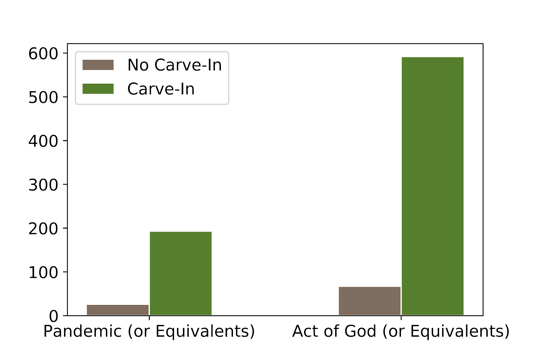
Categories
Securities Regulation

Senator Richard Burr and Mixed Motives for Insider Trading

In response to accusations Friday of trading on non-public information about the coronavirus, Senator Richard Burr of North Carolina asserted independent and lawful grounds for unloading between $628,000 and $1.72 million worth of stock. “I relied solely on public news reports to guide my decision regarding the sale of stocks on February 13,” he said. “Specifically, I closely followed CNBC’s daily health and science reporting out of its Asia bureaus at that time.”[1]

While some people doubted the veracity of Burr’s purportedly lawful trading motives, others denied their significance. Journalist Kurt Eichenwald, for example tweeted:

If you sold after the briefing, this is irrelevant. You had access to inside information. You’re forbidden by law, even if public info could justify a sale, from making stock trades until public disclosure of non-public info. Only 1 fact matters: Did you sell after the briefing?[2]

Senator Burr believes that he can lawfully trade, despite access to non-public information, if he would have traded anyway. Eichenwald thinks Burr was required to abstain from trading, even if it curtailed otherwise lawful stock sales. Who is right?

Scholars of insider trading will immediately recognize this as a recapitulation of a 30-year old debate known as the “mental causation” debate, the “use/possession” debate, or the “use/awareness debate.” It involves the issue of whether a trader with both lawful and unlawful reasons for trading violates the law. Should the law consider just the lawful trading rationales and not the unlawful ones or focus instead on the trader’s having proscribed information despite honest and independent reasons for trading?

This debate emerged alongside a three-way split among U.S. appeals courts in the 1990s. Broadly speaking, the Second Circuit endorsed Burr’s preferred legal theory,[3] the Ninth Circuit endorsed Eichenwald’s,[4] and the Eleventh Circuit came out in between.[5] Dozens of law review articles have debated these different approaches, but none has proven fully persuasive. The SEC purported to have decided the matter through rulemaking in 2000,[6] but courts continued to apply the three conflicting approaches.[7]

One reason that no legal standard has gained universal acceptance is that each advances a worthy policy consideration – while ignoring another. The Second Circuit recognized that positions of trust, whether CEO or senator, create responsibilities; going to confidential board meetings or intelligence briefings means that you can’t just do whatever you want afterward. But the Second Circuit ignored any concern for the trader-defendant’s legitimate reasons for trading. Sometimes an executive desperately needs cash, and corporate stock is all she has; sometimes a hedge fund undertakes months of lawful planning and research, and barring them from trading because they acquire a sliver of proscribed information seems unjustified. The Ninth Circuit, meanwhile, tolerates trading on inside information that is utterly incidental, but the court is insufficiently concerned with pretextual justifications and imposes no special responsibility on insiders in positions of trust.

These two approaches clash because one aims to protect otherwise lawful trades (despite inside information), and the other is designed to prohibit insider trading (despite lawful reasons to trade). The optimal rule would incorporate and balance both goals.

In a recent article, I propose such a rule and show how it does as well or better than each existing legal standard in achieving the various policy goals inherent in insider trading law. I also relate this debate to the broader jurisprudence of mixed-motives.

Senator Burr’s fate is currently uncertain in part because we don’t know which court’s law would govern the matter. If he were charged with insider trading, he might be in peril in the Second Circuit but not in the Ninth Circuit.[8]  His fate would also be uncertain under my proposed standard, but for what I believe are more valid reasons. The outcome would depend on all the relevant facts – such as how compelling  the non-public information he received was and how it compared in magnitude with the public information. An advantage of my test is that it  incorporates information about both purported trading motives, rather than just one. That makes the test more likely to produce the correct and legitimate  result – which matters because of how much turns on this question.[9]

Rule 10b-5 has been interpreted as barring insider trading,[10] with criminal penalties of up to 20 years imprisonment.[11] It is common for defendants in insider trading cases to argue that their trades were motivated at least in part by lawful trading objectives. The 2012 STOCK Act clarified that insider trading law applies to senators and other government officials, who may also lose their office if found to have violated ethical standards.[12] The current controversy is significant not only for how high it reaches in the federal government, but also for how many people it involves – so far. In addition to Senator Burr, at least four senators are accused of selling their shares based on non-public government information about COVID-19. At a time of acute national anxiety, the stakes are high indeed.

ENDNOTES

[1] https://twitter.com/SenatorBurr/status/1241008837479542786

[2] https://twitter.com/kurteichenwald/status/1241022844823355392

[3]  United States v. Teicher, 987 F.2d 112 (2d Cir. 1993).

[4]  United States v. Smith, 155 F.3d 1051 (9th Cir. 1998).

[5]  SEC v. Adler, 137 F.3d 1325 (11th Cir. 1998).

[6]  Securities Act Release No. 33-7881, Exchange Act Release No. 34-43154, Fed. Sec. L. Rep. (CCH) 86,319 (2000). The SEC’s rule is distinct, but can be construed as endorsing the Second Circuit’s approach.

[7] E.g., United States v. Anderson, 533 F.3d 623 (8th Cir. 2008)(applying Smith); United States v. Royer, F.3d 886, 889 n. 12 (2d Cir. 2008) (applying Teicher);  U.S. v. Naccio, 2006 WL 8439745 (D. Co. 2006) (applying Teicher); United States v. Causey, 2005 WL 3560632 at pp. *4–*5 (S.D.Tex. 2005) (applying Adler); United States v. Jun Ying, No. 1:18-CR-74-AT, 2018 WL 6322308, at *5 (N.D. Ga. Dec. 4, 2018) (applying Adler).

[8] In the Ninth Circuit, Burr would prevail unless a factfinder concluded his CNBC story was a mere pretext. In the Second Circuit, Burr could be convicted even if the factfinder believed his CNBC story.

[9] For the record, I predict that my test would convict Senator Burr, given the events that have been widely reported; the confidential information he learned in government briefings likely dwarfed in importance anything he learned from CNBC and other public sources; Burr’s statements to attendees of a luncheon imply that he took his government-derived information quite seriously. https://www.propublica.org/article/senator-dumped-up-to-1-7-million-of-stock-after-reassuring-public-about-coronavirus-preparedness  But actually predicting the legal result would require knowing all the relevant facts, and the factfinder’s assessment of them.

[10] Salman v. United States, 137 S. Ct. 420, 427–28 (2016).

[11] 15 U.S.C. § 78ff(a)

[12] https://www.burr.senate.gov/imo/media/doc/Ethics%20Review%20Request%20March%2020%202020.pdf (Burr’s letter, requesting a Senate Ethics Committee investigation of himself).

This post comes to us from Professor Andrew Verstein at Wake Forest University Law School. It is based on his recent article, “Mixed Motives Insider Trading,” available here.

Categories
Finance & Economics Securities Regulation

Cleary Gottlieb Discusses New SEC Rules on Guaranteed and Collateralized Securities

On March 2, 2020, the SEC adopted rule changes to simplify the financial disclosures that are required when an issuer offers debt securities with guarantees.[1]  The old requirements were complex, and in some circumstances burdensome, and the utility of some resulting disclosures for investors was doubtful.  As discussed below, the new requirements are easier to apply and permit substantially simpler disclosures in some cases.

The SEC also adopted rule changes applicable to a similar, less common situation – securities that are collateralized by a pledge of shares (typically shares of a subsidiary of the issuer).

The new rules have a long transition period.  They will become mandatory in 2021 – generally, for a registration statement first filed on or after January 4, 2021 and for a periodic report for a period ending after January 4, 2021.  However, earlier compliance is permitted, so an issuer planning a guaranteed or collateralized offering should consider whether to follow the new rules rather than the existing rules.  And an issuer that is complying with the existing rules in annual or quarterly reports, because of outstanding guaranteed securities, should consider whether to follow the new rules starting now.

These rule changes are part of the broader Disclosure Effectiveness Initiative, which has produced a long list of reforms in the SEC’s disclosure regime since it was announced in late 2013.  We are maintaining a Disclosure Simplification Explainer, which you can find here.  As with many of the DEI measures, the recent rule changes reflect a regulatory philosophy of moving from detailed prescriptive rules towards principles-based norms that give registrants more flexibility.  As in several other recent instances, the approach drew a dissent from Commissioner Lee, who characterized these rule changes and others under the DEI rubric as based on unfounded “regulatory intuition” rather than evidence about investor protection.

Guaranteed Debt Securities – The Current Rules

Under the federal securities laws, when a debt security is guaranteed, each guarantee is itself a security, and each guarantor is consequently an issuer.  So if the securities are sold in an SEC-registered offering, the full SEC disclosure regime potentially applies to the issuer and each guarantor.

Often, the issuer and the guarantors are all part of a consolidated group – for example, when a finance subsidiary is the issuer and the parent provides a guarantee, or when the parent is the issuer and one or more operating subsidiaries provide guarantees.  In these cases, the SEC recognizes that investors rely principally on the consolidated financial statements, and only need supplemental information about the subsidiary issuers and guarantors.  It also recognizes that requiring separate disclosures from multiple entities in a consolidated group is burdensome and tends to drive securities offerings from the public markets to private placements.

Rule 3-10 of Regulation S-X, adopted in its current form in 2000, is based on this recognition.  To avoid unnecessary disclosures, current Rule 3-10 provides exemptions from the general requirement that the issuer and each guarantor must comply separately with all the disclosure and reporting requirements applicable to an issuer.  These exemptions have, however, proven unwieldy in several respects.

  • 100% Ownership. The exemptions are only available if each subsidiary issuer and guarantor is “100%-owned” by the parent company.  This excludes many common fact patterns in the structure of corporate groups.
  • The Consolidating Footnote. In many circumstances, the exemptions require the parent company to present condensed consolidating financial information, with separate columns for issuers, guarantors and non-guarantors.
    • If this information is required, it must be in the footnotes to the audited financial statements and interim financial statements – a “Consolidating Footnote”. When a new offering is under consideration but the previously published financial statements do not contain the Consolidating Footnote, the audited consolidated financial statements would need to be re-issued to include the footnote, generally with a double dated audit report.
    • If the Consolidating Footnote is required, it must be presented in subsequent quarterly and annual reports under the Exchange Act for so long as the securities are outstanding.
  • Omitting the Consolidating Footnote. The Consolidating Footnote can be replaced by a brief narrative explanation in three cases:
    • the securities are issued by a finance subsidiary, and the parent is the only guarantor – so the only material obligor is the parent;
    • the securities are issued by a subsidiary and guaranteed by the parent, the parent is a holding company, and there are no other subsidiaries other than “minor” subsidiaries – so the obligors include essentially the entire corporate group; and
    • the parent is a holding company, and all its subsidiaries other than “minor” subsidiaries are guarantors – so, again, the obligors include essentially the entire corporate group.
  • New Subsidiaries. Where a reporting company acquires a new subsidiary issuer or guarantor, in specified circumstances, current Rule 3-10 requires the acquirer to present separate audited pre-acquisition financial statements of the new subsidiary in the registration statement.

Guaranteed Securities – The New Rules

Amended Rule 3-10 permits financial statements of a subsidiary issuer or guarantor of securities to be omitted if all of the following conditions are met:

  • The parent consolidates the subsidiary. This represents a substantial relaxation from current Rule 3-10, under which omission of separate financial statements was only available if the subsidiary was 100%-owned by the parent.
  • The consolidated financial statements of the parent have been filed and the parent is an Exchange Act reporting company (or will become one as a result of the offering).
  • The parent issues or co-issues the securities with the subsidiary, or the parent guarantees the securities fully and unconditionally. In contrast to existing Rule 3-10, the new rule does not turn on whether a subsidiary’s obligations as guarantor are “full and unconditional”.
  • The securities are “debt or debt-like” – an expression defined in the amended rule and consistent with the guidance under the current rule.[2]
  • The parent provides disclosures specified in a new Rule 13-01.

The disclosures required by Rule 13-01, in turn, depend on the circumstances.

  • Narrative Disclosures. Rule 13-01 requires three specific types of narrative disclosures in both registration statements and subsequent Exchange Act reports.  Each of these is qualified by the introductory words “to the extent material.”  There was no specific rule requiring these disclosures in the past, but in our experience information along these lines has routinely been provided in offering documents and, to some extent, in footnotes to financial statements, capital resources discussions in MD&A and risk factors.
    • A description of the issuers and guarantors.
    • A description of the terms of the guarantees, and of how payments may be affected by the structure of the corporate group.
    • A description of other factors that may affect payments, such as restrictions on dividends, enforceability of guarantees, subsidiary guarantee release provisions, or rights of minority shareholders in subsidiaries.
  • Subsidiary Guarantor Exhibit. The amendments add a new exhibit requirement to Item 601 of Regulation S-K for registration statements and Forms 10-K, 10-Q and 20-F: a list that identifies each of the parent company’s subsidiaries that is a guarantor, issuer or co-issuer for each applicable guaranteed security.  The original proposal required this information as part of the narrative disclosures under Rule 13-01, but the SEC moved it to an exhibit in list format at the suggestion of a commenter.
  • Summarized Financial Disclosures. New Rule 13-01 requires financial information on subsidiary guarantors and issuers with a more manageable scope and format than the Consolidating Footnote under current Rule 3-10.
    • Information about whom? The rule requires summarized financial information for all obligors, which may be presented as a group, on a combined basis – eliminating intracompany balances and transactions within the group and excluding investments by obligors in non-obligors.  In contrast to current Rule 3-10, there is no requirement to show information for non-guarantors or to show the “consolidating” table (how all the obligors and non-obligors add up to the consolidated totals).  If there are material differences among obligors in the terms of the guarantees and other factors that may affect payment, the summarized information should be presented separately, unless the differences can be easily explained and understood in narrative disclosure (which the SEC suggests would be in limited circumstances).  Issuers should consider materiality when determining the appropriate level of aggregation.
    • How much information? For the scope of the information, Rule 13-01 refers to the summarized financial information requirements under Regulation S-X, which are familiar because they apply to certain required footnote disclosures (such as equity method investees).  Notably, in contrast to current Rule 3-10, there is no requirement to present cash flow information.
    • For what periods? The information is required for the most recent fiscal year and year-to-date interim period included in the parent financial statements.  In contrast to current Rule 3-10, there is no requirement to present information for earlier comparative periods or for the most recent quarter.
  • Omitting the Summarized Financial Disclosures. The new Rule 13-01 only requires disclosures, including the summarized financial disclosures, to the extent material.  In addition, as under current Rule 3-10, there are specified circumstances where the new Rule 13-01 permits the summarized financial information to be omitted.
    • The new Rule provides non-exclusive examples of circumstances in which the summarized financial information can be omitted:
      • if the parent company’s consolidated financial statements do not differ in any material respects from the combined issuers and guarantors;
      • if the combined issuers and guarantors have no material assets, liabilities or results of operations, excluding investments in subsidiaries; and
      • if the issuer is a finance subsidiary and the parent fully and unconditionally guarantees the debt (or is a co-issuer). The definition of “finance subsidiary” under new Rule 13-01 is substantially the same as under current Rule 3-10.
    • The adopting release describes these examples as the most common situations under which the summarized financial disclosures would not be material. However, an issuer can also omit the summarized financial information based on its own determination that the information would not be material.  This principles-based approach does not provide the certainty of a numerical threshold, and it will require judgment, but the SEC expects it to allow issuers to provide more tailored and relevant disclosures to address the needs of investors.
  • Location. Rule 13-01 provides flexibility on where to include the required disclosures.  They can be included in a footnote to the audited financial statements, as under current Rule 3-10, but alternatively they may be included in MD&A. In a prospectus, if they are not otherwise included or incorporated by reference, they must immediately follow “Risk Factors” or pricing information.  The ability to present required information outside the financial statements (and therefore outside the scope of the audit) in both registration statements and periodic reports is an important element of flexibility compared to the former rule.
  • Treatment of Newly Acquired Subsidiaries. Rule 13-01 eliminates the requirement under current Rule 3-10(g) to include in a registration statement separate pre-acquisition financial statements for certain subsidiary issuers or guarantors that are significant.  Instead, if the parent company has acquired a significant “business” after the most recent balance sheet date in the registration statement, Rule 13-01 requires pre-acquisition summarized financial information for any of the new subsidiaries that will be issuers or guarantors of the securities being offered.   This will better align this requirement with other rules under Regulation S-X, although in some cases the summary information may be required before the financial statements would need to be filed under Rule 3-05.  Whether an acquisition is of a “business” is determined in the same way as for pro forma financial statement requirements, and significance for this purpose is measured at the 20% level under the familiar Regulation S-X definition of significance.[3]
  • Catch-all. Rule 13-01 has two catch-all provisions requiring disclosure of any information material to evaluate the sufficiency of the guarantee, and requiring sufficient information to make what is presented not misleading.

The ongoing disclosure obligations under the new rule will, for some issuers, terminate much earlier than under the current rule.  In contrast to current Rule 3-10, which requires the information to be included for as long as the guaranteed securities are outstanding, the disclosure obligations in new Rule 13-01 with respect to a class of securities can be suspended after the first annual report on Form 10-K or Form 20-F following the issuance, if the securities of that class are held by fewer than 300 holders of record.

Collateralized Securities

The SEC applied similar reasoning in amending the disclosure requirements for securities that are collateralized by a pledge of shares of the issuer’s subsidiary.  Current Rule 3-16 requires separate financial statements for an affiliate of a registrant where that affiliate’s shares constitute a substantial portion (defined as 20% or more) of the collateral package for the registrant’s securities.  But when the affiliate is a consolidated subsidiary and debtholders can only foreclose on the shares in an event of default, as is usually the case for these securities, investors primarily rely on the issuer’s financial statements when making an investment decision.

The amendments replace the requirement for separate financial statements under Rule 3-16 with new Rule 13-02, requiring financial and narrative disclosures about the relevant subsidiaries and the collateral arrangements.  Rule 13-02 replaces the bright-line 20% test with a materiality standard.  Its disclosure requirements are generally equivalent to those in new Rule 13-01 for guaranteed securities, including the new exhibit.

A notable difference compared to current Rule 3-16 is that the ongoing disclosures will now be required in the parent’s quarterly reports on Form 10-Q; current Rule 3-16 only requires separate financial statements in registration statements and annual reports.

Commenters on the proposed amendments pointed out that the elimination of Rule 3-16 could have unintended consequences, because indentures for collateralized securities often contain provisions that permit collateral to be released if Rule 3-16 disclosures are triggered.  To avoid causing changes in collateral packages, the amendments leave Rule 3-16 in place for registered securities issued before January 4, 2021, unless the registrant was already providing financial statements pursuant to Rule 3-16.

Takeaways

SEC registrants with outstanding guaranteed or collateralized securities will need to review the new rules closely.  For many of them – issuers of guaranteed securities that are not currently required to provide a Consolidating Footnote under Rule 3-10 – the impact of the new rule will probably be minor.  For those that are providing a Consolidating Footnote, however, the new rules will significantly ease the burden of compliance.  And for some issuers, the new rules will shorten the duration of the obligation to provide additional disclosures.  Issuers in a position to benefit should consider whether to comply with the new rules early.

For some issuers contemplating a new offering of guaranteed or collateralized securities, the new rules will remove important drawbacks to proceeding on a registered basis as opposed to a Rule 144A private placement.  It will be interesting to see whether they tip the balance in favor of the public markets in a substantial number of cases.

ENDNOTES

[1] SEC Release No. 33-10762; 34-88307 (March 2, 2020), available at https://www.sec.gov/rules/final/2020/33-10762.pdf.

[2] Under amended Rule 3-10(b)(2): “A security is “debt or debt-like” if it has the following characteristics: (i) The issuer has a contractual obligation to pay a fixed sum at a fixed time; and (ii) Where the obligation to make such payments is cumulative, a set amount of interest must be paid.”  A note to the Rule specifies that “a set amount of interest” can include interest at floating or adjustable rates.

[3] To the extent these rules are changed pursuant to amendments proposed by the SEC in May 2019, the adopting release confirms that the triggers in Rule 13-01 will be conformed.

This post comes to us from Cleary, Gottlieb, Steen & Hamilton LLP. It is based on the firm’s memorandum, “New SEC Rules on Guaranteed and Collateralized Securities,” dated March 17, 2020, and available here.
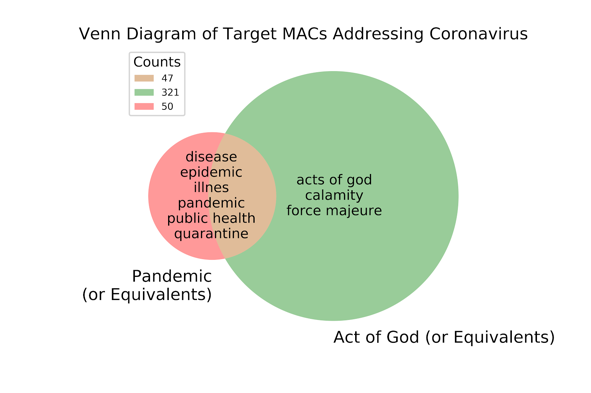
Categories
Finance & Economics

Operating Systems: How Tech Is Changing Asset Management

The impact of technology on finance (FinTech) is one of the hottest topics in business, law, and regulation, with academics and practitioners considering a host of issues that include cryptocurrencies, robo-advice, initial coin offerings, and algorithmic analyses of big data.  Yet very little analysis has been devoted to the world’s largest financial industry: asset management.

The Rise of Concentrations of Digital Technology: Financial Operating Systems

In a new paper, we identify and explore a topic of major significance in FinTech: the rise of financial operating systems (FOS) and their evolution in the global asset management industry. These digital technology ecosystems provide the essential infrastructure for many of the front-office and back-office functions in the global market for investment. As with their software analogs, these operating systems are often relatively inconspicuous but powerful.

FOS already underpin the world’s $50 trillion investment fund industry, where they provide the electronic systems for asset management for pension funds and other institutional investors. So far, commentators have observed only the symptoms of the rise of FOS.  The growth of passive index funds, for example, raises issues that touch upon governance by FOS, but analysis has not considered why we observe such significant growth. Our paper provides a central part of the answer.

Financial Operating Systems as Drivers of Industry Concentration

We argue that FOS lie at the core of the remarkable growth of asset and fund conglomerates including Blackrock, Vanguard, and Fidelity, as well as large brokerage houses such as Charles Schwab and TD Ameritrade, linking the services these financial houses deliver. We identify the massive scope of these systems, the reasons for their dramatic evolution and the legal and regulatory implications that arise from their possible failures and successes. These systems can be seen as the logical progression of the combination of information technology, financial evolution and finance theory: They are the combination of economies of scope and scale, network efforts, and efficiency, all combining to produce competitive advantage for those with the resources and capabilities. At the same time, they raise concerns from the regulatory standpoint: Are these new systemically important financial institutions or systemically important financial market infrastructure? Further, we highlight the potential for such systems to escape regulation while simultaneously stifling innovation and competition.

From Front-end to Back-end to Financial Ecosystems

In the asset management industry, FOS are evolving into comprehensive, front-to-back financial ecosystems. Probably the most significant of these systems is Ant Financial, which provides a single financial ecosystem that links more than 1.2 billion clients (only 67 percent of whom are Chinese nationals) through its payments services, and also offers (1) a money market fund with more than 300 million investors, the largest in the world, (2) the largest fund brokerage platform in China, and (3) a very sizable insurance business. FOS are underlying a similar trend towards concentration in U.S. markets.

Notwithstanding this enormous size and scope, FOS are still developing and underappreciated, with all the related benefits and concerns. In our paper, we examine the evolution of FOS in large asset management houses – and increasingly of the large banks as well, focusing particularly on BlackRock but highlighting how similar processes are driving Goldman Sachs, JP Morgan, and most recently the Morgan Stanley/eTrade acquisition: The combination of scope, scale, network effects, and efficiencies of FOS underpin consolidation and perhaps even winner-takes-all or at the least potentially oligopolistic outcomes.

Risks from Financial Operating Systems

We argue that ever-more components of the asset management value chain will be integrated into ever-fewer FOS. Although some service providers such as asset managers and administrators may remain nominally independent, they will in reality come to depend entirely on the FOS. How critical are FOS to these players?  “Aladdin [the largest U.S. FOS] is like oxygen,” said Anthony Malloy, chief executive of New York Life Investors.  “Without it we wouldn’t be able to function.”

We predict the economic pressure that FOS generate from their access to data and liquidity will squeeze profits out of the rest of the financial system, leading to fewer and larger service providers. While we focus on the rise of FOS in the asset management industry, similar developments are taking place across the financial sector, as FOS are increasingly driven by efforts to build entire financial services ecosystems (such as that of Alibaba/Ant Financial or that being built by JP Morgan or sought through the Morgan Stanley/eTrade merger). This evolution could be partly beneficial, as disintermediation should drive costs down, but not all innovation is good for all purposes. Societies – and their financial regulations – must seek to remain open to innovation, while balancing innovation against risk. The concentration of FOS in the asset management industry and elsewhere in the financial system will likely hamper both innovation and competition – inevitably the winner-takes-all nature of platform industries – which is what we argue are emerging in finance via FOS.

The Case for Regulating FOS

We explore the possible ways in which FOS could be regulated, ranging from doing nothing to intervening dramatically.  On the light end of the spectrum are wait-and-see approaches that foster innovation and encourage innovation; in the middle are moderate regulatory interventions; and at the extreme end are strict regulations akin to those of public utilities or even nationalization.

The options regulators should take will depend on the stage of development of FOS within their jurisdictions, particularly in terms of their market share or dominance and the systemic significance of the functions the FOS provide. Regulators must be prepared to act fast, however, given the short time needed for big tech firms to evolve from too-small-to-care-about to too-big-to-fail or too-connected-to-fail.

FOS versus FinTech and BigTech

In some respects, the rise of FOS reflects the powerful response of massive, established financial institutions to the disruptive efforts by FinTech start-ups: We are witnessing the financial equivalent of the empire striking back. We are only at the beginning of a battle between Big Tech and Big Finance for platform dominance in the provision of financial services.

This post comes to us from professors Dirk A. Zetzsche at the University of Luxembourg, William A. Birdthistle at Chicago-Kent College of Law, Douglas W. Arner at the University of Hong Kong, and Ross P. Buckley at the University of New South Wales. It is based on their recent article, “Financial Operating Systems,” available here.

Categories
M & A

Gibson Dunn Offers Checklist for M&A Amid the Coronavirus

The emergence and rapid escalation of COVID-19 continues to alter every facet of daily life across the globe. For businesses, challenges range from protecting and supporting employees and customers, to contributing to evolving efforts to battle COVID-19, to fighting for survival by preserving liquidity and adapting to new and dramatically different operating conditions. Against this backdrop, the outlook for M&A activity is—understandably—highly uncertain. Assessing value and marshaling necessary financial and human resources are already challenging, and ongoing market volatility may well exacerbate this. Nevertheless, for various reasons, including strategy, opportunity and necessity, both companies and financial sponsors will continue to consider—and where appropriate pursue—transactions. In addition, they will need to address pending transactions that were signed pre-crisis and that now may or may not close.

To assist companies in navigating the M&A process in this unprecedented environment, we have prepared a checklist of key considerations, focusing on areas of particular risk and uncertainty. This checklist is intended as a starting point, as the analysis of each deal making situation will be highly fact-specific. We encourage you to reach out to your Gibson Dunn contact to discuss specific questions or issues that may arise.

1. MAE/MAC provisions. Relying on a material adverse effect or material adverse change (MAE or MAC) as a basis to terminate a transaction has long been extremely difficult under the laws of many states. As a general matter, an MAE or MAC is intended to capture unforeseen events or consequences that have a long-term, dramatic adverse impact on the value of the target. The impact of COVID-19 and its consequences continue to evolve. Whether the impact of the virus will be considered an MAE/MAC will depend upon both what is known at the time a transaction is signed and what the relevant agreement’s MAE/MAC definition says about the inclusion or exclusion of the virus. A pre-crisis MAE/MAC definition that makes no reference to COVID-19 (or even to pandemics or epidemics generally) may or may not be found to include the effects of COVID-19 in determining whether an MAE/MAC has occurred. In such cases, disputes may focus on whether definitional language that typically excludes general economic or market conditions and other broad based factors impacting the business climate or the target’s industry generally is sufficient to exclude the impact of COVID-19. Parties also may debate whether the potential impact of the virus was reasonably foreseeable at the time the agreement was signed or whether the impact is sufficiently long-lasting to be considered an MAE/MAC under applicable state law.

At this point, though, both buyers and sellers would be well-advised to negotiate explicit language to address COVID-19 risk-allocation in the context of an MAE/MAC provision. We have seen this practice followed in response to past crises. We have already seen a fair number of more recent agreements that specifically exclude the impact of COVID-19 (most often building on an exclusion for any “pandemic” or “epidemic,” and sometimes only if it does not disproportionately affect a party) from the scope of an MAE/MAC definition. Whether excluding it completely or specifying a quantitative or qualitative level of financial or operational impact from COVID-19 that, if reached, would give rise to an MAE/MAC, specificity will guard against unexpected results.

2. Termination rights and fees. Always a heavily negotiated deal term, these provisions merit particular attention in the current environment. Aside from MAE/MAC termination rights, parties should give extra attention to the seemingly routine “outside date” termination provision, since requirements for third-party consents and/or government approvals and other closing conditions may be substantially more difficult or take far longer to achieve under current conditions. Who bears the risk of delay, and for what period? How long can buyer and seller wait between signing and closing, and what degree of change in the target’s financial results and operations will be allowed if the pre-closing period is particularly long? Deals that require shareholder approvals and filings with (and clearances from) the Securities and Exchange Commission may face particular delays, as these implicate risks of slower governmental action and potential challenges of obtaining stockholder approvals. In the U.S., the government has already suspended the early termination option for Hart-Scott-Rodino Act antitrust review (meaning that clearance will take at least 30 days in all circumstances), and other agency review and clearance processes may be delayed or uncertain, due to staffing shortages, teleworking and prioritization of resources to crisis demands.

With continued volatility in the financing markets, transactions that depend on third-party debt financing can present particular challenges. Providers of both long-term and bridge financing options may offer less certainty, and well-established norms for the terms of financing commitments and definitive agreements may be changing. Both buyers and sellers will want to explore and understand the added risk and volatility in order to address these factors appropriately in decisions about whether, and on what terms, to proceed. The private equity M&A market has a well-established and often used construct to address what is generally viewed as a fairly remote risk of a “financing failure”—including payment by the buyer of a reverse termination fee and limiting the seller’s specific performance rights where the debt provider is refusing to fund. In the current environment, buyers and sellers may want to consider whether this risk is greater and whether the “standard” financing-failure arrangements fairly allocate that risk between the parties. We expect that both buyers and sellers will argue as to which one is facing greater risk from financing market volatility at present and what “reallocation” of risk—if any—is “fair.” In addition, with the judicial system and other dispute resolution forums increasingly shutting down and consequent delays in the adjudication and enforcement of remedies such as specific performance, the parties’ view of the relative value and utility of different types of remedies may change over the near term.

3. Due diligence and representations and warranties. Due diligence in the COVID-19 context confronts both buyers and sellers with marked challenges. Some of the information that a buyer would seek—such as how a target has weathered similar conditions in the past—may simply not be available, even from the most well-intentioned seller. Projections, which always carry a fair element of uncertainty, will be particularly difficult to prepare and assess. Also, site visits and in-person meetings may be inadvisable or impermissible, particularly in a cross-border deal or where the target business has multi-national operations.

COVID-19-specific representations may help inject some greater degree of certainty and promote additional information-sharing, though crafting appropriate representations amid a constantly changing environment could present new hurdles. Moreover, addressing the appropriateness and adequacy of remedies for breaches may be challenging. Would any material breach give rise to a termination right? If, by contrast, breaches would be subject to an overall MAE/MAC standard for termination, how would the MAE/MAC definition apply (as discussed above)? Would a post-closing indemnity right be sufficient? If the post-closing remedy is for the buyer to make a claim against a representation and warranty insurance policy, and if, as discussed below, COVID-19-related claims are likely to be excluded from coverage, will traditional seller-funded indemnities (in deals where they are feasible) experience a level of re-emergence—at least for COVID-19-related claims? Where a seller’s sole exposure for post-closing damage claims is for “fraud,” should sellers react to fast-changing conditions by providing more extensive pre-closing disclosure updates?

4. Interim operating covenants. Between signing and closing of an M&A transaction, buyers generally want sellers to operate the target business in the “ordinary course” to protect the value of the business they have agreed to purchase (with any deviations requiring buyer’s consent). However, interim operating covenants do not constitute an obligation to maintain the financial condition of the target, only to operate the target consistent with the ordinary course of business. Buyers should consider drafting with specificity if they want to have additional protections as to the virus.

Liquidity maintenance, debt refinancing, and working capital management will all require special attention in the interim operating covenants. With a heightened risk of closing failure or delay, the impact of tight interim operating covenants on a business should be considered carefully. Risks exist both pre-termination (with too-tight interim operating covenants potentially laying the groundwork for breach instead of compliance) and, from the seller’s perspective, post-termination in terms of potential impact on the target in the event the transaction does not close. The “ordinary course” interim operating covenants also may be tested by operational exigencies resulting from COVID-19 and necessitating an injection of additional working capital or liquidity. “Customary” exceptions for changes required by law or regulation also may take on new meaning and significance in the current environment. Fiduciary duties may push a seller to take actions arguably in breach of an interim operating covenant and risk exposing itself to a breach claim, despite the seller believing its actions are in the best interests of the target, its employees and possibly the public. Parties should consider whether and how to account for all of these factors. Interim financial reporting and specially crafted termination rights if pre-closing performance falls below extreme levels may be relevant in certain circumstances.

5. Representation and warranty and business interruption insurance. If either the seller or the buyer is seeking to obtain representation and warranty insurance as a source of post-closing indemnity on a deal, they will need to focus on how exclusions and limitations will apply to the impact of the virus. Because COVID-19 is a known risk, expect insurers to specifically exclude coronavirus-related losses from their policy coverage, and for pending deals signed prior to the COVID-19 outbreak, to insist on a blanket exclusion of COVID-19 impact when the representations made as of the signing date are “brought down” to closing. In addition, the scope of virus-specific or ancillary diligence, as well as any requirement for post-signing “updates” from a seller, and their effect on the insured party’s knowledge should be carefully addressed with counsel in the context of representation and warranty insurance, since an insured’s “knowledge” of a situation typically excludes that situation from policy coverage. Business interruption insurance also may be worth considering—if it is available at a reasonable cost. However, the definition of a covered “business interruption” within the scope of the policy must be carefully reviewed.

6. Purchase price adjustments. The impact of the COVID-19 crisis may necessitate a deviation from the customary approach to purchase price adjustments. As discussed above in terms of interim operating covenants, what constitutes “normalized” working capital may need to be adjusted given the impact of the virus. Sellers may need to take drastic measures to maintain acceptable liquidity at the target company level and may want to seek floors or collars in their purchase price adjustment mechanisms to avoid being unduly penalized during the crisis. Conversely, buyers will be understandably focused on ensuring they will be acquiring a business with levels of working capital and liquidity that are within defined parameters.

This post comes to us from Gibson, Dunn & Crutcher LLP. It is based on the firm’s memorandum, “M&A Amid the Coronavirus (COVID-19) Crisis: A Checklist,” dated March 18, 2020, and available here.
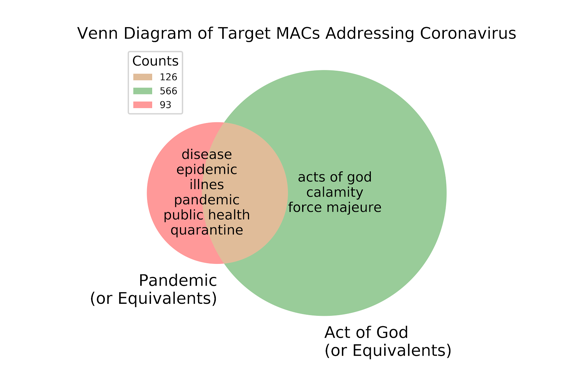
Categories
M & A

Coronavirus Is Becoming a “Majeure” Headache for Pending Corporate Deals

A folk proverb from the American West teaches that the most important ingredient of a successful rain dance is timing. And the timing couldn’t be worse for signed corporate deals hanging in the balance at the onset of the novel coronavirus pandemic.  As of this week, we estimate that there are just under 150 significant mergers and acquisitions (M&A) transactions signed and waiting to close, representing over half a trillion U.S. dollars in economic value. The fate of these deals has been thrown into considerable doubt by the COVID-19 crisis. And, in an uncanny resemblance to the onset of the financial crisis in fall 2008, corporate lawyers everywhere are spending their shelter-in-place hours scouring the terms of these deals in a frenzied search for an escape hatch that might unwind the transaction.

In lawyer-speak, the most likely candidate for an escape-hatch is something called a force majeure (or “Act of God”) provision, which governs when changed circumstances are deemed so significant as to obliterate an otherwise enforceable contract. In business lawyer-speak, force majeures are usually called “material adverse change/material adverse event” (or MAC/MAE) provisions; but they work pretty much the same way, conditioning a party’s (usually the buyer’s) duty to close a deal on the non-occurrence of a specific set of contingencies. MAC/MAEs are virtually ubiquitous in M&A; and – unlike many other boilerplate terms – they are heavily negotiated at the time of the transaction. This is for good reason: When a MAC/MAE is triggered, billions of dollars can hang in the balance.

Some very recent deals – such as Morgan Stanley’s acquisition of E*Trade (announced on February 20) – explicitly account for COVID-19 through their MAC/MAE, typically deeming it not to constitute a force majeure. But most “legacy” transactions – signed before the coronavirus threat exploded – are far more opaque. Consider, for example, LVMH’s pending $16 billion acquisition of Tiffany & Co., announced in late 2019 and subsequently approved by Tiffany shareholders but still not closed. The MAC/MAE in that deal is representative, featuring both affirmative and negative provisos that can be thought of metaphorically as something akin to a slice of Swiss cheese:

  • The affirmative terms represent the cheese, and they lay out situations that would allow LVMH to walk away. Included are contingencies that would materially affect the “business, condition (financial or otherwise), properties, assets, liabilities (contingent or otherwise), business operations or results of operations of Tiffany and its subsidiaries, taken as a whole.” Also included are contingencies that “would reasonably be expected to prevent, materially delay or materially impair” the closing of the deal.
  • The negative terms represent the holes in the cheese, and they specify carve outs or exceptions to the affirmative provisions. Like many MAC/MAEs, the carve outs are far more numerous, and they include:
    • changes or conditions generally affecting Tiffany’s industry;
    • general economic or political conditions in any country where Tiffany operates (including China);
    • changes in the market price or trading volume of Tiffany’s securities or credit ratings;
    • geopolitical conditions, including the outbreak or escalation of hostilities, acts of war, sabotage, terrorism; or
    • natural disasters, including hurricane, tornado, flood, earthquake or “other natural disaster.”

Conspicuously absent from either the cheese or the holes in the Tiffany deal is any explicit mention of a global pandemic. It seems likely that colorable arguments might be made on both sides. Although many of the items enumerated in the affirmative provisions may well be captured by the COVID-19 outbreak, several exclusions could touch on it as well. This deal may thus fall into a relatively difficult and far grayer (if not Gruyère) zone.

And that prompts the question of whether the language of MAC/MAE provisions in the aggregate might be used to unwind signed deals in the face of a pandemic. To get a handle on this question, we deployed some tools of machine learning and natural language processing, an approach that has already been shown to be helpful in studying MAC/MAE provisions as well as other business contracts.

We make use of a turnkey-ready data set that we previously collected and cleaned, consisting of 1128 MAC/MAE provisions and meta-information associated with the deals (all drawn from FactSet). The combined volume of the deals is $7.5 trillion. The dataset covers acquisitions in 21 distinct industries for deals spanning the years 2003 through the end of 2018, thus providing a broad view of over 15 years of market practice (including, importantly, the financial crisis). (We are working to update this dataset to include pending transactions to confirm their similarity, and we plan to post the results.)

In analyzing the MAC/MAEs, we focused explicitly on language that expressly captures a global pandemic like COVID-19. To ensure that we capture all (or nearly all) of the language relevant to COVID-19, we assembled a list of the terms most similar to the words “disease” and “pandemic” from three data sources: (i) WordNet, a large lexical database of English maintained by language experts; (ii) GloVe, a representation of ordinary English language; and (iii) Contracts-word2vec, a language model based on roughly half a million agreements submitted to the SEC by publicly registered companies. We then verified the results by hand. The resulting vocabulary includes terms specific to the outbreak of a contagious disease, such as “pandemic,” “epidemic,” and “public health.” But our list also includes broader, more general terms such as “act of god” and “force majeure” – gray area terms that do not explicitly cover pandemics but arguably could. The complete list contains a total of 50 key terms. Within our data set, 15 of these terms appear with positive frequency, as reflected in the figure below:

Applying this list to our MAC/MAE data, our key finding is that – much like the LVMH/Tiffany agreement discussed above – less than one out of 10 MAC/MAE provisions explicitly carve out pandemics from force majeure events. Indeed, as the figure below shows, the majority of definitions – around six in 10 – do not even address a pandemic (or pandemic-like) outbreak, either with explicit terms or with catch-all terms (such as “Act of God”, “Calamity”, or “Force Majeure”) that arguably have sufficient breadth and scope to do so. Of the remaining 40 percent that arguably address COVID-19, the trigger usually comes through the broad, catch-all provisions (31.6 percent) rather than through an explicit phrase related to pandemics (8.3 percent).

And, when a MAC/MAE provision does feature language bearing on a pandemic via either explicit or general terms, it invariably enters through a carve out to the MAC/MAE (the holes in the cheese) rather than through an affirmative provision. Consequently, such provisions (when included) would appear to push pandemic-related risks onto the buyer (and away from the seller). A typical example of an explicit pandemic-like provision is the private equity acquisition of the telecom company ComScope in 2010. That provision reads (in relevant part):

“Company Material Adverse Effect” means a change, event or occurrence that has a material adverse effect on the financial condition, business or results of operations of the Company and its Subsidiaries taken as a whole; provided, however, that none of the following, and no changes, events or occurrences, individually or in the aggregate, to the extent arising out of, resulting from or attributable to any of the following shall constitute or be taken into account in determining whether a Company Material Adverse Effect has occurred or may, would or could occur:

…

(3) epidemics, pandemics, earthquakes, hurricanes, tornados or other natural disasters

…

provided, further, that, with respect to [clause (3) above, inter alia], such changes, events or occurrences do not materially and disproportionately adversely affect the Company and its Subsidiaries, taken as a whole, compared to other companies operating in the industries in which the Company and its Subsidiaries operate.

This clause is a good indication of the typical location of an explicit provision (in the carved-out Swiss-cheese holes in the MAC/MAE); but it also exposes a caveat that is analogously important: Many acquisition agreements, after expressly carving out contingency from the definition of a MAC/MAE, proceed then to carve it back in if the pandemic affects the seller disproportionally, usually relative to a benchmark of other competitors in the industry.

In fact, as the figure below demonstrates (left-hand panel), a strong majority of express pandemic carve-outs in our data set carve them back in if the seller is disproportionately affected. This tendency towards carve-ins for disproportional effects, moreover, appears to hold even when the carve-out uses more general provisions (right-hand panel), focusing on broad act of god contingencies (rather than pandemics in particular).

The upshot of this observation is that, for most deals, the question of whether COVID-19 triggers the MAC/MAE clause may turn further on a finely-grained analysis of how the pandemic has affected a company vis-à-vis its peers. For targets that are especially susceptible to pandemic risks relative to others in the industry, then, the “disproportional effects” carve-in would shift risk right back to the seller.

A second pressing question is whether the more general language carving out acts of god and force majeure events from the MAC/MAE definition should be read to apply to COVID-19 in the first place. In other words, should one of these general terms be interpreted as a semantic substitute for an explicit term that invokes pandemics? One way to get at that question is to look at the text of the MAC/MAE definitions themselves – and in particular the frequency with which we observe pandemic-specific language enumerated as an example of an act of god or force majeure event.

The figure below displays the relative degree to which explicit and catch-all terms are used as complements versus substitutes.

As one can see, when specific language is invoked, it tends to split evenly between (a) being an enumerated example of a general force majeure provision; and (b) standing alone without also invoking the more general language.  Although this result may be consistent with a variety of interpretive theories, it does seem (at least to us) inconsistent with some of them. For example, it would seem to cast doubt on the argument that general force majeure language can never be interpreted as including pandemic risks, since a large fraction of MAC/MAE provisions make the connection explicitly. But it also casts some doubt on the opposite proposition that general language always captures specific pandemic risks: Indeed, in our reading, the vast majority of provisions with general language tend to enumerate a variety of different specific contingencies (such as weather, climate change, terrorism, and the like), perhaps making it telling that the pandemic language is not included as an enumerated example.

Ultimately, for such provisions, the proper interpretation may well be up to courts and lawyers to work out, if (as we expect) buyers begin to assert walking rights on the basis of a less-than-clear MAC/MAE. This was a situation not unlike that faced in the Hexion v. Huntsman case over a decade ago (when the buyer was unable to carry the burden of showing that the provision was triggered). It is important to note, however, that Hexion unfolded before any Delaware court had sided with a recalcitrant buyer wishing to trigger a MAC/MAE.  That historic losing streak changed with 2018’s Akorn v. Fresenius opinion, which allowed a buyer to walk on a deal by virtue of a triggered force majeure provision. And while the specific facts of Akorn are not germane to the current setting, the precedent will probably uncork a re-escalation of legal kerfuffles over deals where the COVID-19 pandemic has arguably triggered a MAC/MAE.

And that observation brings us to a final prediction, which our analysis permits us to state with some degree of confidence: If you are an M&A litigator on either the plaintiff or defendant side (and you remain healthy over the next few months), your timing couldn’t be better.

This post comes to us from professors Matthew Jennejohn at Brigham Young University Law School, Julian Nyarko at Stanford Law School, and Eric Talley at Columbia Law School.

Categories
M & A

Paul Weiss Offers M&A at a Glance for February 2020

M&A activity globally and in the U.S. was mixed in February. Overall, the number of deals continued to decline in both the U.S. and the rest of the world, while total deal value[1] showed signs of recovery relative to the low levels recorded in January. Globally, the number of deals decreased by 14.5%, to 2,344, while the total deal value  increased by 44.6%, to $255.23 billion. U.S. M&A activity was also mixed, with the number of deals decreasing by 17.3%, to 688, while total deal value increased by 28.7%, to $100.53 billion. Average deal value increased overall—rising by 55.6% in the U.S., to $146.1 million, and by 69.1% globally, to $108.9 million. Figure 1. Even the mixed dealmaking activity in February may be a waning trend, as the continued COVID-19 outbreak continues to impact the global economy and financial markets, resulting in an increasingly uncertain outlook for M&A in 2020. For our client memoranda on navigating this crisis, visit our Coronavirus (COVID-19) Resource Center.

Strategic vs. Sponsor Activity

Strategic and sponsor activity was also mixed in February. The number of strategic deals decreased by 17.0% to 539 in the U.S. and by 16.5% to 1,995 globally. Meanwhile, strategic deal volume as measured by dollar value increased by 11.2% to $62.81 billion in the U.S. and by 23.6% to $161.56 billion globally. The number of sponsor-related deals decreased by 18.6% to 149 in the U.S., but remained relatively flat globally with a slight 0.3% decrease to 349 globally. Sponsor-related volume by dollar value increased by 74.4% to $37.72 billion in the U.S. and by 104.7% to $93.67 billion globally. Figure 1 and Annex Figures 1A—4A.

Crossborder Activity

Global crossborder volume fell across multiple measures in February 2020, and the number of crossborder deals fell to 12-month lows, decreasing in dollar value by 3.3% to $48.99 billion, and in terms of number of deals by 11.2% to 541. U.S. inbound activity as measured by dollar value decreased by 73.3% to $4.95 billion, and the number of U.S. inbound crossborder deals decreased in February by 28.9% to 86. U.S. outbound activity as measured by dollar value decreased by 50.8% to $5.97 billion and the number of U.S. outbound crossborder deals decreased by 13.5% to 96. Figure 1 and Annex Figures 5A—7A.

Japan was the leading country for U.S. inbound activity in February by total dollar value ($1.20 billion), and Canada was the leading country for U.S. inbound activity by total dollar value over the last 12-month period ($48.79 billion). Canada retained its lead for U.S. inbound activity by number of deals in February (22) and over the last 12-month period (318).

Australia was the leading country of destination for U.S. outbound activity in February by total dollar value ($1.86 billion), whereas the U.K. was the leading country for U.S. outbound activity by total dollar value over the last 12-month period ($28.36 billion). The U.K. was the leading country of destination for U.S. outbound activity by number of deals in February (18), and retained its lead as the leading country of destination for U.S. outbound activity by number of deals over the last 12 months (249). Figure 3.

U.S. Deals by Industry

Computers and Electronics was the most active target industry in February and over the last 12 months by number of deals (259 and 3,416, respectively) as well as the most active target industry by dollar value in February and over the last 12 months ($31.67 billion and $416.44 billion, respectively). Figure 2.

U.S. Public Mergers

As for U.S. public merger deal terms in February 2020, average reverse break fees were below their 12-month levels (at 4.5% compared to 5.5%), while February average target break fees were below their 12-month average (at 3.2 % compared to 3.6%). 25.0% of deals contained a go-shop provision in February 2020, while 12.5% of deals contained a go-shop provision over the last 12 months. Figures 6, 7 and 8. Cash transactions comprised 62.5% of U.S. public mergers, above the 53.9% 12-month average. Figure 9. Notably, there were no tender offers for U.S. public mergers in February, compared with the 12-month average of 17.1% of deals.  Figure 11. Hostile or unsolicited transactions comprised 11.1% of U.S. public mergers in February 2020, lower than the 12-month average of 12.0% of deals. Figure 12.

ENDNOTE

[1]    Each metric in this publication that references deal volume by dollar value is calculated from the subset of the total number of deals that includes a disclosed deal value.

All Figures referenced above are available here.

This post comes to us from Paul, Weiss, Rifkind, Wharton & Garrison LLP. It is based on the firm’s memorandum, “M&A at a Glance, March 2020,” available here.
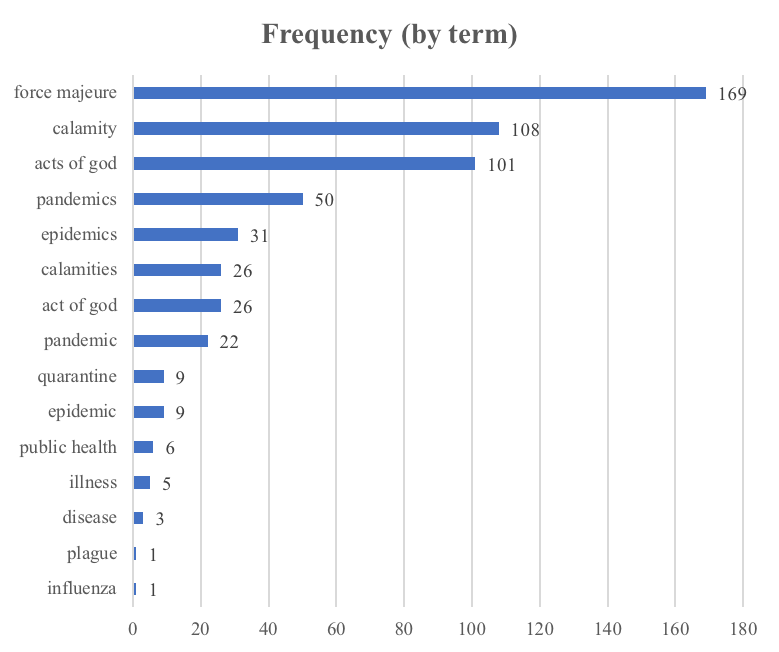
Categories
White Collar Crime

The Cost of Doing Business: Corporate Crime and Punishment Post-Crisis

For many years, law and economics scholars, as well as politicians and regulators, have debated whether corporate criminal enforcement deters too much beneficial corporate activity or lets corporate criminals off too easily. This debate has recently grown more polarized: On the one hand, academics, judges, and politicians have excoriated enforcement agencies for failing to send individual bankers to jail in the wake of the financial crisis; on the other, the Justice Department has since relaxed policies aimed at holding individuals liable and reduced the size of fines imposed on corporations.

A crucial and yet understudied piece of evidence in this conversation is how federal enforcement has affected crime. Indeed, unlike every other type of crime, the government does not collect data about corporate crime levels. Therefore, we cannot tell how corporations are responding to the DOJ’s changed enforcement practices.

In our recent paper, “The Cost of Doing Business: Corporate Crime and Punishment Post-Crisis,” we take important first steps in determining how corporate crime, and financial institution crime in particular, is responding to the federal enforcement regime and its shifting priorities. Specifically, as proxies for financial crime, we use three novel sources: the Financial Crimes Enforcement Network (FinCEN) Suspicious Activity Reports (SARs), consumer complaints made to the Consumer Financial Protection Bureau (CFPB), and whistleblower complaints made to the Securities and Exchange Commission (SEC). SARs are required to be filed by financial institutions under certain circumstances that are highly suggestive of malfeasance, while the CFPB data are generated by aggrieved consumers of financial products. Whistleblower complaints are generally filed by employees of banks and companies who suspect that financial crime has occurred; if the information leads to a successful enforcement action, the whistleblower is eligible for a large bounty.

Our results are summarized as follows. In the period from 2012 to 2019, we document a steep upward trend in SARs filed across every agency that collects them: the OCC, the FDIC, the FHIFA, the NCUA, the FRB, the IRS, and the SEC. This means that financial institutions flagged a greater number of transactions suggestive of money laundering, fraud, or other financial crimes in each year for the past five years. In addition, we document a steep upward trend in consumer complaints about financial misconduct submitted to the CFPB from November 2014 to August 2019. Finally, we observe a steady increase in whistleblower tips submitted to the SEC from 2011 to 2018. In sum, our data suggest a steep increase in reports of financial misconduct in three unrelated places.

We also examine levels of public company recidivism, which are also on the rise. And we document a potential cause: Recidivist companies are much larger than non-recidivist companies, but they receive smaller fines than non-recidivist companies (measured as a percentage of assets and revenue). In theory, high fines can supply adequate deterrence by themselves, but our results indicate that it might not be politically feasible or legally possible to levy a sufficiently high fine to deter future incidents of corporate crime. Put differently, for large companies, criminal penalties may be just another cost of doing business—and quite a reasonable cost at that.

We posit that those who embraced entity-level liability and large financial penalties as the most efficient means of securing deterrence neglected the practical realities of enforcement. In theory, a large fine will cause the people at the top to take steps to prevent future instances of harm across the entity. But the size of the fine necessary to lead to adequate deterrence might not be possible to calculate (What is the social cost of 86 lives?) or politically feasible. (What if the optimal fine puts the firm into bankruptcy? What if the optimal fine for a large company is tens of billions of dollars?)

Not only that, there are practical limitations to the corporation’s ability to adequately deter future incidents of crime. That is because there is a disconnect between the recipient of the punishment and the bad actor when the only punishment is an entity-level fine. Quite obviously, an entity-level fine primarily affects shareholders, not necessarily the individuals who committed or even benefited from the crime. In theory, shareholders should have an incentive to take steps to deter criminal activity, but rationally apathetic shareholders might not recognize the problem nor understand how to address it. In addition, the ultimate deterrent effect of fines against corporations and their shareholders may be muted by several factors. For example, although a company’s stock price falls after the imposition of the penalty, it usually bounces back very quickly. Therefore, shareholders might not demand an appropriate reduction in activity levels, nor the right amount of firm-wide monitoring, to avoid future instances of crime.

In sum, we theorize that an over-reliance on entity-level fines is likely inadequate from a deterrence perspective. Even though the average fine is higher today than ever before, fines are still too low to make up for uneven enforcement. The optimal entity-level penalty is likely to be very large and potentially infinite – well beyond the realm of possibility for those negotiating these settlements. Even if enforcers could levy the optimal fine, the effect would be muted – dispersed shareholders would bear the brunt of the harm, but collective action problems limit their ability to discipline wayward management. In other words, the managers who agree to pay fines out of shareholders’ pockets might not bear any consequences.

We recognize, however, that our data do not allow us to precisely identify the aspects of our enforcement regime that are failing us, nor the appropriate course of action to correct them. Therefore, our principal policy recommendation is for the government to treat corporate crime like any other type of crime and study it. With better data, policymakers would be better positioned to calibrate enforcement to deter corporate misconduct. If, however, our results are confirmed with further study, the normative implications seem to be clear. To increase deterrence, enforcement agencies should look for other ways to deter corporate misconduct, including by pursuing culpable individuals.

This post comes to us from professors Dorothy S. Lund at the University of Southern California’s Gould School of Law and Natasha Sarin at the University of Pennsylvania Law School. It is based on their recent article, “The Cost of Doing Business: Corporate Crime and Punishment Post-Crisis,” available here.
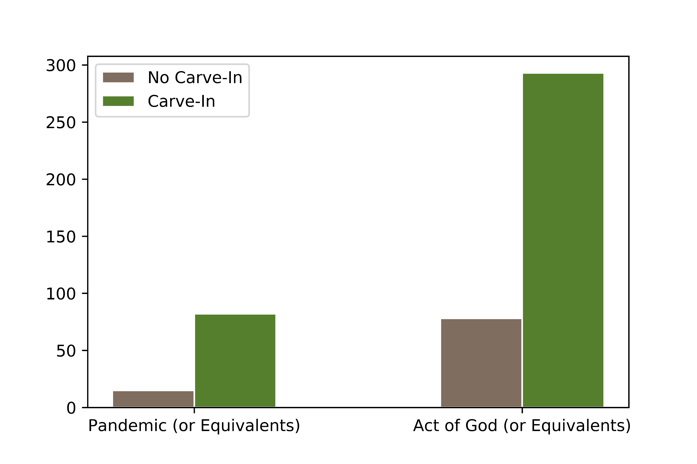
Categories
Finance & Economics

Cleary Gottlieb Discusses Fed’s Final “Stress Capital Buffer” Requirement

On March 4, the Federal Reserve finalized a significant integration of its stress testing regime with its ongoing supervisory capital requirements, by introducing a new “stress capital buffer” requirement for firms subject to the Federal Reserve’s CCAR supervisory stress tests. An institution-specific stress capital buffer will be determined for each CCAR firm as part of the 2020 CCAR exercise and is intended to take effect October 1, 2020. However, given the uncertainty and stress in the market caused by COVID 19 mitigation measures, it remains to be seen whether the Federal Reserve could modify the implementation timeline.

The Federal Reserve’s supervisory stress test regime is, and almost certainly will continue to be, the binding capital constraint on most CCAR firms. The Federal Reserve touts the stress capital buffer and related changes as “simplifying” and part of its “recent efforts to improve the efficiency and risk-sensitivity of its regulations”.
One key simplification is the elimination of the “pass/fail” quantitative assessment. Accordingly, CCAR now becomes primarily an exercise in calculating a CCAR firm’s stress capital buffer. Beginning October 1, 2020, the stress capital buffer will become a day-to-day ongoing capital requirement in order for CCAR firms to avoid restrictions on capital distributions. This ends the prior CCAR regime’s single-point-in-time approach to evaluating capital plans, which allowed CCAR firms’ pre-stress-test capital to decrease (within bounds) in between the CCAR supervisory stress tests.

The final rule generally adopts the proposal released in April 2018, but includes several welcome modifications. Significantly, the Federal Reserve formally discarded the proposed “stress leverage buffer” that would have applied to the Tier 1 leverage ratio and eliminated post-stress leverage capital requirements. CCAR firms no longer must maintain Tier 1 capital above the minimum Tier 1 leverage ratio or minimum supplementary leverage ratio throughout the nine quarters of the hypothetical stress scenario in order to avoid restrictions on their capital distributions. But one anticipated modification to eliminate the requirement to “prefund” one year of common stock dividends was not incorporated into the final rule, despite Vice Chair Quarles’ stated support in recent remarks. Other modifications, such as permitting CCAR firms not to incorporate material business plan changes into the calculation of their stress capital buffer and elimination of the pre-approval requirement for capital distributions above a CCAR firm’s original planned distributions, will provide more flexibility to make distributions.

Included below are (i) an illustration (Figure 1) of the U.S. risk-based total capital and buffer requirements (including the stress capital buffer) as they compare to the Basel capital framework, (ii) a graphical timeline (Figure 2) for the annual implementation of the stress capital buffer and (iii) a summary of and certain key observations on the final rule.

Overview of the Final Rule

The stress capital buffer rule (“SCB rule”) purports to simplify the Federal Reserve’s current capital and stress testing requirements by tailoring the capital conservation buffer (“CCB”) to incorporate the post-stress losses of a subject firm (“CCAR firm”) under the Federal Reserve’s Comprehensive Capital Analysis and Review (“CCAR”).

— Scope of Application. The SCB rule is relevant only for CCAR firms, i.e.:

  • bank holding companies (“BHCs”) with total consolidated assets of $100 billion or more; and
  • intermediate holding company subsidiaries (“IHCs”) of foreign banking organizations (“FBOs”), if the IHC has total consolidated assets of $100 billion or more.

These are the BHCs and IHCs identified in Categories I through IV under the Federal Reserve’s recently revised enhanced prudential standards. Non-CCAR firms are not materially impacted by the SCB rule. For non-CCAR firms, the capital conservation buffer remains a fixed 2.5% of common equity tier 1 (“CET 1”).

— The Stress Capital Buffer and its Calibration. The SCB rule redesigns the CCB for CCAR firms by replacing the fixed 2.5% CCB with a dynamic and bespoke “stress capital buffer” (“SCB”). A CCAR firm’s SCB will be recalibrated with each CCAR supervisory stress test (annually for Category I, II and III firms, and every other year for Category IV firms). The SCB is the sum of:

(i) the maximum projected decline in a CCAR firm’s CET 1 capital ratio (starting with the actual ratio as of December 31 immediately prior to the CCAR nine-quarter horizon) under the CCAR supervisory severely adverse stress scenario (expressed as a percentage of risk-weighted assets (“RWA”)), and

(ii) a CCAR firm’s planned common stock dividends for the fourth through seventh quarters of the nine-quarter CCAR planning horizon (expressed as a percentage of projected RWA for the quarter in the CCAR horizon in which the firm’s projected CET 1 capital ratio reaches its minimum under the supervisory severely adverse scenario).

The SCB would have a 2.5% floor. Based on 2019 Dodd-Frank Act Stress Test (“DFAST”) results, the SCB for CCAR firms could have ranged between 2.5% and over 8%, although the median decline in CET 1 for all CCAR firms was approximately 3%.

— Elimination of the Quantitative “Pass/Fail”.

  • Under the SCB rule, the CCAR process largely becomes an exercise to establish and re-calibrate a CCAR firm’s SCB (each year for Category I, II and III firms, and every other year for Category IV firms), because it eliminates any quantitative objection or pass/fail component as a result of CCAR.
  • In this way, however, the rule transforms the “single-point-in-time” quantitative objection based on stressed forecasts into a day-to-day ongoing capital requirement. As a result, the CCAR quantitative assessment effectively remains, operationalized through the SCB as a daily requirement for CCAR firms to maintain their risk-based capital ratios above their post-stress buffer requirements in order to avoid restrictions on capital distributions.
  • The elimination of the quantitative objection is significant from a leverage capital perspective, as discussed in greater detail in the Key Observations below. Elimination of the quantitative assessment effectively removes the post-stress Tier 1 leverage and supplementary leverage ratio (“SLR”) requirements because a CCAR firm may breach these minimum requirements (4% and 3%, respectively) in the supervisory adverse stress scenario without “failing” CCAR, without being required to revise its planned capital distributions and without needing to increase its buffers.
  • In March 2019, the Federal Reserve eliminated the qualitative objection for most CCAR firms, including all U.S. BHCs. IHCs that are in the Large Institution Supervision Coordinating Committee portfolio or that are “large and complex” firms remain subject to the qualitative assessment for the 2020 CCAR cycle. If most of these IHCs successfully pass the qualitative evaluation this year, they will no longer be subject to a potential qualitative objection.

— Reconsideration Procedure.

  • Any CCAR firm will be able to submit a request for reconsideration of its resulting SCB (or qualitative objection, if any) within 15 calendar days of receipt of its SCB and CCAR results. The Federal Reserve intends to respond within 30 days of a request for reconsideration, but since a CCAR firm’s SCB will not take effect until October 1, the procedure could effectively give the Federal Reserve approximately three months to render its determination.
  • Prior to October 1, a CCAR firm will be able to continue to make capital distributions that were included in its last annual capital plan to which the firm received a non-objection.

— What Happens After CCAR Calculation of the SCB?

  • Incorporation of the SCB into a Standardized Capital Conservation Buffer. The SCB will be incorporated into a broader buffer named the “standardized approach capital conservation buffer” (“Standardized CCB”). All CCAR firms must calculate their risk-based capital ratios under the standardized approaches, including Category I and Category II firms that are subject to the advanced approaches and the so-called Collins Amendment. The Standardized CCB calculation would be the aggregate of a CCAR firm’s:

(i) SCB (floored at 2.5%);

(ii) any countercyclical capital buffer (“CCyl Buffer”) that may be in effect (for Category I, II and III firms); and

(iii) for global systemically important BHCs (“GSIBs”) only, the greater of the firm’s GSIB surcharge under method 1 (which aligns with the Basel capital framework’s GSIB surcharge) and method 2 (which reflects a firm’s reliance on short-term wholesale funding and generally results in a higher surcharge) (“U.S. GSIB Surcharge”).

  • Post-CCAR Adjustments to Planned Capital Distributions. Each CCAR firm must then review its own BHC baseline scenario and assess whether its planned capital distributions could still be accomplished, taking into account its new Standardized CCB. If any planned distribution would cause a CCAR firm to dip into its Standardized CCB under its baseline scenario, the firm must:

(i) reduce its capital distributions to ensure they would be permitted based on its baseline scenario; and

(ii) notify the Federal Reserve of such adjustments within two business days of receipt of its SCB by resubmitting the Form FR Y-14A summary schedule reflecting the SCB requirement and its reduced planned capital distributions.

Whether a CCAR firm’s adjustments to its planned capital actions would be subject to public disclosure is not clear from the 2020 CCAR instructions or the SCB rule, which provides that the Federal Reserve “may” release information related to such adjustments but does not require such disclosures. Under the current CCAR process, the Federal Reserve releases the post-stress capital ratios of all of the CCAR firms (both without and with a firm’s modifications to its planned capital actions to avoid a CCAR “fail”).

— Ongoing Application of the Standardized CCB.

  • On a daily basis, CCAR firms are required to maintain the Standardized CCB above their minimum CET 1 risk-based, Tier 1 risk-based and total risk-based capital requirements. If any one of a CCAR firm’s risk-based capital ratios dips into the Standardized CCB zone, the firm will become subject to increasing restrictions on its capital distributions and discretionary bonus payments.
  • The rule applies the Standardized CCB only at the level of the top-tier consolidated BHC and/or IHC, and thus does not change the application of the current static 2.5% CCB to a CCAR firm’s insured depository institution (“IDI”) subsidiaries. In addition, non-CCAR firms will continue to apply the static 2.5% CCB.
  • The nine CCAR firms that are subject to the “advanced approaches” capital calculation methodologies (i.e., the U.S. GSIBs in Category I and the U.S. institution subject to Category II) are also subject to an advanced approaches capital conservation buffer (“Advanced CCB”) above their advanced approaches minimum requirements. The calibration of the Advanced CCB is identical to the Standardized CCB, but instead of incorporating the SCB, the Advanced CCB includes a fixed 2.5% CET 1 requirement (i.e., the current CCB). The maximum payout ratios are consistent across the various capital buffers, including the Standardized CCB, Advanced CCB and enhanced supplementary leverage ratio buffer.

— Restrictions on Distributions Applicable in the Buffer Zone.

  • The SCB rule does not alter the general framework that requires incremental restrictions on distributions and bonus payments as a firm falls further into the Standardized or Advanced CCB range.
  • However, the SCB rule revises the definition of “eligible retained income” in an effort to address the potential for a dip into the buffer zone to result in an immediate decrease in distributions and bonus payments to a very low amount or to zero, primarily in the scenario where a banking organization has distributed all or a significant amount of its retained earnings over the last four quarters.
    • For a CCAR firm with an SCB greater than the 2.5% floor, its potential restrictions on distributions and bonus payments will be based on the firm’s average net income for the preceding four quarters (without regard to distributions or tax effects) as calculated in accordance with the FR Y-9C instructions (rather than the aggregate of the previous four quarters of net income, adjusted to reflect distributions and associated tax effects not already reflected).
    • A CCAR firm subject to a 2.5% SCB or a non-CCAR firm will not benefit from this change.

— Elimination of Prior Approval for Distributions. In a change from the proposal, the SCB rule provides CCAR firms with flexibility to increase their planned capital distributions in excess of the amount included in their capital plans without prior approval, provided that such distributions would not cause the firm’s capital ratios to breach its buffers. However, CCAR firms must notify the Federal Reserve of any distribution not previously included in its capital plan within 15 calendar days following the distribution. In addition, the rule would not change the prior approval requirements that continue to apply to redemptions of Additional Tier 1 or Tier 2 capital instruments.

— Income Limitation on Dividends Revised. The rule also clarifies that the Federal Reserve will no longer apply heightened scrutiny to planned dividends that would exceed 30% of a CCAR firm’s after-tax net income available to common shareholders, primarily because CCAR firms must effectively prefund their dividends, through their SCB, for the intervening year between CCAR cycles. This limitation was not part of the stress testing regulations, and had previously only been highlighted in the Federal Reserve’s instructions and guidance to CCAR firms.

— Distinction Between CCAR and DFAST Collapsed. The SCB rule collapses the prior distinction between the DFAST and the CCAR supervisory stress tests in several ways:

  • As a procedural matter, the SCB rule eliminates the current multi-step process whereby the Federal Reserve (i) runs the DFAST supervisory stress test based on assumed standardized capital actions, (ii) discloses the DFAST supervisory stress test results publicly, (iii) discloses confidentially to the CCAR firms their CCAR stress test results incorporating planned capital actions, (iv) provides the CCAR firms with the opportunity (typically over a weekend) to modify their planned capital actions and submit revised data and (v) later discloses publicly the CCAR stress test results (including both the “before” and “after” results from the CCAR firms’ modifications to planned capital actions).
  • Under the SCB rule, a new timeline for CCAR results applies, as illustrated in Figure 2 above. CCAR firms will continue to submit their planned capital actions for the nine-quarter stress horizon, but the Federal Reserve will:
    • run its supervisory stress test in the severely adverse scenario using only the DFAST assumptions (which have been modified under the SCB rule by, among other things, including an assumption that no common stock dividends are issued during the nine quarters), and
    • use the result of its supervisory stress tests to size a firm’s SCB requirement.
  • The SCB rule places more responsibility in the hands of each CCAR firm, particularly because there is no pass/fail component. Each CCAR firm will, as noted above, take its SCB and apply it to its own planned capital actions under its own baseline scenario to determine if the capital actions could be undertaken without causing the firm to breach its new buffers.

— Revisions to CCAR Assumptions.

  • Capital Actions. By collapsing the DFAST and CCAR stress tests, the SCB rule does not incorporate planned capital actions into the stress test, thus eliminating an irrational assumption in the CCAR test that a firm would carry out nine quarters of its planned capital actions even under stress and even when applicable buffer requirements would make such distributions impossible.

A CCAR firm will, however, include in its SCB and its Standardized CCB (i.e., “prefund”) four quarters of planned common stock dividends (but not repurchases or redemptions). However, as with the current DFAST assumptions, the Federal Reserve will assume that payments (equal to the stated dividend or contractual interest or principal due in a quarter) on all outstanding Additional Tier 1 and Tier 2 capital instruments will continue uninterrupted. Therefore, in effect, these payments will be enveloped within the capital reductions that become part of the firm’s SCB, and effectively prefunded across the nine-quarter horizon through a different mechanism.

  • Static Balance Sheet. In CCAR exercises up to this point, the Federal Reserve has projected each firm’s balance sheet in the supervisory stress test using models that assume that banks will respond to increased credit demand in a stress scenario, typically by increasing lending and thereby increasing a firm’s total assets. Recognizing the unrealistic nature of this assumption, the SCB rule revises the models to include an assumption that firms maintain a constant level of assets over the stress test horizon.

Additionally, the rule provides an assumption that a firm’s leverage ratio denominator and total RWA would generally remain unchanged over the planning horizon.

  • Material Business Plan Changes. In a simplifying change from the proposal, the SCB rule does not incorporate material business plan changes in a firm’s SCB requirement. For example, planned issuances of common or preferred stock in connection with a planned merger or acquisition (and their associated dividends) need not be included in a firm’s nine-quarter projections. A firm’s capital plan should nevertheless describe the changes. The Federal Reserve indicated that such issuances will be taken into account when they actually occur, and a CCAR firm may be required to resubmit its capital plan (with the potential for a recalibrated SCB) if the changes are material.
  • Different Assumptions for Company-Run Stress Tests. The 2020 CCAR instructions provide that for the 2020 company-run stress tests, firms should follow the capital action assumptions set forth in the stress test rules as of the April 6, 2020 submission date of their capital plans. However, for the supervisory stress tests, the Federal Reserve will use the capital action assumptions set forth in the SCB rule. Accordingly, the CCAR instructions and the preamble acknowledge that, for 2020, the results of the company-run and supervisory stress tests will not be comparable.

— Revisions to Regulatory Reports. The SCB rule also modifies two reports, the Consolidated Financial Statements for Holding Companies Report (FR Y-9C) and the Capital Assessments and Stress Testing Report (FR Y-14A), to collect information regarding the SCB requirement.

  • FR Y-9C. The proposal would add line items to collect the information necessary to monitor a firm’s performance quarterly, including information regarding a firm’s SCB, U.S. GSIB Surcharge, CCyl Buffer, Standardized CCB, Advanced CCB, eligible retained income and capital distributions.
  • FR Y-14A. The SCB rule adds line items to collect (generally annually) similar information necessary to evaluate planned capital actions under a firm’s baseline scenario. A firm is required to report its capital distributions on the FR Y-14A filed under its initial capital plan on April 5 and, if the firm decides to reduce its planned distributions as a result of its review of its SCB, the firm will use the FR Y-14A to resubmit adjusted numbers within two business days.

— Effective Dates.

  • A CCAR firm’s SCB requirement will be effective on October 1 of each year and remain in effect for a full calendar year for Category I, II and III firms. The Federal Reserve stated definitively that the SCB rule will be effective by the time of release of CCAR results in June 2020, and therefore each CCAR firm’s first SCB will be in effect from October 1, 2020.
  • Because Category IV firms are subject to CCAR only every other year, their SCB remains effective for two years. This year (2020) is a CCAR year for these firms, so their first SCB will also be in effect from October 1, 2020.
  • The new annual CCAR cycle timeline is depicted in Figure 2 above.

Key Takeaways

— Stress leverage buffer and post-stress leverage requirements eliminated. As Vice Chair Quarles previewed in a September 2019 speech, the final rule does not include the proposed stress leverage buffer requirement. However, perhaps more significantly, the final rule eliminates Tier 1 post-stress leverage requirements that currently apply to CCAR firms as a function of the quantitative assessment, which is eliminated under the final rule.

  • Elimination of Tier 1 post-stress leverage requirements may allow firms to reduce their Tier 1 management buffers. Because the final rule eliminates the quantitative pass/fail assessment, and the SCB will not include any leverage component, a CCAR firm that does not maintain a Tier 1 or SLR above the minimum requirements (4% and 3%, respectively) under the CCAR supervisory severely adverse stress scenario would not face any self-executing restrictions on its ability to make capital distributions. Accordingly, the SCB rule would appear to permit firms to reduce their management buffers with respect to Tier 1 requirements as Governor Brainard suggests in her dissent—in other words, if a CCAR firm’s Tier 1 capital fell below the Tier 1 leverage or SLR requirements under the prior CCAR regime, it would have “failed” CCAR on quantitative grounds and therefore would have been required to resubmit its capital plan with commensurate reductions in its planned capital distributions.
  • However, Federal Reserve Vice Chair Quarles notes in his statement supporting the rule that “eliminating the post-stress leverage measure removes [incentives to hold riskier assets], but does not reduce the amount of [required] common equity capital by one jot.”
  • In addition, the rule would not change the enhanced supplementary leverage ratio (“eSLR”) requirements that apply to GSIBs (a 2% buffer, resulting in a 5% SLR requirement at the parent holding company level, and a requirement at the IDI subsidiary level to maintain an SLR of 6% to be considered “well-capitalized”). The eSLR may only be satisfied with Tier 1 capital. The eSLR proposal that was released in conjunction with the SCB proposal in April 2018 would replace the current static 2% eSLR buffer with a dynamic measure based on 50% of the firm’s U.S. GSIB surcharge (the higher of method 1 and method 2). The Federal Reserve has yet to indicate a timeline for when or whether these proposed modifications to the GSIB buffer will be finalized.

— SCB should reduce Tier 1 capital requirements for most CCAR firms although CET 1 requirements for GSIBs will increase. The impact assessment accompanying the SCB rule generally indicates required Tier 1 capital levels will decline in the aggregate across CCAR firms in Categories II, III and IV by approximately $49 billion (a 12% decrease relative to current requirements) and CET 1 levels will decline in the aggregate by $35 billion (a 10% decrease). For the U.S. GSIBs, Tier 1 capital levels are not expected to change, while aggregate CET 1 levels are expected to increase by $46 billion (a 7% increase). Governor Brainard’s dissent attributes projected declines in required Tier 1 and CET 1 capital to “the rule’s substantial reduction in the requirement to prefund distributions [other than four quarters of dividends] and, to a lesser extent, the elimination of any stress leverage requirement (for tier 1) and the assumption of a flat balance sheet.”

  • The increase for GSIBs arises because the rule effectively incorporates the U.S. GSIB Surcharge as an additional buffer over and above the SCB. In contrast, the current approach does not require CCAR firms to satisfy the GSIB buffer in stress conditions—a CCAR firm must only maintain its capital above the Basel III minimum levels across the nine-quarter horizon. Therefore, in past CCAR exercises, the capital maintained to keep a CCAR firm’s ratios above those minima “counted” toward satisfaction of the U.S. GSIB Surcharge from a day-to-day compliance perspective. Under the final rule however, the U.S. GSIB Surcharge will effectively be applied “post-stress” since it sits “atop” the SCB as a component of the new Standardized CCB—in other words, capital needed to satisfy the SCB on a day-to-day basis will now be in addition to capital needed to satisfy the U.S. GSIB Surcharge.
  • The Federal Reserve rejected commenters’ concerns that the SCB would be redundant with the U.S. GSIB Surcharge. The Federal Reserve also dismissed commenters’ requests to consider changes to the U.S. GSIB Surcharge as part of the SCB rulemaking.

— Dividend prefunding requirement preserved. The dividend prefunding requirement remains unchanged from the proposal despite prior remarks by Vice Chair Quarles that indicated he supported its elimination in favor of either (i) activating the CCyl Buffer in a manner similar to the 1% CCyl Buffer that is currently applicable under standard risk conditions in the United Kingdom, or (ii) raising the floor of the SCB from 2.5% to 3%. Neither of these alternatives was adopted, or even alluded to, in the preamble.

  • Adverse Impact for IHCs Disregarded. Moreover, the SCB rule summarily dismissed commenters’ concerns regarding the dividend prefunding requirement and its particularly punitive impact on IHCs, which unlike the publicly traded CCAR firms, often deploy dividends instead of share repurchases (which are not subject to the prefunding requirement) because of their nature as subsidiary organizations. For that reason, an IHC’s dividends to its parent also tend to be significantly larger relative to its capital base than a domestic BHC’s ordinary dividends to public shareholders. Therefore, the dividend prefunding requirement has the potential to inflate inappropriately the SCBs of IHCs.

— Interplay with the CCyl Buffer. Although Vice Chair Quarles had indicated in prior statements that the Federal Reserve had been considering the implementation of a non-zero CCyl Buffer in the United States as an alternative to the dividend prefunding requirement, the preamble includes no discussion of the level of CCyl Buffer, which is generally determined on an interagency basis annually. No announcement has been made confirming that the CCyl Buffer will remain at 0% for 2020, although a statement regarding the level of the CCyl Buffer for the coming year is generally made in the first quarter. The Federal Reserve rejected commenters’ requests to eliminate the CCyl Buffer if the SCB is adopted and dismissed assertions that the CCyl Buffer is redundant with the SCB. The preamble reiterates that the CCyl Buffer is a macroprudential tool intended to strengthen the resiliency of financial firms and the financial system, by allowing the Federal Reserve to raise capital standards when credit growth in the economy becomes excessive, a prospect that seems increasingly unlikely in the near term given the adverse economic impacts of COVID 19, particularly with the Federal Reserve’s recent announcement encouraging banks to dip into their capital buffers as they lend to borrowers affected by COVID 19. It is unclear how and whether this announcement will affect the ultimate implementation and effectiveness timeline of the SCB rule.

— Mandatorily convertible LTD issued under the TLAC rule not recognized for purposes of SCB requirements. The Federal Reserve declined commenters’ requests to permit recognition of eligible internal long-term debt issued by IHCs to satisfy TLAC requirements as CET1 for purposes of the SCB, given its mandatory conversion feature. The preamble notes that “providing [such IHCs] greater flexibility to satisfy the buffers would be inconsistent with the general principle that larger and more systemic firms be subject to more stringent and risk-sensitive requirements.” In addition, the Federal Reserve noted that “the loss-absorbing capacity of long-term debt issued under the [Federal Reserve’s] TLAC rule is not identical to the loss-absorbing capacity of CET1 capital as the way in which long-term debt could absorb losses varies by circumstance.”

However, the preamble did not address the potential for convertible instruments more generally to be deemed CET 1 for purposes of CCAR if such instruments were issued by a broader set of institutions. While the Federal Reserve could have used the preamble to shut down entirely the possibility that convertible instruments could be recognized on an as-converted basis in future supervisory stress tests, it seems notable that the preamble did not take that approach.

The SCB rule does not alter the TLAC buffers for U.S. GSIBs and IHCs that have been in place since 2019. If covered firms breach these buffers, they would also become subject to restrictions on capital distributions (even while remaining above the applicable SCB).

This post comes to us from Cleary, Gottlieb, Steen & Hamilton LLP. It is based on the firm’s memorandum, “Observations on the Federal Reserve’s Stress Capital Buffer Final Rule,” dated March 16, 2020, and available here.